

8 Signs Your Property Needs Grading Before Water Wins
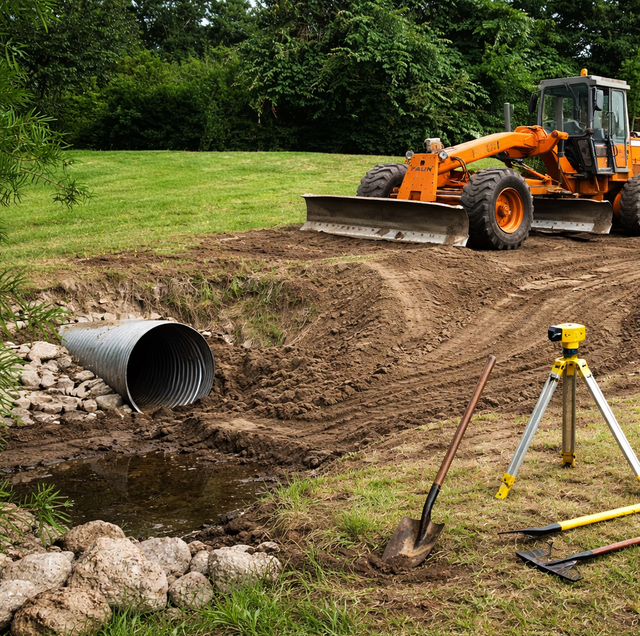
Quick Answer: Your property likely needs grading if water pools or stands after rain, runs toward the house instead of away, or has cut ruts and gullies across the yard. Other signs are a lawn that stays soggy for days, a low or sinking spot that is hard to mow or park on, mulch and soil washing onto walkways, and moisture or cracks showing up against the foundation. Grading reshapes the ground so it falls away from structures and drains evenly, using a mix of filling low spots, cutting high ones, compacting, and shaping swales to carry water off. A single settled dip may only need fill, but water that pools after every rain usually means the overall slope is wrong.
Ground has a job most people never think about until it stops doing it: moving water off the property before that water finds somewhere it shouldn't be. Grading is the work of shaping the ground so it drains away from the house, the driveway, and the outbuildings, and so the surface is even enough to mow, build on, or park on. When the grade is right, rain runs off and disappears. When it is wrong, the water tells on it, sitting in puddles, creeping toward the foundation, or carving little canyons across the yard. Below are the signs worth reading, why they matter, and what fixing them actually involves.
Water Pools or Stands After It Rains
The clearest sign is standing water. After a normal rain, a properly graded yard sheds the water and dries within a few hours. If puddles sit on the lawn, along the driveway, or, worst of all, around the foundation for a day or more, the ground beneath them is either too flat to drain or compacted hard enough that water cannot soak in. Either way, the water has nowhere to go, so it waits.
Think of a good grade like a shallow roof: every surface tilts slightly so water rolls off instead of collecting. A yard that ponds is a roof with a dip in it. The water finds the low point and stays there, and every rain refills it.
Pooling near the house is the version to take seriously first. Water standing against a slab or wall has all day to work its way down and in.
Water Runs Toward the House Instead of Away
Walk outside during a steady rain and watch which way the water travels. It should move away from the structure in every direction. If you see sheets of water heading toward the house, or a slope that clearly pitches back toward the foundation, the grade is reversed, and it is feeding water exactly where you least want it.
The rule crews work to is simple: the ground should fall away from the foundation, dropping a noticeable amount over the first several feet, then easing into a gentler grade farther out. That initial fall is what pushes water away before it can pool against the wall. When that first stretch is flat or tilted the wrong way, no amount of gutter work downstream fixes it, because the problem starts at the base of the house.
Erosion, Ruts, or Gullies Are Forming
Water that moves too fast or always follows the same path leaves evidence. Look for ruts cut into the lawn, narrow gullies where runoff has scoured a channel, or a fan of washed-out soil at the bottom of a slope. These are signs that the water is concentrated rather than spread out, and that it is carrying your topsoil with it every time it rains.
Erosion tends to feed itself. Once a channel starts, water follows it, digs it deeper, and the problem widens. Regrading spreads that flow back out or redirects them into a shaped channel that can handle it without cutting into the ground.
The Lawn Stays Soggy or Has Persistent Wet Spots
A lawn that squishes underfoot days after the last rain is holding water it should have drained. Persistent wet spots, patches of moss, or grass that thins and dies in the same low areas year after year all point to a grade that traps moisture instead of moving it. Turf roots need air as much as water, and ground that stays saturated drowns them.
Soggy ground is also where mosquitoes breed and where the lawn turns to mud under any foot traffic. If one part of the yard is reliably wetter than the rest, the grade under it is usually the reason.
A Low, Sinking, or Uneven Area You Keep Fighting
Some properties have a spot that is simply hard to use: a dip that scalps under the mower, a low corner that is always the last to dry, a stretch too uneven to set a shed or park a trailer on. Over time, the ground can settle unevenly, especially where fill was placed, an old stump rotted out, or the soil was disturbed. The result is a surface that no longer sits flat.
This is where it helps to separate two different problems. A single spot that settled after a specific event, a rotted stump, a filled trench, a collapsed old hole, may just need fill and compaction to bring it level. That is a one-off repair. But when the whole yard drains poorly, pools in several places, and pitches the wrong way, the issue is the overall grade, and filling one dip will not fix it. Knowing which situation you have decides whether you need a load of fill or a regrade.
Mulch and Soil Wash Onto Walkways and Drives
If you are forever sweeping mud, mulch, or gravel off a walkway, patio, or driveway after rain, moving water is carrying it there. Material only travels downhill with runoff, so a walkway that keeps getting buried sits below a slope that is dumping water and everything loose across it. The mess is annoying; the message is that runoff is not being controlled and is carrying the yard with it.
Moisture or Cracks Show Up Against the Foundation
The most expensive sign shows up at the house itself. Water pooling against a foundation soaks the soil beside it, and that saturated soil presses on the wall and finds its way through. Damp crawlspaces, a musty smell, efflorescence on the block, or new cracks can all trace back to water that the grade should have carried away and did not.
This is the reason grading is not just a cosmetic concern. Foundations are designed to shed water, not to stand in it. Correcting the slope so rain drains away from the base is often the first and most effective step in stopping foundation moisture, because it treats the source rather than the symptom.
The Driveway or Pad No Longer Sits Flat
A gravel driveway that has developed ruts, potholes, or a low middle that holds water has lost its shape and, usually, its crown. Gravel drives are built to shed water off a slightly raised center; once that is gone, water sits in the low spots, softens the base, and the ruts deepen with every pass. The same goes for a parking pad or equipment area that has settled out of level. Reshaping and recompacting the surface restores the drainage that the pad was supposed to have.
Why Poor Drainage Is Worth Fixing
Grade problems rarely stay small. Water that undermines a foundation is the costliest outcome, but the everyday damage adds up too: standing water kills grass, breeds mosquitoes, and keeps areas unusable, while concentrated runoff strips topsoil and eats away at slopes. Left alone, a yard that cannot drain gets muddier, more eroded, and harder to correct each season. Fixing the grade addresses all of it at once, because every one of those problems traces back to water going the wrong way.
Climate makes the stakes higher in some places than others. In flat country with heavy, sudden downpours and sandy soil, water can arrive faster than the ground absorbs it, so a poor grade shows itself quickly. And when land has been cleared of trees and brush, the root networks and ground cover that once soaked up and slowed runoff are gone, which is why freshly cleared property so often needs grading it never seemed to need before. Even in dry stretches, the same low spots that flood in a storm are the ones that stay soft and unusable, so the fix reads correctly in any season.
What Proper Grading Actually Involves
Grading is more than pushing dirt around. Done right, it starts with establishing the correct slope so the surface falls away from every structure. Low spots get filled, high spots get cut down, and the reshaped ground is compacted so it holds instead of settling back out. Where water needs to be routed, a crew shapes swales, shallow, contoured channels that guide runoff around or away from the property. In some cases, the fix also includes a French drain to carry subsurface water off, or rebuilding the crown on a gravel driveway so it sheds again.
The right combination depends on what the ground is doing. A yard that only ponds in one spot is a different job from one that pitches toward the house across its whole width. Reading the property first is what separates a lasting fix from a load of dirt in the wrong place.
A Safety Note Before You Start
Grading near a foundation or with heavy equipment is not a casual weekend project. Getting the slope wrong close to the house can send water toward it instead of away, and machinery on uneven ground is truly dangerous to operate without experience. This is work worth handing to people who do it daily.
One rule applies to everyone, regardless of who does the work: call 811 before any digging or deep grading. That free service locates and marks the buried gas, power, water, and communication lines running under your property, and reshaping the ground without knowing where they are can hit a line, which is both dangerous and expensive.
Frequently Asked Questions
A common target is about 6 inches of fall over the first 10 feet out from the foundation, which works out to roughly a 5 percent grade. Past that first stretch, you can ease into a gentler slope of around 2 percent so the yard stays usable while still draining. Paved patios and walks can be gentler still, about 1 to 2 percent, since a hard surface sheds water without needing much pitch. Those numbers give you a way to check the ground with a level and a tape rather than eyeballing it.
Not always, and a timing test tells the two apart. Water that still stands a day or two after the rain stops points to a grade issue or soil compacted too hard to drain. Water that clears within a few hours is often just slow-draining clay soil doing its normal, sluggish thing rather than a grading fault. Time how long a puddle lingers before deciding whether the ground needs reshaping or simply drains slowly by nature.
Often, but pair it with downspout extensions that carry roof runoff 4 to 6 feet past the foundation. Grading alone will not fix a downspout dumping a concentrated stream right at the wall, because that flow overwhelms even a correct slope at the point it lands. Re-sloping handles the sheet of surface water while the extensions move the roof volume out to where the grade can take over. Together, they treat both the broad wetting and the concentrated point source that a crawlspace usually suffers from.
Freshly cleared and disturbed soil is loose, and it keeps settling unevenly for a season as it recompacts on its own. That ongoing settlement opens new low spots where none existed before, so puddles show up in places the yard used to shed. This is exactly why grading is best done after the ground has had time to settle, or done with proper mechanical compaction, so the surface holds its shape instead of sinking piecemeal. Grade too soon over loose fill, and the low spots simply return as it drops.
A swale is a shallow, gently shaped channel built into the ground to carry runoff around or away from an area. You need one when slope alone cannot redirect the water, for example, when runoff from a higher neighbor's lot or a large roof has to be routed past the house rather than simply tilted away. The swale gives that concentrated water a defined path instead of letting it choose its own across your yard.
Yes. Call 811 before any digging or deep grading so the utility companies can locate and mark buried gas, power, water, and communication lines. It is free, and it is the step that prevents a regrade from becoming a struck line, which is dangerous and costly. Make the call several business days ahead, since locators need time to come out and mark before the work starts.
Book a free on-site drainage and grading assessment — get a clear plan to move water off your property for good, including grading and ground leveling in Bartow. Polk Services LLC serves Lakeland, Highland City, and Mulberry. Call (863) 344-5806.
