
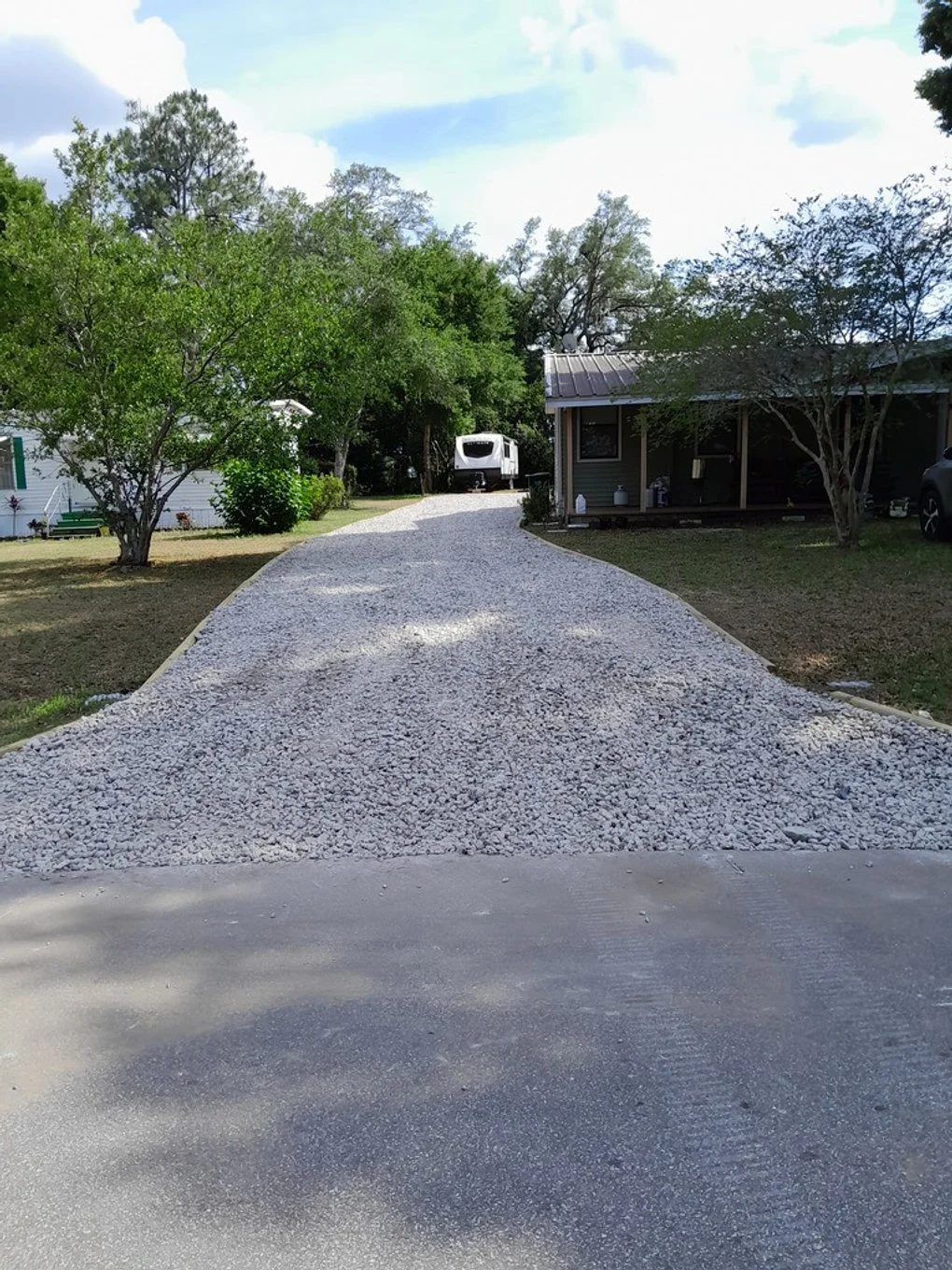
Polk Services gravel driveway installation in Lakeland, FL — the Kubota SCL1000 spreading crushed-asphalt milling.
HomeDriveways & Land WorkGravel Driveways
Driveways & Land Work · A Polk Services Specialty

Gravel Driveway Installation & Resurfacing in Lakeland, FL & Across Polk County

Granite, limestone, river rock, crushed concrete — and Donny’s default pick, premium crushed-asphalt milling, for the way it packs and holds up under Central Florida rain and heat. Real base prep and compaction, not just aggregate spread on top.

Owner Runs Every Install Crushed-Asphalt Milling Default All Aggregates in Scope Real Base Prep + Compaction 20-Mile Radius · No Travel Fee
Crushed-Asphalt Milling Default
Not the cheapest — it holds up best under Central Florida rain and heat, and reads like a finished drive.
Every Common Aggregate
Granite, limestone, river rock, crushed asphalt, crushed concrete, decorative — your look and budget.
Real Base Prep, Not Just Spread
Graded and compacted sub-grade before the top course goes on — no ruts and washouts within a year.
Low-Ground-Pressure Equipment
The 4-psi Kubota spreads and grades without chewing up the surrounding lawn.
Three Driveway Situations We Handle

New Install, Resurfacing, or Rural Acreage

01

New Driveway Installation

A new gravel drive on a rural property with none today, or replacing a failed concrete/asphalt surface. Scope: grade and compact the base, geo-textile fabric for drainage if needed, base-layer aggregate on soft ground, then the top course at the correct spread depth — across the full material range.

02

Resurfacing an Existing Drive

Existing gravel loses material over time — rain washes fines, traffic pushes aggregate to the edges. Resurfacing adds a fresh top course over the sound base at a lower cost than a full install. Quoted separately because the scope and material volumes differ.

03

Rural Corridor & Acreage Driveways

Longer runs, larger vehicles — RVs, trailers, farm equipment. Bigger material volumes and more involved base prep, where the full-size Cat skid steer earns its keep. Polk Services covers the rural corridor within the 20-mile radius.
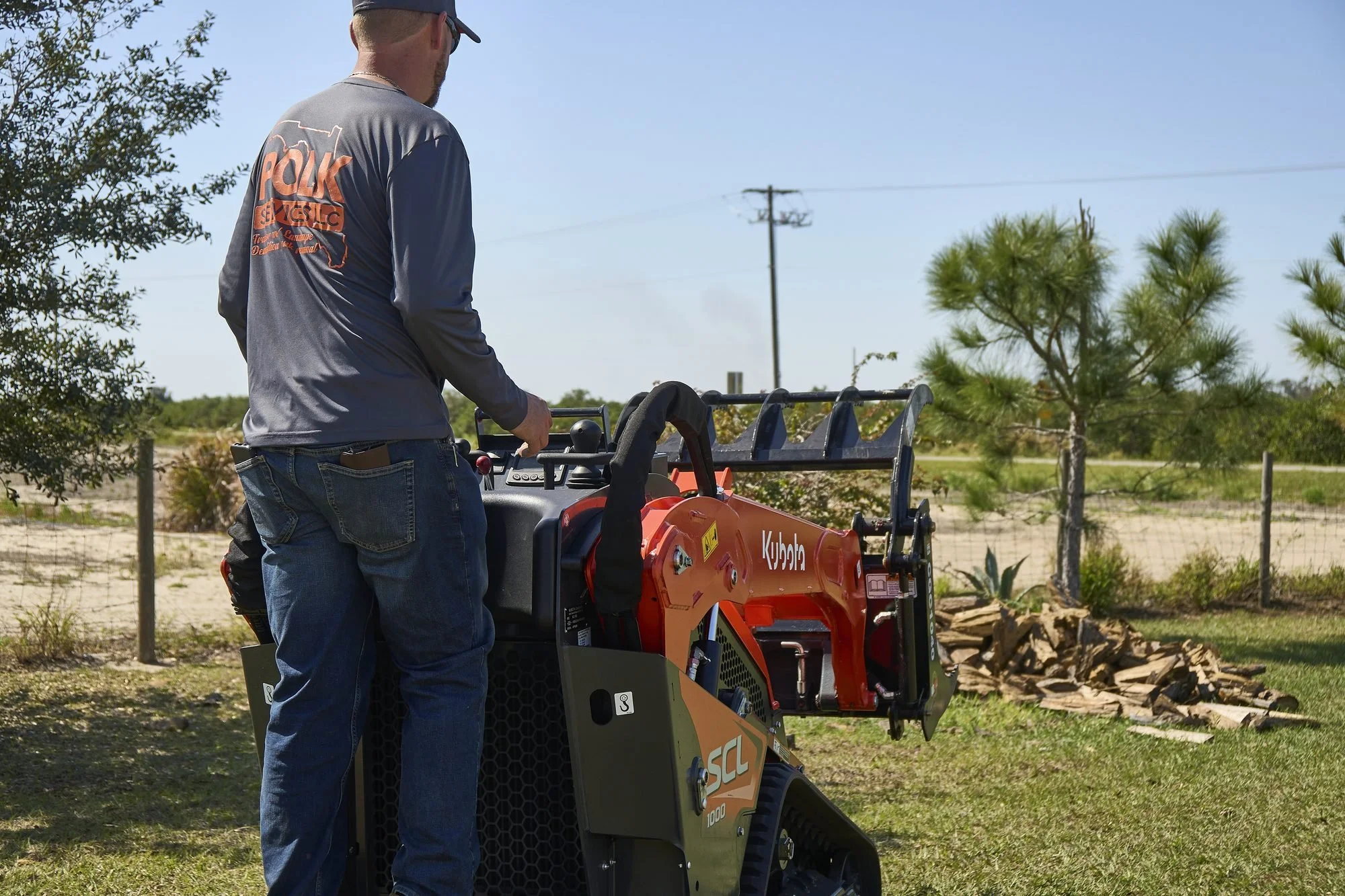
Donny operating the Polk Services Kubota SCL1000 on a driveway and land-work job.
Crushed Asphalt Milling · Donny’s Default Pick
Graded, based, and compacted — a driveway that sheds water instead of rutting.
The Full Scope

Every Material & Install Type

Material Types

Crushed-asphalt milling — Donny’s default for durability & looks
Crushed concrete — cost-effective, packs well
Granite chip — decorative and durable
Limestone gravel — cost-effective for larger runs
River rock & decorative aggregates on request

Install Scopes

New install on bare ground — full site prep
New install replacing a failed concrete/asphalt drive
Resurfacing — top course only over a sound base
Widening an existing gravel driveway
Circular driveways, parking areas, and RV pads

Site Prep & Base Work

Existing surface removal or grinding to sub-grade
Grading and compacting the sub-grade first
Geo-textile fabric where drainage/soft ground needs it
Base-layer aggregate under the top course
Drainage grading so water runs off, not pools
Edge containment — timber, poured concrete, or berm

Related & Bundle Scope

Concrete demo of an old, failed drive
Grading and ground leveling for larger site prep
Stump grinding along the driveway edge
Landscape reset alongside a new install
Gravel parking pads for RVs, boats, and trailers
How an Install Runs

Our Process, Start to Finish

01

Call, text, or fill out the estimate form

Reach Donny directly at (863) 344-5806. Text wide shots showing length, edge shots of the existing surface, and access considerations. For bare-ground installs, include the sub-grade and any drainage features.

02

Free estimate — photo quote or walk-through

Standard residential driveways price accurately from photos. Larger scope, rural acreage, or installs that involve concrete demo benefit from an on-site walk-through. Either way, the estimate is free.

03

Material recommendation & verbal quote

Donny walks through the material options and the recommended pick for your site — crushed-asphalt milling is the usual default, but decorative or budget goals may point elsewhere. The verbal quote breaks out material, labor, base prep, and disposal.

04

Written quote by text — material & labor line items

Every install is priced twice. The written quote shows material cost, installation labor, base prep, and any bundled work (concrete demo, grading, edge containment) as separate line items. No hidden fees.

05

Site prep — removal, grading & base compaction

The first workday: remove or grind any failed surface, grade the sub-grade for proper drainage, add base-course aggregate if the situation calls for it, and compact — with the skid steer or a plate compactor for edge work.

06

Top course, spread & final grade

The finish course goes on at the correct depth (usually 3–4 inches residential), graded so water runs off, then final-compacted into a stable surface. The last step is a walk-through and a rake-clean of the edges and approach. Most residential installs finish in 1–2 workdays.

What It Costs

Pricing, Material Selection & Site Prep

Standard Project Pricing

Standard residential installs are quoted per project with a written all-inclusive number. Resurfacing (top course only over sound base) is quoted separately at a lower cost. Rural acreage and larger commercial-scale installs are quoted per project with projected material volume and timeline.

Material Cost as a Line Item

Aggregate cost varies by material — crushed concrete runs lower, decorative granite higher, crushed-asphalt milling sits in the middle with a premium reputation. Polk Services quotes material as a separate line item so you see exactly how the choice affects the total.

Why Donny Defaults to Crushed-Asphalt Milling

It packs and holds together better than loose stone, sheds water, and compacts into a surface that reads like a finished driveway. In Central Florida rain it holds up over years without turning into ruts and washouts. Middle-of-the-pack cost, top-tier durability.

Bundle Pricing

Driveways pair naturally with concrete demo of an old drive, grading and leveling, stump grinding along the edge, or a landscape reset. Bundle pricing brings the total below booking each separately.

Payment Terms

Cash, check, credit/debit, Venmo, Zelle, and Cash App (3.7% fee on card/electronic; cash and check free). Installs typically require 20–50% down to cover material delivery, with the balance due on completion.
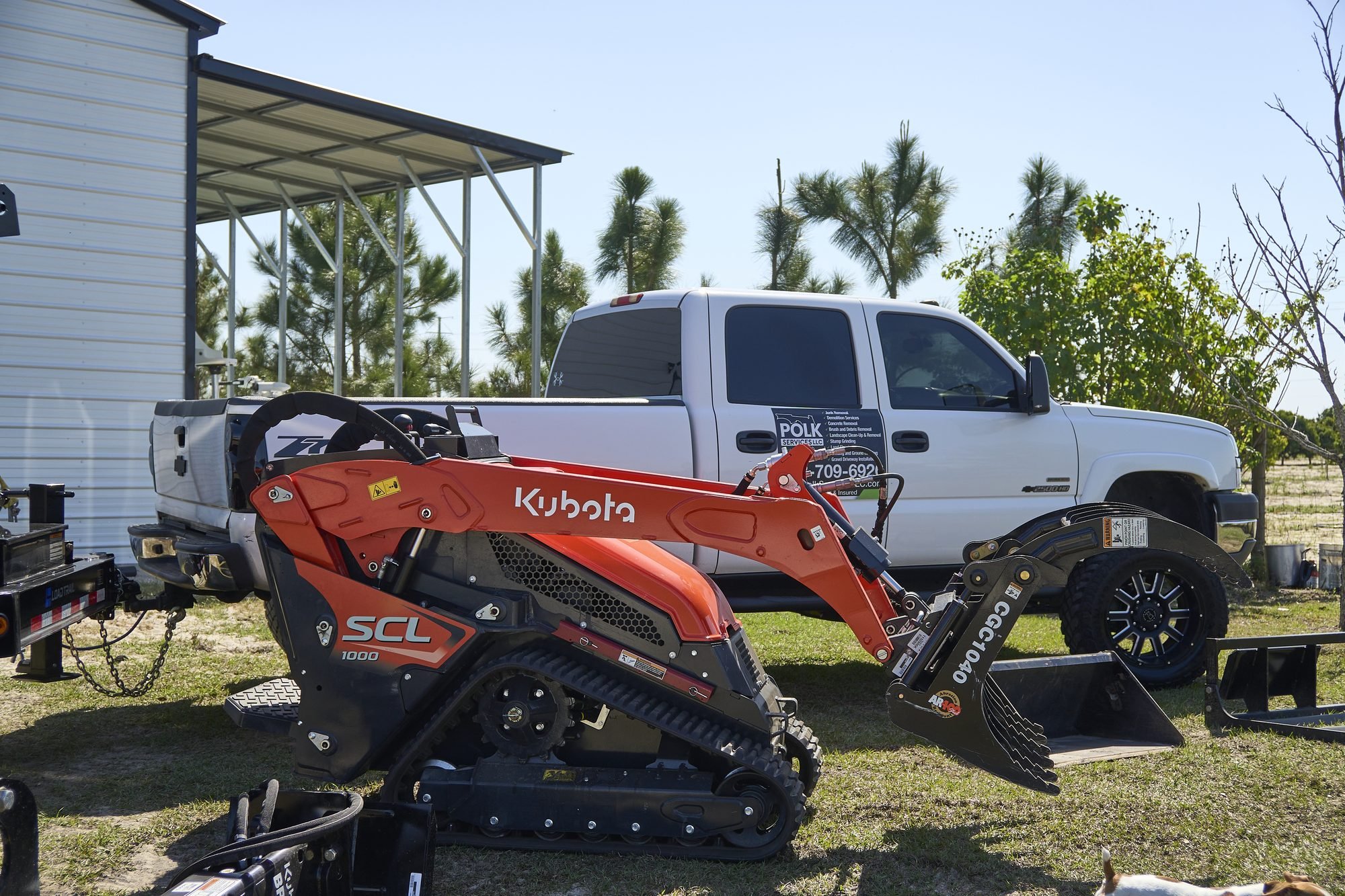
The Polk Services truck and Kubota SCL1000 staged for a gravel driveway install.
Head to Head

Polk Services vs Aggregate-Delivery-Only Companies

Comparison Point
Delivery-Only
Polk Services
Who does the installation
Truck drops the pile; you or a separate crew spread it
Owner-operated install with heavy machinery — Kubota + Cat
Site prep and grading
Not included — you arrange it separately
Included — sub-grade preparation and compaction
Material recommendation
You pick blind from spec sheets
Donny recommends the right pick for the specific site
Base course installation
Not typically part of a delivery quote
Base-layer aggregate installed when the site needs it
Drainage grading
Not addressed
Sub-grade graded so water runs off, not pools
Compaction
Not addressed — left to you
Included — sub-grade and top course both compacted
Time to finish a residential install
Often multi-week with separate crews
One to two workdays for standard residential
Accountability
Delivery vs installer finger-pointing
Direct call or text to the local owner
FAQ

Gravel Driveway Questions

What material do you recommend for a Central Florida gravel driveway?
Crushed-asphalt milling is Donny’s default — it packs and holds better than loose stone under Central Florida rain and heat, sheds water rather than absorbing it, and looks like a finished driveway. Middle-of-the-pack cost, top-tier durability. Granite, limestone, river rock, and crushed concrete are all in scope for a specific look or budget.
How long does a gravel driveway installation take?
Standard residential installs are typically completed in 1 to 2 workdays — site prep, base course (if needed), top course, and final compaction. Larger rural or acreage driveways can run three or more. Resurfacing (top course only) is usually a single workday.
How much does a gravel driveway cost?
Quoted per project, because material choice, length, existing surface, and site-prep needs all affect the total. The written quote shows material cost, installation labor, base prep, and any bundled work as separate line items so you see exactly what each part costs.
Do you install with a base course, or just spread the top layer?
Both, depending on the site. On stable Polk County sandy sub-grade, a single-course install works fine. On soft, wet, or drainage-challenged sub-grade, a base course of coarser stone underneath provides stability. Donny identifies which applies during the walk-through.
Do you remove an old concrete or asphalt driveway first?
Yes. Concrete or asphalt removal bundles with the new install, and bundle pricing brings the total below separate demo + installation contractors.
Can you resurface my existing gravel driveway instead of a full install?
Yes. Resurfacing (top course only over a sound base) is a separate, lower-cost scope — best for driveways that have lost material over time but still have a good sub-grade. If the sub-grade has failed, a full rebuild is the better call.
Will my gravel driveway pool water?
Not if it’s graded right. Polk Services grades every sub-grade at a 2–3% slope toward the drainage side so water runs off rather than pooling — the specific step that separates a lasting install from one that ruts within a year.
Can the driveway handle an RV or heavy trailer parked long-term?
Yes, but the install has to be specified for the load. Polk Services adjusts base-course depth, top-course depth, and edge containment based on the actual vehicle load. RV pads and heavy-trailer areas often need a heavier install than a standard driveway.
How often do I need to maintain a gravel driveway?
Plan on a top-up every 3 to 5 years, a grading pass every 5 to 10 years to reset the drainage grade, and edge maintenance if aggregate starts migrating. Polk Services runs resurfacing and maintenance directly.
Can you add edge containment to keep the aggregate in place?
Yes — available as an add-on line item. Options are timber edging, a poured concrete edge strip, or an aggregate berm. Timber and berm are the most common residential picks; concrete edge lasts longest but costs more.
Real Polk Services Jobs

Verified Google Reviews From Real Jobs

Every review below is a verified Google review with full customer attribution, each showing a competency this work depends on.
Local Conditions

Seven Polk County Realities That Shape Gravel Driveway Installation Here

1

Rain Makes Drainage Critical

50+ inches a year, mostly June–September with near-daily storms. A driveway that doesn’t shed water ruts, washes out, and pools within months. Polk Services grades every driveway to shed water rather than absorb it — the detail that separates a quality install from a top-dressing shortcut.

2

Sandy Soil & Sub-Grade Compaction

Sandy sub-grade over hardpan compacts well mechanically, but skip the compaction step and it shifts under vehicle loads into ruts and low spots. Polk Services compacts the sub-grade as part of the workflow — not skipped, not shortcut.

3

Rural Acreage Driveways

Rural parcels around Bartow, Mulberry, and eastern Lakeland have driveways running hundreds of feet on 5-acre-plus lots, with proportionally larger material volumes. Polk Services covers rural installs throughout the 20-mile radius with the equipment and sourcing for the volume.

4

Regional Aggregate Sourcing

Central Florida has suppliers and recycling facilities producing crushed asphalt milling, crushed concrete, and standard aggregate. Polk Services sources from established regional facilities — the crushed-asphalt recommendation is real premium material, not a cost-cut substitute.

5

Hurricane Driveway Damage

Milton (2024) and other storms caused washouts where drainage failed, displaced aggregate, and sub-grade failures from saturation. Post-storm resurfacing and repair run the same rate card, with itemized invoices for insurance claims.

6

HOA Material Rules

Some newer communities (Lakeland Highlands, FishHawk, Winter Haven) govern driveway material — and not every HOA allows gravel at all. Polk Services flags this at the walk-through so you verify with the HOA before scheduling; rural properties have the full range.

7

Vehicle-Load Considerations

Rural properties often support RVs, work trailers, farm equipment, and heavy trucks. Standard residential installs may rut under those loads — Polk Services adjusts base depth, top-course depth, and edge containment to the actual load, which delivery-only companies don’t address.

The Expertise

Seven Details That Separate a Polk Services Install From Aggregate-Delivery-Only

1

Why Crushed Asphalt Milling Packs & Holds

Milling is recycled asphalt pavement processed into aggregate; the asphalt residue acts as a natural binder that locks the material into a stable surface. Loose stone (river rock, granite) lacks the binder and shifts under traffic — the reason Donny defaults to crushed asphalt.

2

Sub-Grade Drainage Grade

A driveway on flat ground pools in the middle; on a 2–3% graded sub-grade it sheds water to the edges and off the surface. Polk Services grades the sub-grade before any aggregate is placed — what makes the finished driveway shed water rather than absorb it.

3

Base Course vs Top Course

Stable sub-grade takes a single top-course install; soft, wet, or drainage-challenged sub-grade needs a coarser base course underneath for stability. Polk Services identifies which applies at the walk-through — most Polk County sand is single-course, rural clay/muck often needs a base.

4

Two-Stage Compaction

Sub-grade is compacted before aggregate to lock the soil against shifting; the top course is compacted after spreading to settle it into a stable surface. Skip either and you get ruts and low spots within months — Polk Services runs both as standard workflow.

5

The 3–4 Inch Spread Standard

Residential driveways use a 3–4 inch top-course spread. Thinner (1–2 in) looks thin, fails fast, and exposes the sub-grade; thicker (5–6 in) wastes material and compacts unevenly. Polk Services spreads at the standard depth and goes heavier for RV pads and trailer areas.

6

Edge Containment

Without containment, aggregate migrates into the lawn under traffic and rain. Timber edging, a poured concrete strip, or an aggregate berm keeps material where it belongs — offered as an add-on line item on every install quote.

7

Post-Install Maintenance Planning

Every gravel driveway needs occasional top-up material, a grading pass every 5–10 years to reset drainage, and edge maintenance if aggregate migrates. Polk Services walks the customer through the expectations, and resurfacing is available directly when a refresh is due.

Polk Services truck and Kubota mini skid steer.

Ready to Book a Gravel Driveway?

Text photos of the driveway or the site, call directly, or fill out the estimate form. Crushed-asphalt milling is Donny’s default, but the full material range is in scope.

Call or Text (863) 344-5806