

How to Clear an Overgrown Lot Without Missing a Hazard
Quick Answer: Clearing an overgrown lot works best as an ordered sequence: assess the ground and mark property lines, call 811 to have buried gas, power, and water lines located before any digging or stump grinding, then clear loose trash and debris, cut and remove brush and small trees, grind or pull the stumps, and mow or mulch the heavy growth with a brush mower, forestry mulcher, or mini skid steer. If the ground is uneven, grade it, and finally deal with the debris, mulch it on site, chip it, or haul it off. In a warm, humid climate, the growth comes back quickly, so a follow-up mow keeps the lot from disappearing again.
A lot that has gone wild doesn't clear itself in one careless afternoon, and rushing straight in with a mower is how people hit a buried water line or a hidden roll of old fence wire. The work is very doable, but the order matters more than the muscle. Below is the sequence a crew actually follows, the machines that do the heavy lifting, and the hazards that dense growth is good at hiding until you're already on top of them.
Start by Reading the Lot and Marking Its Edges
Before anything is cut, walk the property and figure out what you're dealing with. Look for where the ground rises and dips, where water seems to sit, and where the growth is thickest. Find and mark the property lines so you don't clear onto a neighbor's parcel or leave your own corners untouched. If there's an old survey pin or a fence line, that's your reference.
This is also the stage to spot the obvious trouble: a leaning dead tree, a section that's clearly wetter than the rest, or a pile someone dumped years ago that's now buried in vines. You're building a plan, not just a to-do list. Knowing that the back third is mostly saplings and the front is head-high brush tells you which machine goes where.
Call 811 Before Any Digging or Grinding
This step is not optional, and it's free. Before you grind a stump, pull a root, or dig for any reason, contact 811 and have the underground utilities located and marked. Buried gas, power, water, and communication lines can run across a lot with nothing on the surface to warn you, and tall grass and brush hide the meters and markers that might otherwise tip you off.
The service sends locators out to paint or flag where those lines run, usually within a few business days of your request, which is why you call ahead rather than the morning you plan to start. Hitting a gas or power line is dangerous and expensive; a stump grinder that bites into a buried service line turns a routine clearing job into an emergency. Mark it, respect the paint, and grind around it.
Clear the Trash and Loose Debris First
Once the lines are marked, pull out everything that isn't plant. Overgrown lots collect things: bagged trash, tires, scrap lumber, an abandoned appliance, chunks of old concrete. Getting this out first keeps it from being chewed up and scattered by a mower or mulcher, which turns one dumped tire into a hundred shredded pieces you then have to rake out of the mulch.
Work methodically from one edge inward so you're not stepping back into brush you've already searched. This is slow, hands-on work, but it protects your equipment, and it's far easier to haul a whole appliance than to fish its fragments out of the ground later.
Cut and Remove the Brush and Small Trees
Now the growth comes down. Brush, vines, and small trees get cut back so the heavy machinery can reach the ground. Hand tools and a brush cutter handle the tight spots, around structures, along fences, near the marked utility runs where a big machine shouldn't be swinging.
For larger areas, this is where a brush mower or a mini skid steer with the right attachment takes over, knocking down dense growth far faster than any hand tool. Anything with a trunk too big to mow gets cut and set aside for the stump and debris stages. The goal here is to open the lot up so you can see the ground and get equipment across it safely.
Deal With the Stumps
Cut a small tree and you're left with a stump. Stumps don't just look unfinished: they're trip hazards, they sprout back, and they get in the way of grading. You've got two ways to handle them. Grinding uses a rotating wheel to chew the stump down below grade into chips, leaving the roots to rot in place; it's quick and doesn't leave a crater. Full removal pulls the stump and root ball out entirely, which is more disruptive but clears the way if you plan to build or dig there later.
Because both involve going into the ground, this is exactly why the 811 locate had to happen first. Grind or pull around the marked lines, never through them.
Mow and Mulch the Heavy Growth
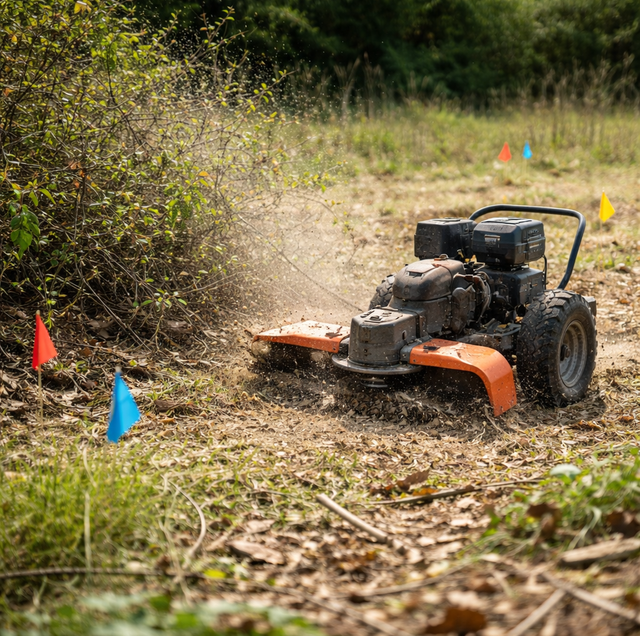
With the big stuff down and the stumps handled, the remaining field of grass, saplings, and brush gets mowed and mulched. A brush mower handles thick grass and light saplings. For a lot that's truly overtaken by brush and small trees, a forestry mulcher earns its keep: it grinds standing vegetation, brush, and small trees into mulch in a single pass, leaving that mulch spread across the ground instead of piled up.
A mini skid steer is the workhorse that carries these attachments across a soft or uneven lot and squeezes into spots a full-size machine can't. Which tool leads depends on the lot: grass and light brush lean toward the mower, while a wall of saplings and vines leans toward the mulcher.
Grade the Ground If It Needs Leveling
Clearing often exposes an uneven surface: ruts, old stump holes, low spots where water collects, and mounds left by roots. If you plan to use the lot for anything, grading smooths it out and, just as important, shapes it so water runs off instead of ponding or cutting channels through the bare dirt. A newly cleared lot has lost the root network that was holding its soil, so getting the slope right protects it from washing.
Not every job needs grading. A lot that you are simply keeping clear may be fine left as is. But if the ground is rough or drainage is off, this is the stage to fix it, while the lot is open and the machines are already there.
Handle the Debris
Whatever you cut has to go somewhere, and you've got three honest options. Mulching leaves the ground cover in place, where it breaks down, feeds the soil, and helps hold moisture and slow erosion. Chipping runs branches and limbs through a chipper into a manageable pile of chips you can spread or cart off. Hauling loads of debris (trash, stumps, oversized wood) and taking it away entirely.
Most lots use some mix: mulch the brush, haul the junk, and stumps. Deciding this up front shapes the whole job, because a plan built around mulching in place looks very different from one built around loading a trailer.
Keeping the Lot Clear After You Finish
Clearing a lot once is the loud part; keeping it clear is the quiet part that people forget. In a warm, humid climate, cut ground doesn't stay bare. Seeds and roots you didn't remove push new growth up fast, and within a season, an untouched lot starts heading back toward where it began. A follow-up mow a few weeks or months out, before saplings harden into trees again, is far less work than repeating the whole clearing. The first clearing sets the stage; light, regular maintenance is what keeps the lot usable instead of letting it slide back into a project.
Frequently Asked Questions
It turns a routine job into a real hazard. A grinder or excavator that bites into a live line can cause an electric shock, a gas leak and fire, or a flooded work area, and beyond the danger, whoever disturbed the ground is typically on the hook for the repair and for any service outage to the surrounding area, a bill that dwarfs the cost of the clearing itself. The locate is free, and in most places you're required to call before you disturb the ground, precisely because buried utilities are invisible from the surface and overgrowth hides even the meters that might warn you. There's no version of the math where skipping the call comes out ahead; it usually gets skipped only because people don't know the service exists.
A forestry mulcher grinds standing brush and small trees into mulch in a single pass and leaves that mulch on the ground, which means no felling, no piling, no burn pile, and no hauling that debris away. Cutting-and-hauling is the older multi-step route: fell it, drag it, load it, dump it. The mulcher collapses those steps into one and leaves behind a layer that feeds the soil and slows erosion. Cutting and hauling still wins when you need the ground completely bare or the material gone entirely, such as before construction.
More than most people expect: old barbed or field fence wire that wraps a mower blade, forgotten wells or holes you can step into, dumped debris like tires and scrap, and wildlife (snakes, wasp nests, rodents, fire ants) that shelter in thick brush. Clearing safely means walking the lot first, wearing boots and long sleeves, moving deliberately rather than plunging in, and pulling out visible junk by hand before any machine chews through it and scatters it.
Often, yes. A healthy mature oak or other established shade tree is worth protecting rather than clearing on reflex. It's decades of growth you can't get back quickly, and it holds soil and shade. The move is to decide before the machines run, which trees stay, then keep the equipment and grinding clear of their trunks and root zones so you don't wound the bark or compact the roots. Clearing brush away from a good tree can actually help it by cutting competition for water and light.
Left alone, freshly cleared ground in a warm, humid climate can push up ankle-to-knee-high growth within a single growing season, because the seed bank in the soil and the roots left behind sprout fast on open dirt with no competition. The trick is timing the follow-up before saplings "woody up," since once a stem hardens from green and bendable into a woody trunk, usually within a year or two, a mower can no longer take it, and you're back to cutting and grinding. A maintenance mow a few times through the growing season, while everything is still soft, keeps the lot in check for a fraction of the first clearing's cost. Miss that window, and the woody regrowth means paying for much of the clearing over again.
A brush cut knocks the visible growth down so the lot looks tidy and you can walk it, but the stumps, roots, buried debris, and uneven ground all stay. A full clear-and-grade removes the brush and trees, grinds or pulls the stumps, hauls the debris, and levels and shapes the dirt for drainage. Which one you need is driven by what comes next: a brush cut suits a lot you are just keeping maintained, or need to see across, while anything that involves the ground itself, a survey, a perc test for a septic system, staking out a build, or showing a graded parcel to a buyer, needs the clear-and-grade so crews and equipment can actually work the site. Deciding up front avoids paying for a cut now and a full clearing a few weeks later.
Ready to reclaim an overgrown lot the right way — hazards checked, growth cleared, debris handled, from bush and lot clearing in Bartow to brush pile removal in Lithia. Polk Services LLC serves Lakeland, Highland City, and Mulberry. Call (863) 344-5806.
