

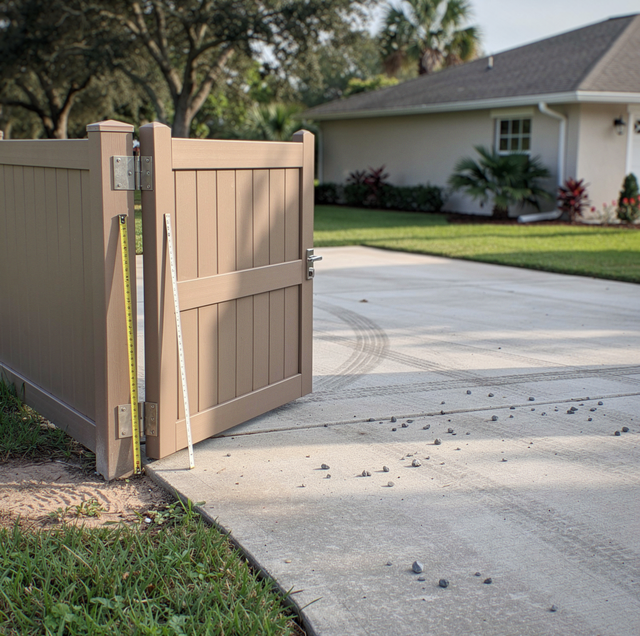
A brush pile can be picked up straight from the backyard, not dragged to the curb first. What decides it is whether a skid steer and dump trailer can reach the pile without squeezing through a gate or a side-yard run narrower than the equipment itself. When they can, the crew loads the pile where it sits. When they can't, the same pile gets carried out by hand, load by load, before it ever reaches a trailer. Everything else about the job, from how the pile should be staged to how long it takes, comes down to that one test.
The Access Test That Decides Where a Pile Gets Picked Up
The test isn't about property lines or whether a pile sits in the front yard or the back. It's about whether there's a continuous, clear run of solid ground from the street or driveway to the pile, wide enough and firm enough for equipment to drive in, load, and back out again. A pile ten feet past an open side yard and a pile seventy feet behind a detached shed get judged the same way: the question is whether the route in stays open and firm the whole distance, not how far back the pile happens to sit.
A stand-on loader built for this kind of work runs around 36 inches wide with its bucket attached, narrow enough to fit through most openings that look too tight for a full-size truck. That width is the baseline against which the rest of the access test is measured. A yard that opens straight onto a driveway, with no gate in the way, is passed without a second look. A yard boxed in by fencing, hedges, or a locked run needs that opening checked before anyone assumes the machine can get through.
Snap a photo of the gate or narrowest point in the route before pickup day, not just the pile. A clear shot of the opening settles the access question faster than a verbal description of how wide it "feels."
What Counts as Vehicle Access for a Skid Steer and Trailer
A single walk-through gate for foot traffic typically measures 36 to 48 inches across, with 36 inches as the default width for a standard gate. On paper, a 36-inch gate and a 36-inch-wide machine match exactly, and a gate with a true 36-inch clear opening is the narrowest one the loader threads, with almost nothing to spare. Hinge hardware, a latch post, or a sagging leaf can take an inch or two out of that opening, and a gate that measures under 36 inches between whatever sticks out furthest turns the route into a hand-carry.
Driveway gates, single or double-leaf, open several feet wider than any walk-through gate, so a fenced yard with one passes on width alone. The difference isn't the fence style or how new the gate looks; it's the clear opening once every leaf is swung fully back, measured the same way a single gate would be.
Measuring that clear opening takes a tape and a minute. Swing the leaf as far open as it goes, then measure at the narrowest point between the latch post and whatever stands out furthest on the hinge side: a hinge knuckle, a drop-rod bracket, or the open leaf itself, which on a gate hung inside its posts stands its own frame thickness into the gap. Take a second reading near the ground, where a leaning post or a dragging leaf can pinch the opening tighter than it reads at waist height.
When a Fenced or Narrow Yard Means a Hand-Carry to the Curb
Once a route fails the access test, the plan changes shape. The pile still gets removed, just not by driving the trailer to it. Instead, the material is carried or cart-hauled past the narrow gate or fence run to a spot the trailer can reach, where it is then loaded. The work is the same; only the order changes, and a step gets added that a wide-open yard never needs.
A fenced, vehicle-inaccessible backyard doesn't disqualify the job. It changes which parts of the process use labor rather than machine time, which also shapes how long the visit runs.
Staging the Pile So Nothing Gets Nicked Along the Way
Once a pile is going to be loaded by machine, by hand, or both, where it sits relative to everything else in the yard starts to matter. A pile set too close to a fixed object turns a routine pickup into one where something gets scraped, crushed, or blocked along the way. Keep a few feet of open ground between the pile and mailboxes, parked vehicles, fence lines, utility boxes, sprinkler heads, overhead wires, fire hydrants, and drainage inlets or swales.
Two of those are worth a specific number. A fire hydrant is kept with about three feet of open space around its full circumference so it stays easily reachable, and an electric meter panel maintains roughly the same three-foot clearance in front of it for anyone who needs to reach a disconnect. A pile stacked against either one eats into that clearance even if nobody touches the hydrant or panel directly, which is reason enough to leave both a wide berth when deciding where the pile should go.
Sprinkler heads sit low and get crushed under a tire or a dragged branch without anyone noticing until the next time the system runs. Overhead wires change how high a bucket can safely lift on that side of the yard, so a pile staged well clear of a low utility drop keeps that part of the job from getting more restricted than it needs to be. A pile set directly over a swale or drain inlet blocks runoff on its own, and repeated equipment or foot traffic over the same low spot can leave the ground more compacted than it was before the pile ever showed up.
Leave any limb that is resting on or tangled in an overhead service wire where it is, and keep the pile out from under that wire. The electric utility clears or de-energizes a line before anyone pulls a branch off it.
Why Carry Distance Changes the Job as Much as Pile Size
In a hand-carry, labor time equals the number of trips multiplied by the length of each trip, and the length is the half that placement controls. Every armload or wheelbarrow load walks the full route out, and the carrier walks it back empty, so a small pile forty feet from the gate can take as long to move as a larger pile fifteen feet from where the trailer parks.
That's why two piles of similar size, on two different properties, can turn into very different jobs. One stacked near a driveway apron adds almost no carry time at all. The other, pushed back against a far fence line, turns a short load-out into a long run of trips before the trailer ever gets filled.
Routine Trimming Versus a Storm-Season Pile
A pile's size isn't fixed; it depends on what built it. Months of routine hedge trimming and seasonal yard work tend to produce a modest pile, since the material accumulates in small amounts between each round of upkeep. A pile left after a major wind event is a different job: downed limbs and wind-tossed branches can pile up faster and in greater volume than a season of trimming ever would, and that size difference cuts two ways. A trimming pile may fit what a household curbside yard-waste collection takes, while a storm pile can outgrow that collection and leave a hauled pickup as the way it goes; in a fenced yard that already needs a hand-carry, the storm pile is also the one that stretches the carry.
A routine-trimming pile in a backyard that needs carrying adds only a trip or two to the visit. A storm-sized pile in that same fenced yard can make the hand-carry step the longest part of the job, regardless of how open the gate is. Neither case changes the access test itself; a narrow gate is still a narrow gate whether the pile behind it came from a major storm or a weekend of pruning. What changes is how much that narrow gate ends up costing in time.
Whether a pile gets loaded at the curb or where it sits, the question underneath both scenarios is the same one: can equipment reach it without tearing anything up along the way? Settle that first, and the size and placement of the pile decide the rest of the plan on their own.
Frequently Asked Questions
Yes. Access gets judged section by section rather than for the whole property at once. If a gate on one side of the house is too narrow but the rest of the yard opens onto a driveway, only the portion beyond that narrow run needs a hand-carry step, while the rest still loads straight onto the trailer.
It can. A standard work wheelbarrow runs about 25 to 26 inches wide at its widest point, so a side yard under roughly three feet across forces loads through single file, leaving no room to turn a full wheelbarrow around, which stretches a hand-carry into more trips than the same pile would take through a wider run.
It can turn a machine-accessible yard into a same-visit hand-carry. An electric gate needs to be set to manual release, or the access code shared ahead of time by the scheduled arrival; if it's still locked down when the crew shows up, that route is treated as closed for that trip, even though the opening itself is wide enough on paper.
Yes, and it gets judged at the moment of the visit rather than on how the property is normally laid out. A single vehicle blocking the driveway on the scheduled day turns a yard that would otherwise pass the access test into a same-day hand-carry, since the crew works from what's open when they arrive, not from what's usually possible.
Sometimes, even on a yard wide enough to pass the access test on paper. Saturated turf can rut or compact under a loaded machine's tracks in a way dry ground doesn't, so a crew may choose the longer hand-carry over driving onto soaked grass, a call made on ground condition rather than on gate or yard width.
It can rule a path out even when it's wide enough. Pavers set in a sand base without mortar can shift, crack, or sink under the concentrated weight of tracked equipment, so a paver side path is sometimes skipped in favor of a grass or gravel run that can support the same weight without damage.
Send photos of the pile and the path in — that's enough to tell whether it loads from where it sits or needs a hand-carry to the curb. Polk Services LLC serves Lakeland, Highland City, and Mulberry. Call (863) 344-5806.