

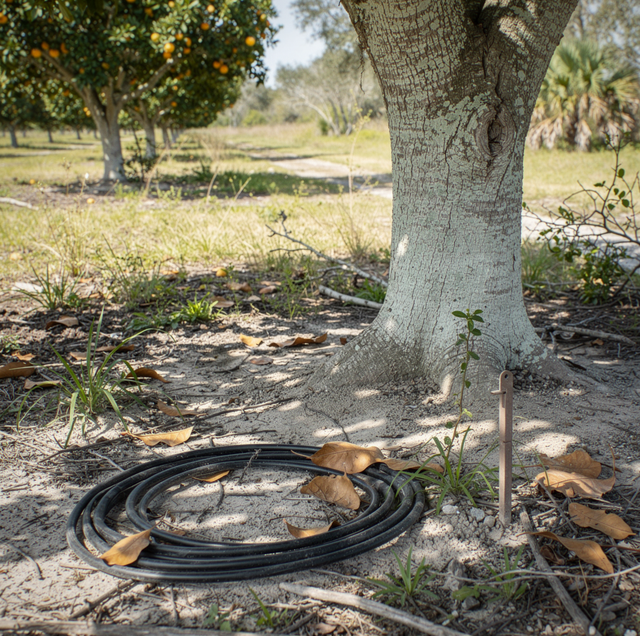
From the road, an abandoned grove reads as a green wall: vines climbing the fence, volunteer trees crowding the first row, a few gray citrus skeletons poking through the canopy, and maybe a gap where a lane once ran. Walk into the first row and the picture changes. The old trees still stand in straight lines, some dead, others sprouting from the base. The ground between them rises into long mounds or drops into furrows; black tubing and plastic stakes sit at the foot of each trunk, and a ditch full of leaves passes for solid ground. Abandoned citrus grove clearing is planned around those hidden pieces, because each one decides where a machine can travel and what has to come out before the brush cutter starts.
Reading the Grove From the Road and From Inside the Rows
The age of the neglect sizes the job alongside the citrus trees themselves. Warm, wet weather keeps an untended grove growing year-round, so a block ignored for several years may hold grapevine, undergrowth, and volunteer trees that fill the gaps between rows and climb over the old canopy. A grove that went untended for a season or two carries less of that growth, and the work there is closer to tree removal and stump work than to brush clearing. Two groves of the same acreage can be very different jobs for that reason alone.
The table below lists what you can see at the edges of the rows and what each sign can mean once the brush comes off.
| What you see | What it can be | What it changes |
|---|---|---|
| Long, parallel humps under the brush | Raised planting beds | Machines travel along the beds, not across them |
| A strip of taller, greener growth | A water furrow or ditch holding moisture | The strip gets walked and probed before tracks cross it |
| Short stakes or pipe stubs at each trunk | Irrigation risers and emitters | They come out before any mulching head runs |
| An open stripe at the end of every row | An old turning lane | It becomes the staging area and haul route |
| A large tree that is not citrus | A shade or windbreak tree | Someone decides whether it stays before work starts |
Dead Trees, Standing Trunks and the Stumps Left Behind
Row spacing tells you how many trees, and later how many stumps, the job holds. Older plantings were set wide, with roughly 25 feet between rows and about 12 feet between trees in the row. Newer blocks were planted tighter, at 18 to 22 feet between rows and 8 to 12 feet between trees. At 22 by 12 feet, an acre holds 165 trees; at 18 by 8 feet, it holds 302. Every one of those trees leaves a stump, so the planting pattern says more about the stump work than the height of the brush does.
Dead citrus wood dries brittle. A dead trunk pushed with a bucket can snap at the base and throw limbs back toward the machine, so the crew grabs dead trees with a grapple and lifts them out of the row in pieces. Trees that are half-alive behave differently: the top may be bare, while new shoots climb from the trunk near the ground.
Those shoots are the reason the stumps matter. A citrus stump cut at ground level keeps its rootstock alive, and the rootstock can keep pushing sprouts. Grinding the stump crown below the surface removes the living tissue at the root collar where those sprouts start. Where the land will become lawn, every stump is ground below the surface; under a future house site or driveway, stumps are removed with their root plates so no decaying wood is left under the build. Where it returns to open pasture, you can decide row by row, keeping in mind that a cut-only stump will need attention again.
Raised Beds, Water Furrows and Ditches Under the Brush
Whether your grove sits on beds depends on the soil it was planted in. On low, poorly drained ground, citrus was planted in two rows per raised bed, with the crown of the bed 3 to 4 feet higher than the bottom of the furrow beside it. Those furrows drain into larger ditches, and a perimeter ditch carries the water off the block. On deep, fast-draining sand, groves were planted flat, with no beds and few ditches, and the clearing works across open, even ground.
On bedded land, the furrows and ditches are the hazard. Years of leaf litter, vines and fallen branches can bridge a ditch so completely that it looks like part of the row. A tracked machine that drops one side into a hidden ditch can tip or bury itself, so the crew walks each low strip first and probes it before anything crosses. Work then runs along the length of the beds, with crossings only at checked points.
Clearing leaves the beds and furrows in place. Flattening them, filling the furrows and shaping the land for a house pad, a driveway or a pasture is grading work, planned as its own step once the trees are out and you know what the land will be used for. Before anyone fills a ditch, find out where it sends its water; a ditch that still carries runoff from a neighboring parcel or a road will keep doing that job whether or not the citrus is gone.
Old Irrigation Risers and the Mainline Below
A grove planted in recent decades may have been watered with low-volume microsprinklers, where each tree had an emitter on a stake or a short riser, fed by polyethylene tubing running down the row. That tubing branches from PVC submains, which connect to a mainline buried across the block and back to a pump station.
The row tubing and risers come out by hand or with a grapple before any mulching starts. A snapped riser leaves a sharp stub at ground level that can cut a tire or a boot, and stakes hidden in the grass are hard to see from the seat of a machine. The buried PVC mainline can be traced by following the rows of risers back to where they meet; the tees and valve boxes line up at the ends of the rows.
The pump station needs its own look. If the groove is pumped by an electric motor, a service line may still run to it, and a weathered conduit can remain live. An electrician or the utility confirms the line is dead before the crew works around it.
Keep machines and fill away from any open well casing near the old pump station, and do not try to cap it yourself. A water well contractor seals an abandoned well so it cannot carry surface water down into the groundwater.
Why an Untended Grove Matters to the Citrus Next Door
An abandoned grove can serve as a reservoir for the Asian citrus psyllid and the bacterial disease it spreads, known as citrus greening. Untended trees receive no pest control, so the insects breed on them and spread to neighboring groves and backyard trees. Taking the trees out removes that host.
The stumps decide how complete that removal is. A cut stump that keeps sprouting puts out tender new growth, which the psyllid feeds on and lays eggs on. Ground stumps and pulled sprouts close that gap. If no citrus grows near your property, the urgency is lower, but the same stumps still affect how clean the cleared ground stays.
Access Lanes, Row Ends and the Clearing Order
Every grove was laid out for equipment, and that layout still helps. The open strip at the end of each row was a turning lane, and on some blocks a perimeter road ran inside the fence. Clearing starts there: the gate, the perimeter lane, and the row ends open first, giving the crew a place to stage the machine, stack debris, and back in a trailer for haul-off.
From the lanes, the work moves down the rows in the direction they were planted. On bedded land, it keeps the machine on the bed tops, and on flat land it keeps the crew working in straight, predictable passes. Furrows, ditch crossings and any low pocket that holds water come last, once the dry ground around them is open and the crew can see what it is dealing with.
Deciding Which Shade Trees Stay
Not everything in an old grove is citrus. Homesites and pump stations were shaded by large trees, windbreak rows were planted along some boundaries, and volunteer trees seeded into the rows after the care stopped. Some of those are worth keeping, and the decision is yours before the machine moves.
Position: A tree that sits where a house, driveway, or septic area will go cannot stay, however healthy it is.
Structure: A volunteer that grew up through a dead citrus canopy can be leaning, one-sided, or wrapped in vine, and it may not stand well once its neighbors are gone.
Kind: Some volunteers are invasive species that spread by seed, and keeping one keeps the seed source on the property.
Spacing: A single tree left alone in open ground catches the full wind, so a sheltered tree with a weak crown may be a poor candidate to keep.
Mark the keepers with bright tape around the trunk and walk the line with the crew so everyone agrees on what stays.
An abandoned grove is a planted system that kept its shape after the care stopped. The rows, beds, pipes and lanes are still there under the growth, and a clearing that reads them first goes faster and leaves fewer surprises for whoever builds, grazes or plants on the land next.
Frequently Asked Questions
Look for low strips repeating at a steady interval across the block. On bedded ground, the water furrows were cut 2 to 3 feet deep and spaced roughly 48 to 55 feet apart, so evenly spaced dips at that distance, each with two lines of trees between them, point to beds.
No. The sprouts come from the rootstock, which is a different plant from the fruiting variety grafted onto it. On some rootstocks, the sprouts carry three-part leaves and stiff thorns, and any fruit they set tends to be small, sour, or seedy.
The buried PVC mainline can stay where nothing will be dug, built, or paved over it. The row tubing is 1/2- to 3/4-inch flexible polyethylene, and if it is left on the surface it can wrap around a spinning mulching head and stall it, so it comes out first.
The bulk of a citrus root system lies within the top 2 feet of soil, even in a mature tree. Some rootstocks also send a few deeper roots well below that mat, which is why a pulled stump can still leave an anchor root snapped off in the hole.
Check each one first. A tree with blotchy, uneven yellowing that does not match on both halves of the leaf, along with small, lopsided, bitter fruit, points to citrus greening, which a lab test on the leaves confirms; an infected tree keeps declining, so it makes a poor keeper.
Yes, where any work runs along a boundary. Corner markers can be iron rods, pipes or concrete monuments, sometimes capped and sitting flush with or just under the surface, and a machine clearing a fence line can bend or bury one without the operator noticing.
Book a walk-through of your old grove — we will show you which trees, beds, risers and ditches set the size of the clearing before any work is quoted. Polk Services LLC serves Lakeland, Highland City, and Mulberry. Call (863) 344-5806.