

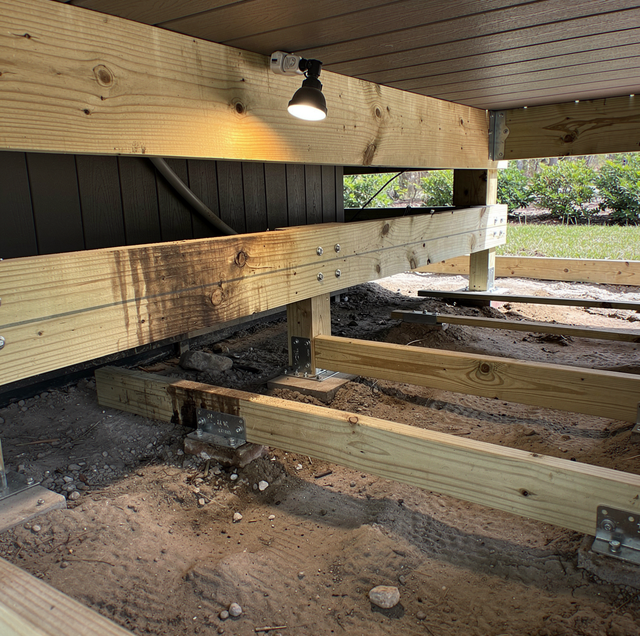
The first question owners ask about a hot tub set into a deck is which comes out first: the tub or the deck built around it. The short answer is the tub, once its power is off and its water is out. The framing around it was built to carry that weight, so it is the part of the deck you want left standing while several hundred pounds of shell, foam, and cabinet are still sitting on it. The longer answer depends on three things you cannot see from the deck surface: how the tub sits in the deck, what the framing under it was built to do, and how many years that framing has spent wet.
Two Ways a Tub Sits in a Deck
A deck hot tub removal starts by determining which of the two arrangements you have, because they do not come apart the same way.
On top of the deck, the tub's cabinet rests, with its full footprint bearing on the decking and on the joists beneath it. The tub leaves the way it arrived, across the surface and out through a gate or down the stairs.
Set into the deck: the deck surface sits level with the tub's top lip, or close to it, and the boards stop at a framed opening cut to the tub's outline. The cabinet sits lower than the deck surface, bearing either on a reinforced platform of framing or on a pad on the ground.
The second arrangement is where the order question gets real. When the deck is framed after the tub is set, the opening can be tighter than the cabinet under the lip, and the railing, stairs, and posts may leave no path wide enough for the tub to pass through. A tub in that position is trapped by its own surround. Freeing it means opening the framing on at least one side or taking the tub out in pieces, and that call gets made before anything is cut, because a joist or header removed to free the tub may also be the member holding up the boards someone is standing on.
The Framing Built to Carry the Load
A filled tub is a heavy, concentrated load, and the framing under it was sized for that number. Water weighs about 8.3 pounds per gallon, so a four-person tub holding 300 to 400 gallons carries roughly 2,500 to 3,300 pounds of water. Add the tub itself at 400 to 800 pounds empty, plus the people sitting in it, and the load on a footprint around seven feet square can come close to 100 pounds per square foot. An ordinary deck is framed for a live load of about 40 pounds per square foot.
That gap explains why the framing under a tub looks different from the rest of the deck. A builder could close it several ways:
- joists doubled, or set closer together, under the tub footprint
- an added beam running under the tub, carried on its own posts
- posts on footings sized for the tub, placed outside the deck's original post layout
- solid blocking between joists to spread the load sideways
- for a set-in tub, a concrete or compacted-gravel pad on the ground that carries the tub directly, with the deck framing only boxing in its edges
Each of those choices changes what happens once the tub leaves. Reinforcement that carried only the tub becomes surplus wood. Reinforcement tied into the main frame, such as a beam that also carries ordinary joists, is still structural, and pulling its posts without checking what rests on it can cause a section of the deck to drop. Telling the two apart is the first thing to settle under the deck, before any member is marked to come out.
Power Off Before Anything Moves
A deck tub runs on a dedicated circuit: 120 volts on some plug-in models and 240 volts on larger tubs. It reaches the tub one of two ways: a cord to a GFCI receptacle on smaller plug-in units, or a hardwired feed from the house panel to a disconnect box near the tub, then through conduit into the tub's equipment bay. On a deck, that conduit tends to run along a joist or up a post and enter the cabinet from underneath, which puts it inside the same framing that has to come apart.
None of that wiring is yours to handle. The removal crew disconnects a tub on a plain plug or a simple breaker-box GFCI circuit as part of the pickup. A hardwired 240-volt feed with permanent conduit or a sub-panel is an electrician's job: the electrician de-energizes it, disconnects it, and makes the remaining wire safe before the crew lifts the tub or cuts into the framing that carries the conduit. The sequence matters for one plain reason. Sawing through a joist with live conductors fastened to it is a mistake that cannot be undone.
Leave the disconnect box, breaker, and wiring alone, even to check whether the feed is dead. On a hardwired tub, book the electrician's disconnect for a day before the removal, so the crew arrives to a circuit already proven dead.
Draining the Tub and the Water Under the Deck
The tub empties before it moves. The bulk of the water leaves through the drain spigot at the base of the cabinet or through a submersible pump set in the footwell, and the hose goes to an open lawn well away from the house foundation. Water let out across the decking runs through the gaps in the boards onto the ground under the deck, a spot that dries slowly at the best of times.
The bigger drainage story is the one the tub has been writing for years. Splash-out, drips from the cover, overflow while refilling, and the occasional leak from a fitting inside the cabinet all land on the framing around the tub. Wood kept under about 20 percent moisture content does not decay. Framing that is wetted again and again, shaded by the tub, with little air moving under the deck, can stay wetter than that for long stretches, and the members nearest the tub take the brunt of it: the header and trimmer joists around a set-in opening, the tops of the posts under the tub, and the ends of boards that butt against the trim ring.
A set-in tub on a ground pad adds one more wrinkle. If the pad was poured or packed without any fall, water that reaches it has nowhere to go, and it sits against the bottoms of the posts and the base of the cabinet.
The Order of Operations, Start to Finish
With power and water settled, the removal runs in a fixed sequence:
- Clear the deck: The cover, the steps, planters, and furniture come off so the path is open.
- Power: The simple disconnect at pickup, or the electrician's disconnect beforehand for a hardwired feed.
- Drain: Spigot or pump, routed to the lawn away from foundations.
- Strip the surround: The trim ring, the skirt boards, and any decking that overlaps the tub's lip come up, so the lip is free on every side.
- Open a path: A railing section or stair run comes off if the tub cannot clear it.
- Lift the tub: A mini skid steer with a lifting attachment raises it out, with distribution pads under the jack points to spread the load across the decking.
- Inspect what was hidden: With the tub gone, the opening and the members under it can be seen and probed for the first time.
- Take down what is coming out: Decking first, then joists, then beams, with posts last.
Step 6 is the reason the tub goes first. As it moves toward the edge, the tub's weight crosses parts of the deck that were never reinforced for it, so the route is planned over joists and beams rather than across the middle of a span. If the framing around the tub has already been cut away, that route and the support under it are gone before the tub has left.
Which Framing Leaves With the Tub and Which Can Stay
If the deck around the tub has weathered along with the tub, there is little reason to split the jobs. The tub comes out, the framing that carried it follows, and the rest of the deck goes in on the same visit, when the boards and joists farther out have softened too. Taking the whole structure at once avoids a second setup for a frame that would not have lasted much longer.
A sound frame can keep some of its members. Reinforcement that carries only the tub can be removed with it or left in place, since an extra joist or post under a sound deck does no harm. The members that outline a set-in opening are the harder call. Removing the header and trimmers leaves cut joist ends with nothing to bear on, so those members either stay until new joists are framed across the opening, or the whole bay comes out together. Framing and decking over the opening are carpentry for whoever rebuilds, and they sit outside the removal. What the removal leaves is a sound frame with a clean opening, or a clean section of open ground where the bay used to be.
A tub in a deck looks like one object sitting in another, but the two were built as a pair: the framing exists to hold the water, and years of that water decide what shape the framing is in. Take them apart in the order they depend on each other: power, water, tub, then frame, and the deck tells you on the way down how much of it is worth keeping.
Frequently Asked Questions
Pry up a small sliver from the side of a joist with a flat screwdriver, away from any wiring. Sound wood lifts as a long splinter, tearing with fibers running along its length. Decayed wood snaps off short and square across the grain with little resistance, even where the surface looks only gray and weathered. Check several members, because decay can be patchy along one frame.
It can be, once the sanitizer is spent. Stop adding chlorine or bromine, leave the cover off for several days, and check with a test strip before draining, aiming for a reading close to zero. Spread the flow across the grass and keep it out of the street gutter, where storm inlets carry untreated water to ponds and lakes.
It comes off before the lift, and its mounting decides how. Some lifters bolt to brackets screwed into the side of the cabinet and leave attached to the tub. Others use flat mounting plates that slide under the tub and are held down only by its weight; those come free the moment the tub rises and get gathered before the decking around them is opened.
Yes, and for a tub trapped by its surround or too damaged to lift safely, it is the cleaner choice. The cabinet panels come off first, then the shell and frame are cut into sections small enough to carry across the deck. The spray foam packed around the plumbing crumbles as it is cut and blows across the yard, so it gets bagged as the cutting goes.
Yes. The thing to plan for is the opening a set-in tub leaves: an open drop from the deck surface to the ground until it is framed over. A single plywood sheet will not span a tub-sized opening, about seven feet across, with framing at every edge, so the opening gets a temporary barrier at deck level, or that part of the deck stays closed for use until it is removed or rebuilt.
If it is hardwired, yes. A tub that will not heat or run has failed somewhere inside the cabinet: the control board, the heater, the pump, or a tripped high-limit switch. Any of those can leave the feed from the panel fully live up to the tub, so a dead tub says nothing about the wire. On a hardwired feed, the electrician confirms it is off and disconnects it; a plug-in tub is unplugged at the pickup.
Text photos of the tub, the deck around it, and its electrical connection — get a removal order planned around the framing that carried the tub and the sound parts that can stay. Polk Services LLC serves Lakeland, Highland City, and Mulberry. Call (863) 344-5806.