

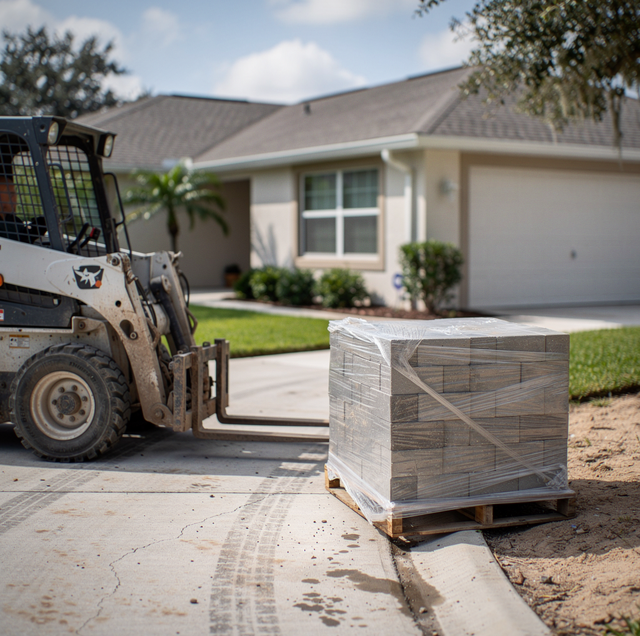
The delivery truck sets two or three pallets down at the curb or the edge of the driveway, wherever its own wheels can still reach pavement, and pulls away. What's left behind is a stack of shrink-wrapped pavers, rolled sod, bagged mulch, or landscaping stone weighing well past what two people can carry by hand, and it has to get from that spot to wherever the job is: a patio pad in the backyard, a bed along the back fence, a low spot that needs filling. A hand truck can carry a few bags at a time. Getting it there calls for something that can lift heavy loads, carry them low across turf without tearing it up, and still fit through whatever gate or side yard stands between the curb and the job.
Letting the Forks Do the Carrying
A pallet fork attachment locks onto the loader's quick-attach plate in place of a bucket or grapple, changing the job from hauling to lifting. Two steel tines, spaced to slide into the openings every standard pallet is built around, go in at ground level and lift a stacked load as one rigid unit instead of handling bags or stones piece by piece. Because the tines run the length of the pallet and support it along its full base, the load rides level front to back as the loader backs away from the curb, rather than tipping forward the way a hand truck does under a few hundred pounds stacked high. Swapping the forks on for a bucket or a grapple takes a few minutes at the trailer, so the same loader that spreads gravel or loads brush on one job handles the pallet move on the next without a separate machine showing up.
The Real Weight of a Loaded Pallet
The reason this job outgrows a hand truck so quickly is the weight already on the pallet before anyone touches it. A pallet of concrete pavers commonly runs 2,900 to 3,100 pounds once it's fully banded and shrink-wrapped. A pallet of sod lands at a lighter per-square-foot weight but still commonly falls between 2,000 and 3,000 pounds, depending on how wet the turf and the soil clinging to its roots are. Bagged mulch lands near the lower end of that range, and bagged landscaping stone can run heavier than either. Every one of those figures sits above what a compact loader is rated to lift at once, and that shapes the rest of the job. None of those numbers leave room to carry the material by hand past the driveway, and all of them are well above what a person, or even two people together, can move any real distance without a machine doing the lifting.
Rated Capacity Carries a Built-In Margin
A stand-on loader narrow enough for a 36-inch gate carries a rated operating capacity of about 1,000 pounds, set at 35 percent of the load that would tip it forward, so the machine stays stable while it moves, turns and crosses uneven ground with weight on the forks. A full pallet of pavers or sod weighs two to three times that rating, and no driving method makes that load acceptable: carrying it low and slow does not change what the machine is rated to hold. The pallet gets split instead. At the curb, the crew cuts the bands and restacks the material into smaller stacks on separate bases, each under the loader's rating, which comes to three or four stacks for a full paver pallet. The loader carries those one at a time at a walking pace. Where the route is wide open, a full-size skid steer with a higher rating can carry the material in fewer, heavier sections, but that machine will not fit through a walk gate.
A load raised high or swung through a sharp turn can tip a mini skid steer forward even under its rating. The operator keeps each fork load a few inches off the ground, slows before every turn, and keeps people clear.
When the Gate Is Narrower Than the Load
The loader is 36 inches wide, narrow enough to thread a standard backyard gate without pulling a fence post. A standard pallet doesn't share that dimension. Its footprint runs noticeably wider than the loader, wide enough that a gate opening sized for the machine won't clear a load built on one. Since a full pallet gets split for weight anyway, the gate only decides how each section is built: restacked on a base narrow enough to clear the opening, such as a half-width pallet or a pair of boards, rather than on a full-size pallet. A wider side yard or a double gate removes the width problem but not the weight one, so the load still crosses in sections sized to the loader's rating.
Steel or poly strapping under tension can snap back sharply when cut. The crew cuts from the side, keeps a hand clear of the strap's path, and lets each band go slack before pulling it free.
Walking the Route Before the First Lift
Before the forks go anywhere near the pallet, the actual path from curb to backyard gets walked on foot. That walk checks three things: the narrowest point the load has to pass through, how narrow each split section's base has to be to clear the gate or side yard, and what the ground looks like along the entire route rather than just at the gate. A straight shot across a flat, firm yard is a different job than a route that doglegs around a pool cage corner or crosses a soft low spot partway through. Picking the shortest straight line that still clears every pinch point before the first lift means every loaded pass follows a route already proven, rather than a trip that starts and backs out partway through to find another way around.
Crossing the Yard Without Leaving a Mark
Each fork load adds real weight to what the tracks are carrying, stacked on top of the loader's own weight, and that extra load pushes more pressure into the same strip of ground the tracks were already resting on. The unloaded machine already runs light underfoot, about half what a person walking across the same lawn exerts, but a loaded pass across the lawn isn't the same crossing as an empty one. Sandy soil that's gone soft after a few days of rain can rut under that loaded pass, or even under a hand-pushed pallet jack trying to cover the same stretch, while the same route over soil that's dry and firm all the way through carries the same weight and leaves nothing behind. That difference is why the route gets walked, and the ground checked first, so the path chosen is one the soil can hold on the day of the move, not just the shortest one on paper.
Setting the Load Down Where It's Needed
The last few feet of the job matter as much as the first. Lowering the forks to set each section flat on the ground, rather than dropping the last inch, keeps its baseboards from cracking and keeps the stack from shifting out of square. Backing the machine out from under a section already resting on the ground, instead of lifting the tines out from underneath it, avoids catching a corner board on the way out. Once the last section is down, the material sits where the job needs it, close enough to the patio base, the planting bed, or the fill area that none of it needs a second move to get within reach.
A pallet move comes down to two limits: what the machine is rated to lift and what the route can carry. Split the load to fit the first, pick the path for the second, and have the material reach the patio base or the bed in a few clean passes instead of dozens of trips with a hand truck.
Frequently Asked Questions
On some compact loaders, the pallet forks carry a higher rating than the machine itself, around 1,200 pounds against the loader's 1,000. The lower of the two numbers always governs, so forks that can hold more never raise what a single lift carries.
Yes, though not by much. A full pallet of two-cubic-foot mulch bags is built from around 65 bags at 30 to 35 pounds each, landing the whole pallet between roughly 2,000 and 2,275 pounds, close to the lighter end of a sod or paver pallet rather than meaningfully under it.
A full pallet of bagged landscaping stone can weigh from about a ton to two tons, depending on the stone and the bag count, so the heaviest stone pallets weigh more than a paver pallet and require one more fork load to move than pavers do.
That plate is a spill guard, built to stop a loosely stacked load from sliding backward toward the operator platform as the forks tilt during a lift. It matters most on a load that isn't fully banded, like a bagged pallet with a torn wrap, where gravity alone would otherwise walk material back off the tines mid-lift.
The loader's own operating weight, unloaded, runs around 3,035 pounds. Adding a fork load near its 1,000-pound rating pushes the total on the tracks up by about a third, raising ground pressure by a similar share, even though the number stays in the single digits of pounds per square inch.
Not through the narrowest one. A standard pallet's footprint is close to 48 by 40 inches, wider than the 36-inch gate opening the loader threads through, with almost nothing to spare. Where that is the only access point, each split section goes onto a base narrower than the opening it moves through.
Schedule a pallet move with the mini skid steer — get pavers, sod, mulch, or stone carried from the curb to exactly where the job needs it. Polk Services LLC serves Lakeland, Highland City, and Mulberry. Call (863) 344-5806.