

What Goes Back into a Pool Cavity, and Why It Takes Less Fill
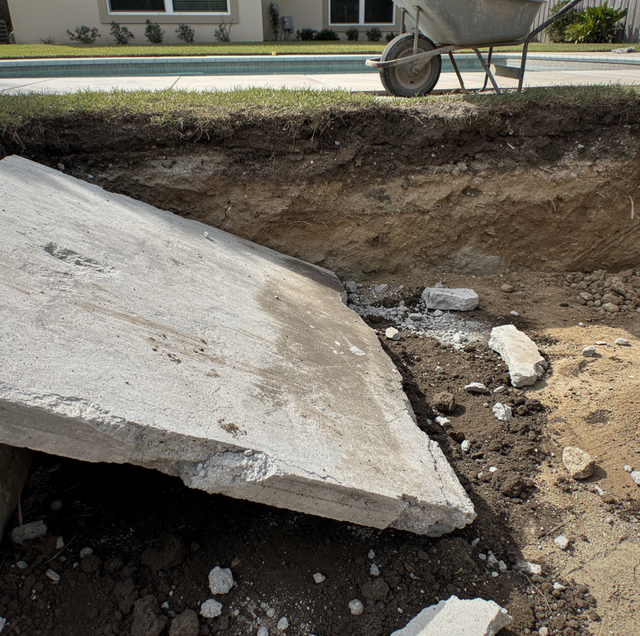
Fill in an in-ground pool and the cavity takes less imported dirt than the pool held water. That runs against intuition, because the two volumes look like they should match: the hole is the hole, water filled it, so dirt ought to fill it too. What breaks the arithmetic is that the shell does not leave. The concrete that used to be the walls and floor ends up inside the pool, and every cubic foot of it is a cubic foot no truck has to deliver.
That single fact explains most of what happens on demolition day, and it explains the question owners usually ask second: what actually goes back in, and what does not belong down there at all.
Where the Missing Volume Goes
Before anything gets broken, holes are jackhammered through the shell's floor. Any remaining water drains out through them rather than sitting under the work. Where a floor slab stays in the ground rather than being broken out, those same openings are what stop it from working as a bowl once fill is on top of it. An intact shell left underground holds water. A shell with its floor perforated is just buried concrete.
Then the deck comes up, and the shell comes apart, and both go into the hole. This is the displacement people underestimate: solid material takes up space the same way your body raises the water when you get into a bathtub, except here the concrete is displacing dirt that would otherwise have to be hauled in. The imported fill a cavity needs is the volume of the hole minus the volume of everything already sitting in it.
It is also why a full removal does not generate the truck traffic people brace for. Most of the material stays on the property rather than being loaded onto one truck and replaced by another. How big the difference is depends on the size of the deck and the area and thickness of the shell, which is worked out on site rather than read off a chart.
What the Broken Shell and Deck Contribute
Concrete only displaces fill if it actually fills space, and that depends on how small the pieces are. Large slabs dropped in the whole bridge against each other, leaving open pockets underneath. Pieces are broken down so they nest rather than span, and so dirt can work its way between them.
Voids matter more than they sound like they should, and sandy ground makes them worse. Soil with little clay in it has almost no cohesion, so it runs into any opening it finds rather than arching over the top. The surface drops as loose material migrates down into the gaps. Breaking the debris down small enough that it nests rather than bridging is what makes the following compaction effective. A compactor cannot close a void that a spanning slab is holding open.
Plumbing is the other buried void. Suction and return lines run out from the shell, under the deck, and into the yard, and a length of abandoned pipe is a small tunnel waiting to crush. Accessible lines are pulled during demolition, and those running beyond the work area are noted on the way out so nobody has to guess later.
If you have an old plan of the plumbing runs or remember where the lines cross the yard, say so before the machines arrive. Accessible lines get pulled; the ones nobody knows about are the ones that collapse later.
What Clean Fill Means in Practice
Clean fill is a plain description rather than a technical grade: dirt with nothing in it that will rot, compress, or turn into a hollow. Three kinds of material fail that test.
What separates fill from spoil is covered in its own right elsewhere on this site, so the short version applies here: anything that rots, compresses, or holds a hollow is not structural fill. Organic material is the obvious case, and a cavity is the worst possible place to bury the tree you also took down.
Buried stumps, roots and yard waste rot away over the years and leave voids under whatever you put on the surface. A cavity is the worst possible place to bury the tree you also took down.
Two consequences are specific to a pool cavity rather than to fill in general. Oversized rock creates exactly the problem an unbroken slab does: it bridges, holds a void open under itself, and stops the material around it knitting together, which matters far more here than in a shallow yard repair because there is broken concrete already doing the same thing. And the dirt already sitting on the property does not automatically qualify. Spoil from another excavation may be sound subsoil or it may be laced with roots and topsoil, and on a cavity this deep that is a look-at-it judgment made on the day rather than an assumption carried over from the last job.
What Goes on Top of the Debris
Once the debris is in and the gaps around it are filled, clean fill dirt brings the site back up to the grade of the surrounding yard. It doesn't go in as one deep pour. Fill is placed and compacted in 6- to 8-inch lifts, with each layer compacted before the next is placed.
The last pass is grading, and the target is drainage rather than flatness. Surface water has to run away from the house, which usually means the finished footprint carries a slight fall in the direction the rest of the yard already sheds. A perfectly level patch that ponds is a worse result than a gently sloped one that drains.
A pool cavity is a different problem from a low spot in a yard, and the two get talked about as though they were the same. A low spot is shallow, sits on ground that was never disturbed, and needs material added to a surface. A cavity is deep, sits on a layer of broken concrete, and has a perimeter where new fill meets undisturbed soil the whole way around. That perimeter is where a filled pool announces itself years later if the transition was sloppy, and it is why the edges get as much attention as the middle.
The finished result is meant to be usable ground: lawn, planting beds, a patio or other hardscape. What it takes to make it a base for a structure is the subject of the next section.
What Changes If a Structure Is Coming Later
Say what the space is for before the first hole gets drilled, because the intended use changes decisions that cannot be revisited once the shell is buried.
What demolition controls is what ends up down there. The requirements for anything with a foundation are set by whoever designs and builds that structure, not by the crew filling the hole. Where a slab is coming, the answer is often to haul more of the shell off the property and import more fill instead, deliberately trading away the displacement advantage in ground exchange that is uniform the whole way across.
That trade is the whole reason to understand where the volume goes. Burying debris is what keeps imported fill down. Hauling debris is what makes the ground beneath more uniform. Which way a job leans is a decision about the future of that footprint, made before demolition starts rather than discovered afterward.
Frequently Asked Questions
They come out with the wall they are cast into rather than being unthreaded first. A skimmer throat is a molded box set through the shell wall with the deck poured up against it, so it arrives in the cavity as part of a broken wall section. The fittings matter less for what they are than for what they are attached to: each one is the end of a buried line, so finding them is how the runs heading out into the yard get traced before the fill goes in.
Yes. Steel reinforcement remains bound in the concrete it was cast into, and unlike organic material, it doesn't lose volume, so it leaves no voids behind. Tile, plaster, and coping stone go in alongside it; none of them are salvageable once the wall they are bonded to is being broken. The one thing to watch is a bar protruding from a broken piece, which can prop two chunks apart and hold an opening under them, so those pieces get broken down further.
Fiberglass is handled case by case, and the volume math changes. A fiberglass shell is a thin laminate, so it contributes a fraction of what a gunite shell of the same size would, and the displacement advantage largely disappears. Expect the plan to lean more on imported fill, and expect the shell to be cut apart rather than jackhammered.
The starting point shifts from demolition to water removal. The level is pumped down before a machine works near the edge, and the drainage holes are cut once the floor is reachable. The sludge and leaf litter on the floor are organic material, so it comes out rather than getting sealed under the fill where it would rot.
Sod is a common finish and can go down once the final grade is set. If you are adding irrigation, have your installer run the lines while the grading is still open rather than trenching across the footprint afterward. The first few weeks of watering are when any weakness at the perimeter, where new fill meets undisturbed yard, tends to show.
The main drain line under the deep end is the usual exception, and leaving it is a deliberate call rather than an oversight: chasing it means digging below the cavity floor. What matters is that it does not stay as an open tunnel. It is cut, capped at both ends, and crushed or filled where it can be reached, so it cannot hold a void under the tallest part of the fill.
It helps to see the cavity as two problems stacked on each other. The lower one is about debris: how much concrete stays, how small it gets broken down, and how completely the gaps between pieces get closed up. The upper one is about dirt: what material quality goes over it and how it is placed. The arithmetic that surprises people, the cavity taking less imported fill than the pool held water, is really just the first problem quietly solving part of the second.
Thinking about removing an in-ground pool — get the shell demolished, the cavity filled and compacted, and the site graded to drain by an owner-operated crew. Polk Services LLC serves Lakeland, Highland City, and Mulberry. Call (863) 344-5806.
