
Where is all the brush going to go? That is the question that decides what a clearing job costs, and it is almost never the first one anybody asks.
Mulch It, Haul It, or Burn It
Every clearing job ends the same way: the vegetation that was standing up is now lying down, and somebody has to deal with it. These are the only three answers.
The honest version of the trade-off is this. Mulching keeps everything on the property, so there is no trailer and no scale ticket. Hauling brings both back, and it is the only answer when the material has to be gone rather than lying there. Burning looks like the simple route and almost never is.
Inside the City, Burning Is Off the Table
The City of Bartow's Fire Department publishes a standing position on its website: until further notice, there is to be no burning within the city limits of Bartow, which expressly includes lawn trash and any type of recreational fire. It is written as an open-ended prohibition, and it names no exception for a contractor clearing a lot. If you want it confirmed for a specific job, the Fire Department is who confirms it.
So, for a city address, the material is either mulched where it lies or loaded onto a trailer. That is worth knowing before you compare quotes, because a number that only works if the pile gets lit is not a number you can use in 33830.
Outside the line, the state rule is stricter than most people expect
On rural ground beyond the city limits, burning land-clearing debris is possible, and it is conditioned in ways that surprise people. Florida rule requires that the burning remain on the site where the debris was generated, so material cannot be carted to a back parcel to be lit. The Florida Forest Service has to be contacted before the burn, and unlike an ordinary household brush pile, there is no eight-foot-pile allowance that lets you skip that step. The setbacks are the Forest Service's, and for a residential land-clearing burn they run 300 feet from an occupied building other than the landowner's, 50 feet from wildlands, brush or a combustible structure, and 100 feet from a paved public road.
Those are not the numbers a homeowner burning yard trimmings works to. That case falls under a different rule chapter: 25 feet from wildlands, brush, or a combustible structure; 50 feet from a paved public road; and 150 feet from an occupied building other than the burner's, with the pile capped at 8 feet across. A cleared lot and a brush pile are different categories with different distances and different obligations, so what a neighbor does with yard trimmings is no guide. On a typical rural residential parcel, the setbacks alone decide the question before anyone gets to the weather.
Meeting the setbacks is not the last check either. Polk County has its own burn ban ordinance that can close burning across the county when conditions warrant, and it applies to unincorporated land regardless of distance. Whether a county-declared ban also reaches inside a given municipality turns on that municipality's own governing decision. So, on rural ground, the current county status and the geometry have to be checked as well.
Stumps left standing after the clear? → Stump Grinding →
Clearing Questions People Ask Before They Book
Can I just burn it myself and save the haul-off?
What is the difference between mulching and hauling, in plain terms?
Will it grow back?
Can you keep specific trees?
Do you need a permit to clear a lot in Bartow?
What the Job Looks Like at Each Scale, and What Sets the Number
The Overgrown City Lot
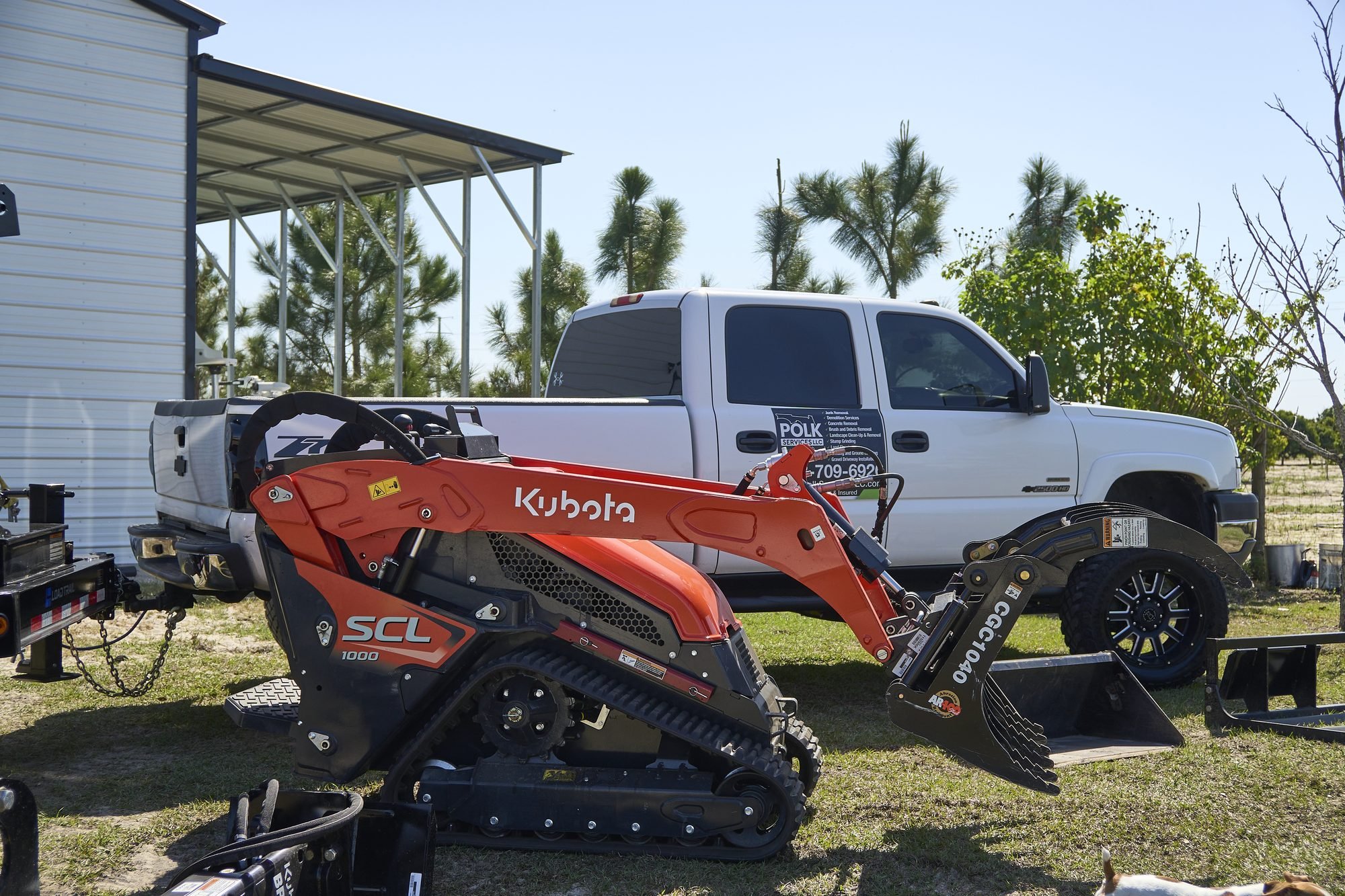
A vacant or neglected parcel inside 33830, usually fenced, usually reached through a gate. The 36-inch Kubota gets in without taking the fence apart, and the material goes out by trailer.
Pasture and Rural Acreage
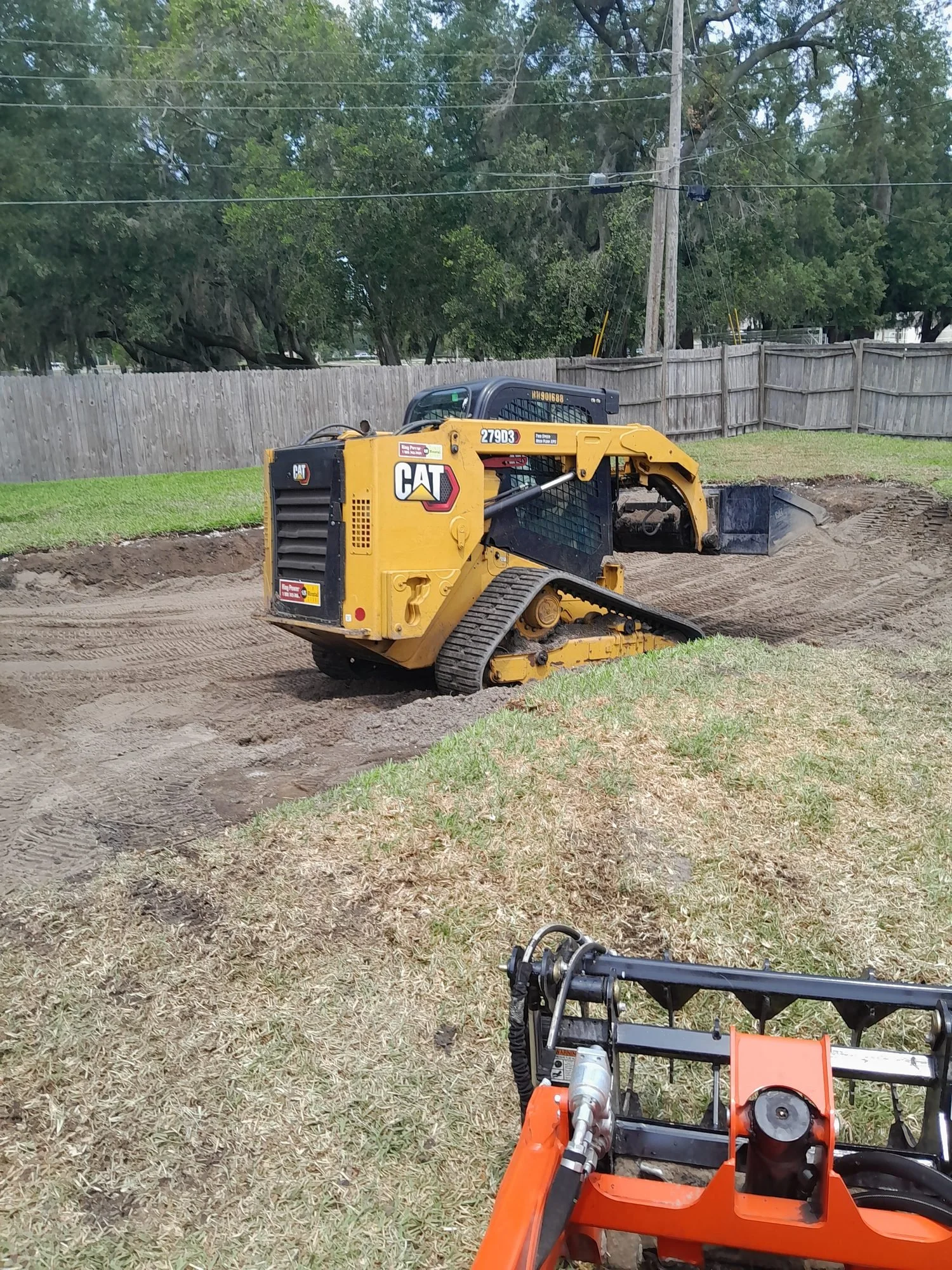
Open ground where the work is volume across distance. The full-size Caterpillar runs it, and mulching in place is far more often the right finish because there is somewhere for it to sit.
Pre-Build Site Prep
Clearing to a defined footprint ahead of another trade, cut to a line you set and left at a grade the next crew can work from.
Selective Clearing
Take the undergrowth, keep the oaks. Marked at the walk, agreed before the machine starts, and worth being specific about because it cannot be undone.
What Comes After
Stumps are their own job and their own price. So is grading the cleared ground. Both are quoted separately so you can see what you are buying.
What Routes Elsewhere
Anything requiring a certified arborist, and any tree beyond the light-duty scope, is noted in the estimate and sent to the appropriate trade.
What Moves the Number, and Why the Exit Route Is the Biggest of Them
Clearing is quoted per project. Five things move the number: how much ground it covers, how thick the growth has gotten, what is actually in it, how the machine gets to it, and where the material goes when it leaves. On a dense lot, that last one can be the largest. Hauling is billed against the loads that leave, starting at the $300 minimum for the first four cubic yards. Open ground that needs machine hours more than it needs hauling runs at the skid-steer rate: $300 for the first hour or two, and $100 an hour after. Density is the variable people under-read, so the walk matters more on a clearing quote than on almost anything else Polk Services does.
The Polk Services Standard on every clearing job
Donny walks the job with you before he leaves, rakes the work area clean before he drives off, texts you 30 minutes before arrival, and gives you both a verbal and a written quote up front. No sub-crews, no surprise pricing, and the site left ready for whatever comes next.
Payment and scheduling
Cash, check, card, and electronic payment accepted. No processing fee on cash or check; Donny states the card fee when he quotes. Same-day and next-day scheduling is common in Bartow when the calendar allows. On rural jobs where burning is part of the plan, the date also has to clear whatever the county burn status is that week, which is not something anyone can promise in advance.