
Grading is the one service where the estimate is partly a guess about what is under the grass. In a city settled in 1851, where much of the housing predates 1980, that guess has more history to get wrong than it does in a subdivision built in the last decade.
Every Grade Is an Answer to One Question: Where Does the Water End Up?
Leveling a yard by eye is easy, and it is also how yards get worse. A finished grade has to send water somewhere deliberate: away from the neighbor's ground and away from the slab you just paid to replace, and not back into the low spot it came from. That decision gets made standing on the lot with a line of sight down the fall, before any dirt moves.
The rulebook side is easy to misread. Bartow's land development code adopts Polk County's stormwater quality ordinance by reference, and the city code's own soil-conservation measures apply to development that requires site plan or subdivision review. Whether a particular yard job falls inside that is the city's call, and its planning and building staff are the ones who make it. Donny raises it at the estimate whenever scale, slope, or distance to water makes it live.
Near the Peace River it changes again. Bartow's floodplain rules are keyed to the Flood Insurance Study for Polk County, effective December 22, 2016, so on riverside ground, the elevation question comes before the grading question. Where the maps put a specific parcel is the city's determination, and not a contractor's. What Donny will do is flag it and point you at that determination before a blade goes in the ground.
Six Things Bartow Ground Turns Up, and What Each One Does to the Grade
The Footprint of Something That Used to Be There
Bartow lots have had sheds, garages, and carports come and go for decades. What stays behind is a slab edge, a footing, or a pocket of rubble backfill. It has to come out, or the grade sits on a hard spot, and the turf tells on it within a season.
An Old Drive Base Nobody Removed
Limerock or shell base from a driveway that was abandoned, never dug out. It grades hard, sheds water the wrong way, and it is a different job from cutting native ground.
Fill of Unknown Origin
Ground brought in years ago to build a lot up. Sometimes clean, sometimes half construction debris. What it turns out to be decides whether it can be regraded in place or has to leave, and that is the biggest single swing in a grading quote.
Live Oak Root Plates
The roots that lift Bartow driveways also sit shallow and wide under lawns. The grade goes around a root plate, never through it, and where a cut would go close to a trunk that is a tree decision before it is a dirt decision.
Mined Ground, South and West
On the Bone Valley side, whether a parcel was mined and when are matters of record. Land mined before 1 July 1975 was never required to be reclaimed; land mined after that date had to be contoured, revegetated, and returned to standard under Florida law.
Water Already Doing Something
Much of what looks like a leveling problem is a routing problem that has been running for years. Grade the low spot flat without changing where the water arrives from, and the puddle moves a few feet.
On the mined-land question, check rather than guess
Florida's phosphate district covers a good deal of ground south and west of Bartow. The Florida Department of Environmental Protection publishes a parcel-level map showing whether ground was ever mined. It is free, and it takes minutes. Polk Services will not tell you your ground is unstable, because the published record supports no blanket claim like that. What the answer changes is what the machine expects to find.
Root-lifted concrete on the same property? → Concrete Demolition in Bartow →
The Questions Bartow Owners Actually Ask About Grading
The yard was graded two years ago, and it is low again. What went wrong?
Can you bring fill in, or only move what is here?
We just had a shed and its slab taken out. Is the footprint a separate job?
Will the machine tear up the lawn getting to the back?
The Right Machine Is Usually the Smaller One
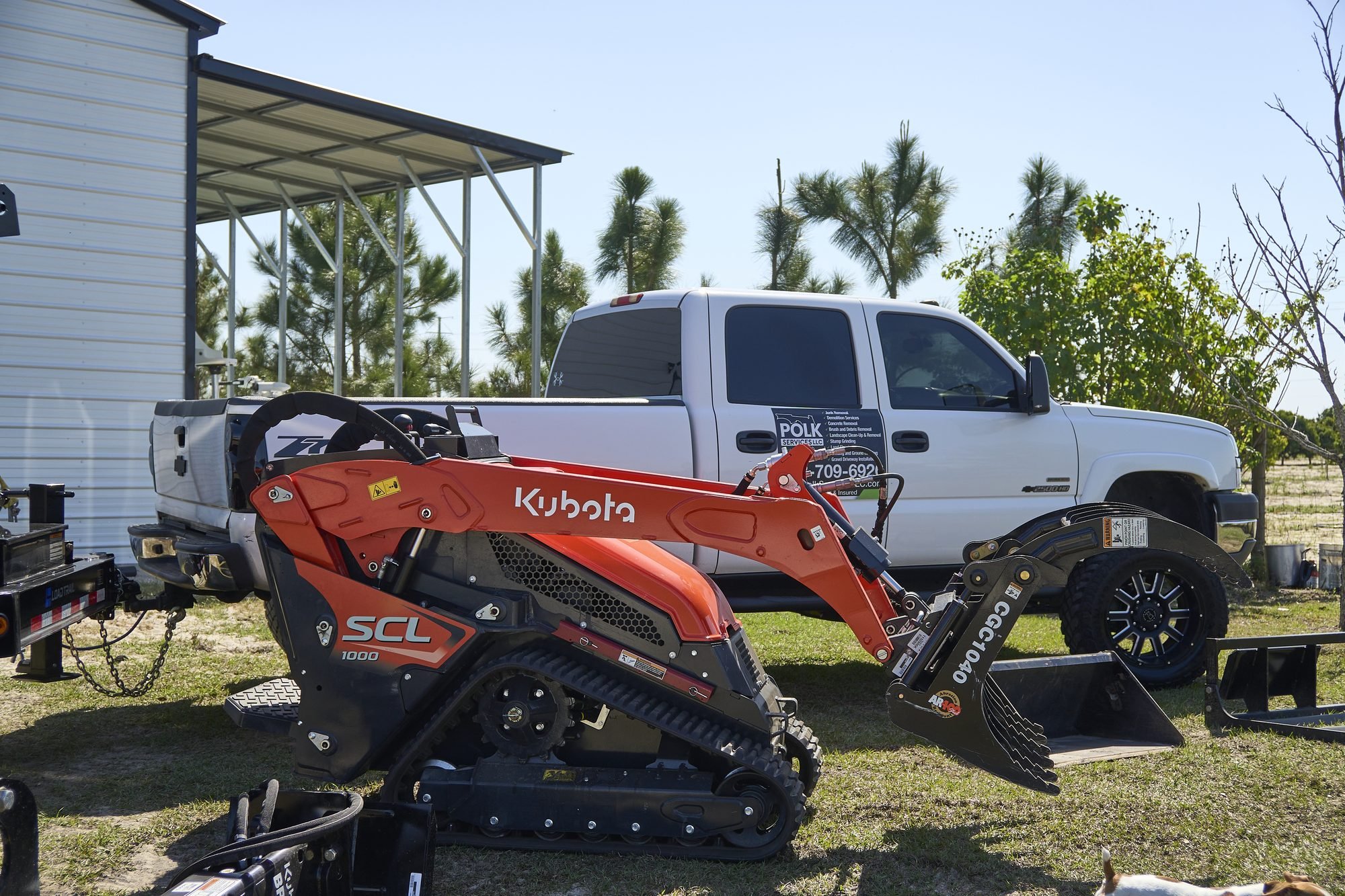
In a damp Bartow backyard, the Kubota SCL1000's four pounds per square inch is the difference between grading a lawn and printing tracks into it that then need to be graded themselves. It also happens to be narrow enough for the gate at the side of the house.
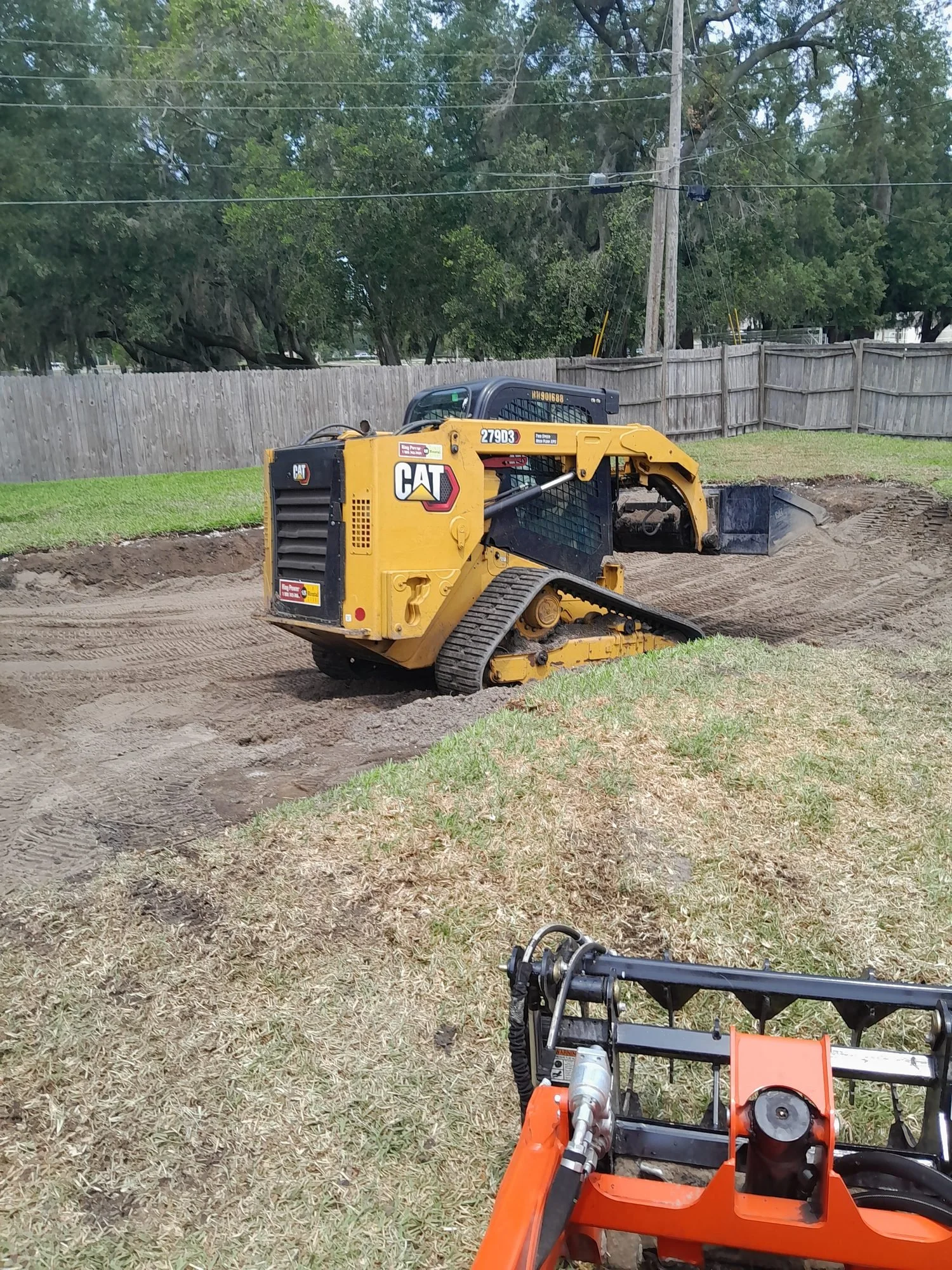
Open ground is a different animal. Acreage out toward the Mulberry line and the rural ground south of Bartow gets the full-size Caterpillar, where the work is moving volume across distance. Donny picks the machine at the walk-over and says why.
Finish matters as much as cut. Ground gets compacted during lifts and is never smoothed over in one pass, which is why a grade holds through a wet season and does not settle back into its original shape. Where sod or seed follows, the surface is left ready for it.
Quoted Per Job, Because No Two Yards Hide the Same Things
Grading is quoted per project, never off a rate card, for the reason this whole page is about: the number depends on what is under the grass. On ground that is already clear, skid steer work starts at a $300 minimum covering the first one to two hours and runs at $100 per hour after that. Where material has to be hauled, hauling is priced by the load, with a $300 minimum for the first four cubic yards, and concrete or dirt priced by weight rather than volume. What the walk-over cannot settle is named as an unknown in the estimate, so a surprise is a line item, not an argument.
The Polk Services Standard on every grading job
Donny walks the job with you before he leaves, rakes the work area clean before he drives off, texts you 30 minutes before arrival, and gives you both a verbal and a written quote up front. No sub-crews, no surprise pricing, and the site left ready for whatever comes next.
Payment and scheduling
Cash, check, card, and electronic payment accepted. No processing fee on cash or check; Donny states the card fee when he quotes. Same-day and next-day scheduling is common in Bartow when the calendar allows, and rural parcel work is scheduled around ground conditions, never squeezed into a wet week.