
Stand on your driveway in daylight before you call anyone. If the break is a ridge with one side sitting higher than the other, and there is a mature oak near it, you already know most of what this page has to tell you.
What the Crack Is Telling You
Concrete fails in patterns, and those patterns are diagnostic. Walk out and look at the slab in daylight, then find the closest match below. This is not a substitute for someone standing on the driveway, but it is usually enough to know what conversation you are about to have.
The first row is the Bartow one. On streets where the canopy meets overhead, the heaved-ridge pattern is the common call.
Five Times the Trunk, and Why That Number Governs the Job
University of Florida extension guidance on live oaks is blunt about the cause: a tree planted too close to a curb, sidewalk or driveway grows roots large enough to lift and crack the surface. The number that matters on demolition day comes from somewhere else. Arboricultural guidance warns against cutting any root closer to the trunk than five times the trunk's diameter.
Run that on a real Bartow front yard. A live oak with a two-foot trunk puts the caution line about ten feet out. Inside that circle, cutting the root that lifted your driveway is not a concrete decision anymore. It is a decision about the tree, and it belongs to you and, where the tree matters enough, to an arborist as much as to the person running the breaker.
What Polk Services does with that
Donny locates the root before the slab comes out, so the break can be sequenced around it. Where the root sits outside the caution distance, and the tree is not in question, the work is ordinary. Where it sits inside, he says so in the estimate and lays out the options, including those that do not involve cutting anything.
What is not stopping the root being cut
It would be easy to assume that a city ordinance is what prevents the root from being cut. In Bartow, there is no diameter-based tree ordinance that applies to private ground, and that was checked against the code itself. Utility easements, recorded covenants, and a homeowners association can still have something to say, and the city planning office is the one who confirms that. What does not change either way is the arboricultural limit, which determines whether the new slab will still be flat in five years.
Driveway and Slab Questions, Answered Straight
My driveway is lifted by an oak root. Can you just cut the root?
If I replace the driveway, will it lift again?
Do you handle the piece out by the street?
What about rebar or a slab poured over an older one?
Can you break it out and leave the base ready for what comes next?
Scope, Access and the Disposal Side
Anything that involves breaking ground gets a Sunshine 811 notification before the machine starts. House-scale structural foundation demolition is outside what Polk Services takes on and routes to a licensed demolition contractor.
Driveways, Aprons and Walks
Full residential driveways, aprons, and front and side walkways, including the narrow older pours common on Bartow's pre-war streets.
Patios, Pool Decks and Slabs
Rear patios, pool decking, shed and utility pads, and old carport slabs, broken out and cleared to grade.
Low Walls and Steps
Block and poured retaining edges, planter walls, and front steps, taken down and hauled with the rest of the load.
Access Behind the House
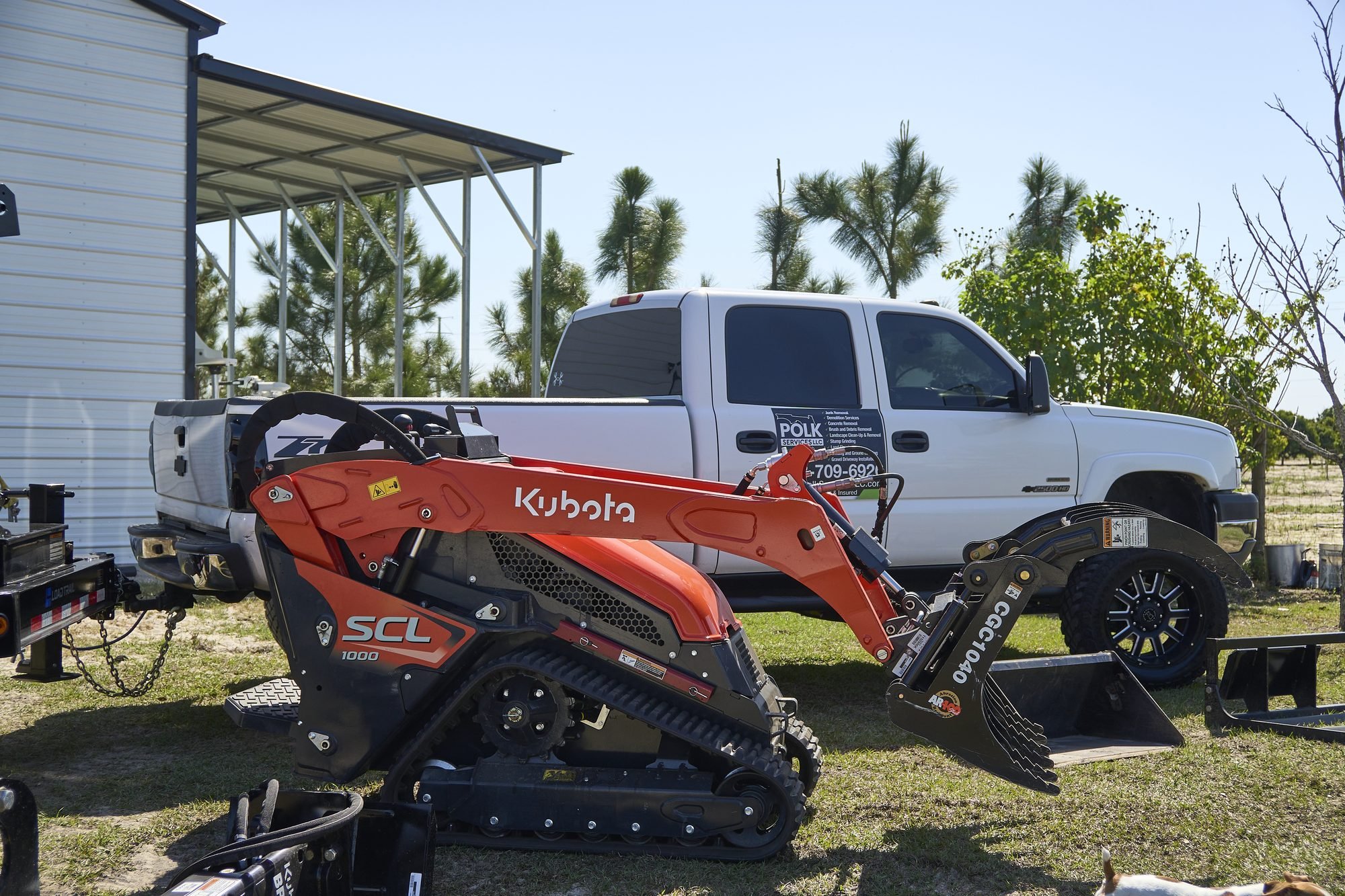
A rear patio or pool deck does not have to start with dismantling a fence. The mini skid steer is built narrow enough to fit through the existing gate.
Reinforced and Layered Pours
Rebar, mesh, and a second pour over an older one all add time and weight. All three get identified at the estimate and priced there.
Where the Material Goes
Clean concrete is accepted for recycling; a load with soil, wood, or trash mixed into it is not, and goes to the landfill as mixed debris. That is why Donny sorts as he loads and not after.
Priced on the Slab, Because Weight Decides It
Concrete is priced as heavy material, from a $500 minimum for the first four cubic yards, because weight, not volume, governs hauling and disposal. Thickness, reinforcement, and a second pour over an older one all move that number, which is why it gets set on the slab. On the day, the slab comes out in sections, goes into the trailer as it comes up, and the opening is left graded rather than as a hole with a pile beside it.
The Polk Services Standard on every concrete job
Donny walks the job with you before he leaves, rakes the work area clean before he drives off, texts you 30 minutes before arrival, and gives you both a verbal and a written quote up front. No sub-crews, no surprise pricing, and the site left ready for whatever comes next.
Payment and scheduling
Cash, check, card, and electronic payment accepted. No processing fee on cash or check; Donny states the card fee when he quotes. Same-day and next-day scheduling is common in Bartow when the calendar allows, though a slab that needs an arborist to look at the root first is scheduled around that visit.