

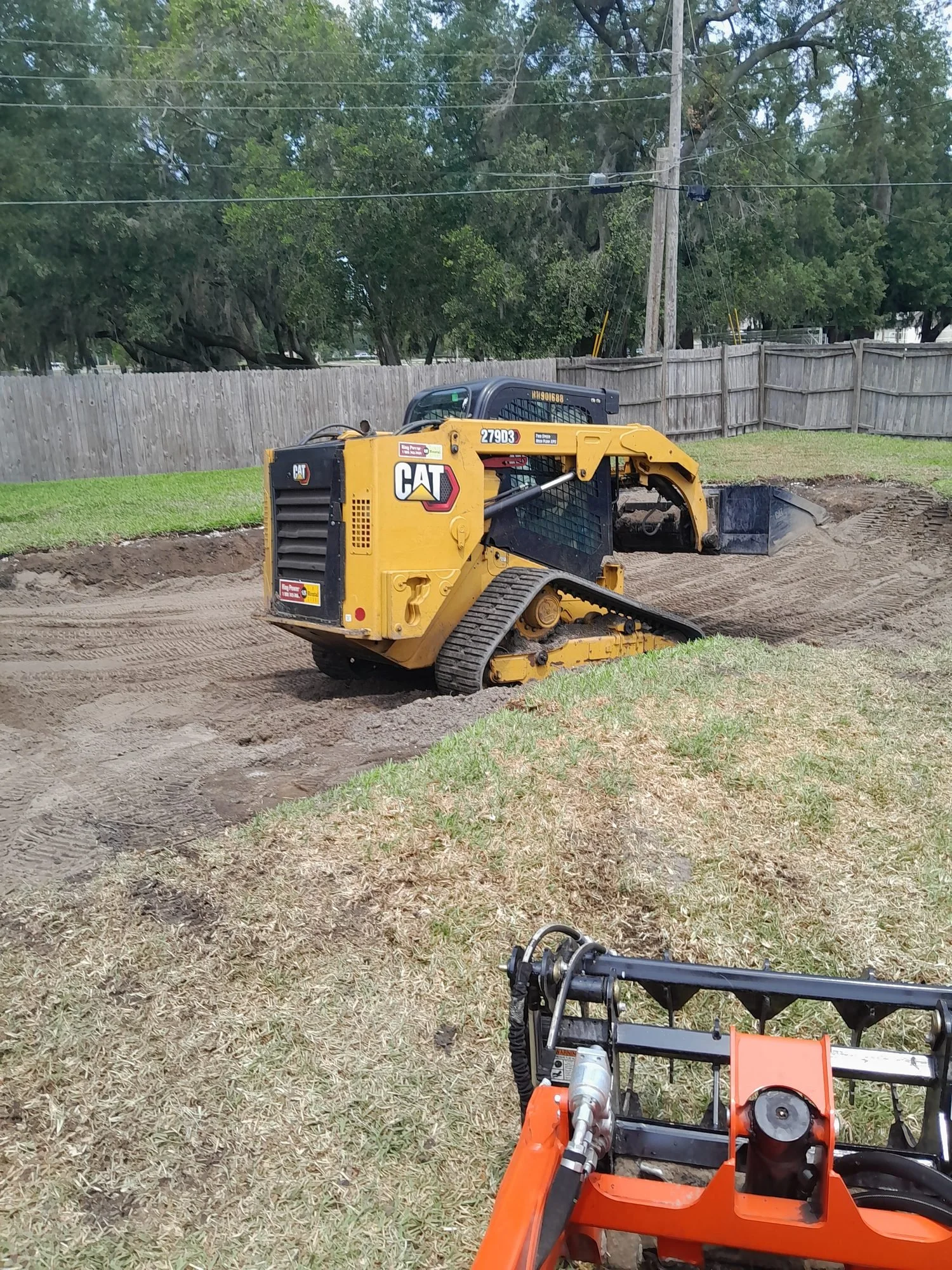
Nine in ten housing units in the Fish Hawk census area were built in 2000 or later, and the median one went up in 2009. That is a young neighborhood by any measure, and it produces a situation you do not get in an older town: the play structure in the back yard is very often older than the house standing behind it.
There Is No Permit, and No Agency Is Telling You to Take It Out
The building code puts play equipment outside its own scope
The Florida Building Code says it in one line: this section does not apply to swings and other playground equipment accessory to a one- or two-family dwelling. A published Florida code interpretation, informal, non-binding, and subject to your local building official, states that it covers the equipment, whether for initial installation or any other work, including repairs, removal, and relocation. So, on the face of it, there is no permit to put one up and none to take one down. If you are in an attached townhome and not a detached or duplex home, the exemption is written around one- and two-family dwellings, so a call to Development Services is worth five minutes.
No agency recommends removal either
Worth saying plainly, because the internet is full of the opposite. For structures built from arsenically treated wood, the EPA's position is that it does not require the removal of existing structures or surrounding soil. The Consumer Product Safety Commission voted unanimously to deny a petition to ban the equipment, and its standing advice to parents is to wash children's hands with soap and water immediately after they play on it. EPA adds that a penetrating coating applied regularly may reduce leaching.
Your backyard set is not held to a playground standard
The CPSC's Public Playground Safety Handbook explicitly excludes home playground equipment from its scope. The standard for home equipment is a voluntary consumer performance specification aimed at manufacturers and places no obligation on a homeowner.
Which leaves the real reasons, all of them good ones
The children are done with it. The yard is worth more as yard. The wood has gone soft at the ground line. The house is going on the market, and a fifteen-year-old fort is not what you want in the listing photographs. None of those is a compliance problem. The one approval that is real in FishHawk is your association's architectural control committee, which governs what changes you can make to your lot.
One County Rule Closes the Free Route, and No Test Reopens It
The exclusion is written by name
Hillsborough's residential yard and wood waste rules say the material must be free of paint, glue, and wood preservatives or treatments, and the accepted-items list adds no varnished, painted, or treated wood. A treated-lumber play structure is excluded from that stream in those words. Burning is not an alternative either, in subdivisions or on acreage: Florida's open burning rule lists treated wood among the materials that may not be burned openly.
You cannot tell by looking, which is the whole problem
The state's own guidance says that weathered copper-treated wood turns silver, and that untreated wood weathers to nearly the same silver. The indicator stain the state publishes reacts to copper, which modern replacements also contain, so a positive result tells you only copper, not arsenic. The only reliable discriminator is the treatment date, and almost no set still carries its end tag. Nobody on this job can tell you what your lumber is, and anyone who says they can is guessing.
So it is routed as treated wood, and that is the end of it
State guidance is that treated wood be kept separate from clean wood and taken to a lined disposal facility, and that it not be ground up on-site as mulch or a soil amendment. Federally, arsenical-treated wood discarded by the person who used it is excluded from the hazardous waste rules. This is a routing question, and not a hazardous materials event.
There is one honest exception, and the county publishes it
If you are prepared to take the set apart yourself, Hillsborough's bulky curbside list carries disassembled swing sets as a scheduled per-item pickup, and the call has to go in before the pieces reach the curb. What it is not is the yard-waste cart, and a set you have not taken apart is not on that list at all.
One structure, five streams
A play set is not one material. Treated lumber, galvanized hardware, plastic slides and seats, the steel swing beam and chain, and the surfacing underneath. Only one of those is awkward. They are left separated because that is how they have to be handled.
What Is Actually Holding It Down
Anchors on most of them, concrete on some
This surprises people who have priced the job elsewhere. Many mainstream residential wooden sets ship with driven metal ground stakes or spiral ground anchors, and on hard, compact soil that is all the manufacturer calls for. The same manufacturers call for anchors set in concrete on looser soil, which describes many sandy Florida yards, and previous owners add concrete on their own initiative. Concrete under a post roughly doubles the post work, and nothing in a photograph shows you which you have.
Weight is why it is not an errand
Manufacturer specifications for residential wooden sets run from around 150 pounds for a small cedar kit to over 1,100 pounds for a large solid-cedar structure. The same manuals ask for two or three adults and six to twenty-four hours to build one. Taking it down is faster than that, and it is still most of a day.
The Polk Services Standard, on every teardown
Donny walks the job with you before he leaves, rakes the work area clean before he drives off, texts you 30 minutes before arrival, and gives you both a verbal and a written quote up front. No sub-crews, no surprise pricing, and the site left ready for whatever comes next.
Paying for it
Cash, check, card, and electronic payment accepted. No processing fee on cash or check; Donny states the card fee when he quotes. A play structure is a half-day job once the machine is on site, and Donny gives you a morning or an afternoon.
Three Things Worth Settling Before You Book
What if somebody wants it?
Do you take the swings, the slide and the sandbox too?
How do I find out what my wood is?
What Is There the Next Morning
The fall zone is the part people forget, and it is bigger than the thing standing on it. Manufacturer manuals for home equipment call for around nine inches of engineered wood fiber or rubber mulch under a setup up to eight feet, extending six feet in every direction, and in front of and behind the swings out to twice the height of the top beam. Those are also the figures the public-playground guidance uses, which is why the borders on your set were almost certainly built to them. Do the arithmetic, and the surfacing is a larger volume than the structure.
Most people spread it through the beds, because the surfacing is not treated lumber and there is nothing wrong with it. Say so before the quote, not on the day when the trailer is already full.
Then what is left is a bare rectangle, sitting a little lower than the lawn around it, with the grass line showing exactly where the borders were. It will look like that for a season. Nobody puts that photograph on a website, so it is worth saying out loud: you are buying back the space.