

Agricultural Centrifugal Booster Pump Sizing: HP Comes Last
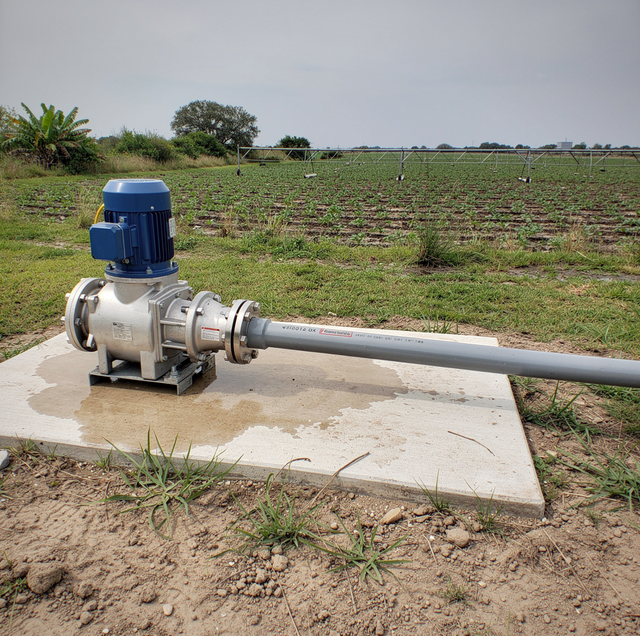
Most sizing conversations open with a horsepower number that somebody already trusts. It came off the nameplate of the unit that just failed, or from a supplier who asked two questions before answering, or from the operator down the road running what looks like the same setup on the same crop. By the time a technician is standing at the pad, the number feels like a decision made months ago that does not need revisiting.
It almost always needs revisiting, for a reason that has nothing to do with who suggested it. Horsepower is not an input to a booster sizing calculation. It is the output. Working backward from it is how a pump ends up mismatched to the field it was bought for.
A centrifugal booster takes water that is already available and raises its pressure to the level needed to run the system at the pressure the crop requires. What that takes comes down to two quantities, and neither one is horsepower. The first is TDH, the total head the pump has to work against, expressed in feet. The second is flow: the gallons per minute the system must move at its busiest moment, then hold for the length of a set.
On farm ground, the two head terms that do most of the work are the ones only a field measurement produces: static lift and discharge friction. What follows takes those two in the order they get added, puts the sum together, then pairs that sum with the flow an irrigation set actually sustains hour after hour.
Static Lift: the Vertical Work That Never Goes Away
Static lift is the simplest term to picture and the easiest one to underestimate. It is the vertical distance between the surface of the water being drawn and the highest point the water has to reach on the discharge side. Gravity sets it, and gravity does not negotiate. Whether the pump is moving a trickle or running flat out, the lift stays the same.
That also makes static lift unique: friction and pressure demand both move when flow moves, and static lift does not. It is the fixed floor under the whole calculation.
Where it goes wrong is the word "highest." On ground that reads as flat from the tailgate, a long run can climb noticeably from one end to the other, and it is the high corner that sets the term, not the average elevation of the field. A rise at the far edge, a hill the mainline crosses, a riser feeding a raised line: all of it counts, and all of it is measured against the water surface rather than against the pump. A booster sized to serve the middle of a field will fall short at its top edge every time the system runs.
Discharge Friction: What the Mainline Takes Back
Water moving through pipe loses energy against the pipe wall, and the pipe gives none of it back. Every foot of run, every elbow, tee, valve, filter, and screen takes a share of the pressure the pump produced. Friction loss is the term for the total, and it is added to TDH exactly as if it were more vertical lift, because the pump cannot tell the difference. A rider climbing into a headwind feels the wind and the grade in the same set of legs; an impeller feels friction and elevation the same way.
Friction is also the term with the least intuitive behavior. It does not scale evenly with flow. Push more gallons per minute through the same line, and friction rises much faster than flow does, which is why a system that behaved acceptably at partial demand can fall apart when everything opens at once. Pipe inner diameter drives it, the length of the mainline drives it, and the interior roughness of the material drives it. Fittings add their own share, so a compact run with many direction changes can lose more than a longer, straighter one.
Friction climbs far faster than flow. A line one size smaller than the design calls for can absorb head the pump was never sized to make, and the outlets furthest from the pump feel it first.
This term also drifts over time. Sediment and fine grit load screens and filters over a season, and a partially clogged element adds friction that was nowhere in the original numbers. That is one reason a technician measures the mainline, counts the fittings, and looks at the filtration in place rather than pulling a figure from a general table. The table describes clean pipe of a stated size. The field has the pipe that is actually buried in it.
Adding the Terms Into One Number
Static lift and friction describe the process of getting water to the far end of the system. One term is left, and it describes what still has to be there when the water arrives. Sprinklers, guns, drip emitters, and micro heads are each built to operate within a stated pressure range, and that requirement applies at the emitter rather than at the pump discharge, which has not yet paid for the lift and the friction ahead of it. Converted to feet of head so it uses the same units as the other two terms, it adds directly.
Add the three, and the result is TDH: one number in feet describing everything the pump has to overcome. In an agricultural system, that sum includes a moving part most people leave out. A sand media or screen filter station is specified with a clean pressure drop and an allowable dirty pressure drop, and the pump has to carry the dirty figure, because that is the condition the station spends most of a season sitting in. Size to the clean number and the system meets its pressure the week it is commissioned, then drifts under it as the season loads the filters.
TDH is calculated, not estimated. Elevation, the buried run, the counted fittings, the filter station, and the head specification are all properties of one specific field, and not one of them can be looked up from a desk.
Continuous-Duty Peak Demand: Gallons at Once, Hour After Hour
Flow is the second half of the sizing problem, and on farm ground it arrives with a duration attached that a household system never has. The pump does not have to serve every emitter on the property. It has to serve every emitter that can be opened at the same instant, at full pressure, without the last one in line starving, and it has to maintain that condition for the entire length of a set.
That makes zoning part of the calculation rather than a detail of the layout. A technician adds up the rated output of everything that can run concurrently, accounts for anything else the same line feeds while irrigation is running, and sizes to that worst case. Edge conditions get counted too: a filter backflush that fires mid-cycle, two blocks opened together during a manual run, a valve sitting in a position nobody recorded on the layout. Peak demand is what the system can do, not what it usually does.
Duration is what separates the agricultural case from every other one. A set running four to eight hours keeps the pump at that duty point continuously rather than briefly touching it and dropping out, so there is no idle interval to carry the heat away, and nothing forgiving about a marginal selection. Margin that an on-off rhythm would absorb somewhere else is carried all day, on the same bearings and the same windings.
Flow and head cannot be solved separately. Raising the gallons per minute a system moves also raises the friction it has to overcome, so both terms are worked out together against the same worst-case simultaneous demand.
What the Sum Actually Decides
Pair TDH in feet with peak-demand flow in gallons per minute and the pair becomes a duty point, a single coordinate of this much water against this much resistance.
That coordinate is what a pump gets selected against. Every centrifugal pump has a performance curve, and the curve slopes: delivering more flow, the same pump makes less head. Sizing means finding a pump whose curve passes through the required duty point in the range where that pump runs efficiently, not at the ragged end of its capability. Horsepower is what it takes to drive that impeller at that point, and it arrives last because it cannot arrive any earlier.
A booster selected that way also leaves a record behind. The measured lift, the run and its fittings, the filter station's dirty pressure drop, and the simultaneous flow the system was sized around are the numbers anyone will want when a block gets added three seasons later. They are far easier to keep than to recreate. A field sized to the math can be checked against the math. A field sized to an inherited nameplate has nothing to check against at all.
Frequently Asked Questions
Yes, and it moves the one term people treat as fixed. Static lift is measured from the water surface, so a surface source standing high in a wet stretch and several feet lower by the end of a dry one hands the booster more lift for the same field, arriving at the point in the season when demand is already highest. A well does the same thing through drawdown while the pump runs. Sizing is taken against the lowest working level the source actually reaches, not the level it stands at on the day of the visit.
It needs the right duty rating, which is a separate question from horsepower. Agricultural pumps commonly run four to eight hours a day throughout the growing season, which is continuous duty in practical terms, not intermittent service. A motor built for the short, occasional cycles of household use will not hold up to that schedule, whatever the nameplate horsepower says. A technician checks the duty classification and the service factor against the hours the operation actually demands.
It changes what wears out first. A centrifugal booster sits in open air taking heat and airborne dust that a submerged pump never encounters, and both are hard on bearings. Grit finds its way into seal faces, sustained heat thins the lubricant film, and bearing clearance opens up long before anything is wrong with the impeller. Keeping the unit shaded, the pad clean, and vegetation off the motor's cooling path all extend the interval between bearing replacements.
They can, and how they are piped decides what you actually gain. Two matched pumps in parallel, both feeding the same manifold, roughly add their flows at the same head, which suits a system whose gallons-per-minute swing widely between one block and everything running. The same two pumps in series, one discharging into the other's suction, add their heads at the same flow, which suits a long climb up a mainline. Arranged the wrong way round, they give neither, and a parallel pair on a system that actually needed head sits off curve just as badly as a single wrong pump.
Read pressure at the last head in the system with everything that can run together running, and compare it against that emitter's published operating range rather than against the gauge at the pump. The discharge gauge will look reasonable long after the far end has stopped performing. A far-end reading that sits below the emitter's stated minimum, while the discharge gauge holds normal, indicates the addition has outrun what the mainline can deliver. Both readings falling together as the extra outlets open says the pump itself has been pushed past its duty point. Take the reading during the longest simultaneous set the schedule allows, since a short manual test rarely reproduces the condition that causes it to starve.
Routinely, the difference is in the impeller rather than the motor. A given pump casing is offered with a range of impeller diameters, and trimming the impeller shifts where that pump sits on its performance curve, trading head against flow while keeping the same motor rating. A substitution based solely on matching horsepower can land well off the duty point the system was sized around, and the shortfall shows up at the far end of the run, where it is easy to misread as a pressure problem elsewhere.
Have the numbers taken before the pump is ordered — a measured booster sizing beats an inherited horsepower figure every season. Perry-Pump Repair Service LLC serves Lake Butler, Gainesville, and Alachua. Call (352) 320-2412.
