

Gravel Driveway Potholes: The Rebuild Steps That Hold
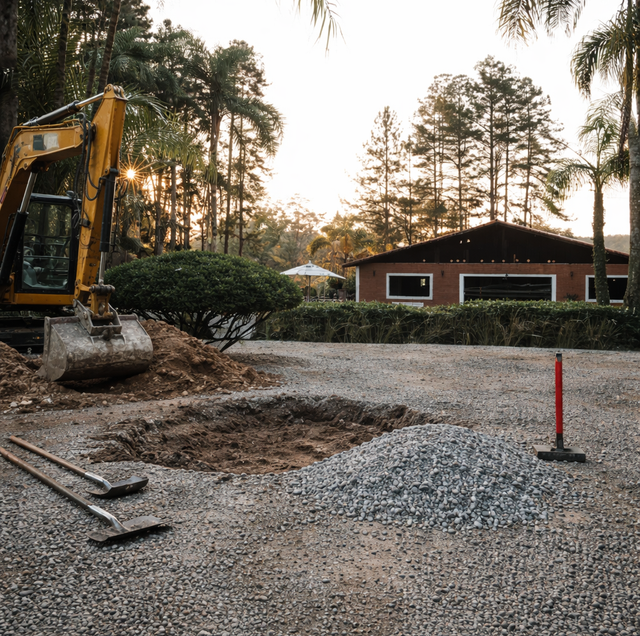
A pothole that reopens after fresh stone is dumped in it almost always has a failed layer underneath; the exact mechanism is covered in the diagnostic read on ruts, washouts, and potholes. A shallow groove under about an inch, still just displaced surface stone sitting nearby rather than gone, is a different and smaller job, one a rake and a hand tamper handle can handle on their own. What follows here picks up once one of those two things is already true: the damage has been read as a real subgrade failure, or the hole is simply too deep and too wide for a hand-tool fix to hold. At that point the job becomes an excavation and rebuild, and the sequence matters more than how fast any single step gets done.
Setting the Excavation Extent
The most common shortcut, and the one that undoes the repair fastest, is digging out only the hole that's visible from the surface. The material that needs to come out, the base ground into the subgrade or the pocket where fines have worked their way up into the stone, usually extends past the visible edges of the depression.
Dig past the visible rim: work the excavation outward until the shovel or a probe meets consistent, firm resistance in the surrounding base, not just until the low spot stops looking like a hole. A patch cut to the exact outline of the surface damage often leaves a ring of already-weakened material at its edges, and that ring tends to become the next soft spot within a season.
Depth matters the same way. The dig needs to go through the compromised base and far enough into the upper subgrade to remove the soft, contaminated material, not just skim the top few inches and call it excavated.
Why a Utility Locate Belongs Before the Dig
An excavation this size needs a utility locate first, not just a rake and a shovel; the same standard this trade applies to any dig that goes past a shallow surface fix. What varies by jurisdiction is the formal process for requesting one, the lead times, and whether a specific permit review includes it, so those specifics are worth checking with the local utility notification service or building department. The locate step itself isn't optional at this depth regardless of what that local process looks like.
Excavating past the visible rim without a confirmed utility locate risks striking a buried gas, electric, or water line. Don't start digging on the strength of an old locate or a guess about what's under that stretch — wait for current marks on the ground.
Rebuilding the Separation Layer
Once the excavation is open, the layer that goes back in before any stone does is the geotextile fabric, whose job is to keep the subgrade separated from the base course so that fine soil can't work its way up into the stone. If the original fabric is torn, buried in mud, or simply wasn't there to begin with, that's why the pothole kept coming back. It gets replaced or added across the full width and depth of the excavation, not patched around.
Building the Base Back in Lifts
Backfilling happens in lifts, roughly 2 to 4 inches of stone at a time, compacted before the next lift goes on top rather than dropped in as one thick pass. Total base depth for a standard repair ranges from 4 to 6 inches, closer to 8 inches in sections that carry heavy axle loads or sit in a high-water-table spot. Angular, sharp-faced crushed stone interlocks and compacts tighter than rounded material, so the base stone going back into a rebuilt section should match that angular profile rather than something rounder that's just handy.
Compact each lift before the next one goes down: run a plate compactor over each layer until it no longer sinks noticeably with repeated passes. Skipping this between lifts, filling the whole depth at once and compacting only the top, leaves the lower material loose and undoes most of the benefit of building in lifts to begin with.
Finishing the Surface Flush With the Surrounding Grade
The last lift is the surface stone, brought up flush with the driveway around it and tied into the existing crown or cross-slope, rather than left as a flat patch that interrupts the shape water is supposed to run off. It's normal to leave the patch very slightly proud of grade at the finish, since a freshly rebuilt section settles a small amount under the first few weeks of regular traffic even with proper compaction. A patch left dead flat on day one can end up slightly low once that initial settling happens.
What Reduces Pothole Formation in the First Place
Prevention happens mostly during the initial build and in the years that follow. A section built with adequate base depth and real compaction in lifts, with fabric separation in place under the stone, is far less likely to develop the pumping failure that leads to a recurring pothole. Where fabric is missing or was installed thin in one section, that's typically the spot that fails first.
The other lever is drainage and shape: a lost crown or a corner where runoff concentrates sends the same repeated saturation into one spot, softening the subgrade enough to start pumping (the specific patterns worth watching for are covered in the diagnostic read mentioned above). Catching that while it's still a soft or slow-draining spot, before it's opened into an actual hole, is less work than excavating a full pothole later. The same goes for a spot that's needed a top-off more than once or twice: treat that recurrence as the early warning it is.
Frequently Asked Questions
There's no fixed number, since it depends on how far the failure has spread, but a foot or more past the visible edge in each direction is common once you start probing and finding soft material outside the obvious depression. The right stopping point is wherever the material starts feeling consistent with the firm base nearby.
It's the same material category, but the application differs slightly. A repair patch needs the new fabric to overlap the edges of any surrounding fabric that's still sound by roughly a foot, so there isn't a seam where the old and new sections meet that fines can still work through. Woven and non-woven geotextiles are both used for this separation function, and the choice usually comes down to what the surrounding base was built with originally; matching it keeps the patch behaving the same way as the rest of the driveway.
A rebuild that runs the standard 4 to 6 inch base depth usually breaks down into two lifts, roughly 2 to 3 inches each, with the surface stone counted as a separate finish lift on top of that. A deeper rebuild on a heavy-axle or high-water-table section, closer to 8 inches, generally needs a third lift rather than stretching two lifts to cover the extra depth, since a thicker single lift takes more compactor passes to reach the same density all the way through and is easier to under-compact in the middle. Skipping straight to two thicker lifts on a deep rebuild is a common shortcut that leaves the middle of each lift under-compacted even when the top surface looks and feels solid.
Recycled concrete aggregate (RCA) is a workable base material in a rebuild, provided it's properly crushed and graded rather than raw broken slab pieces. What matters more than which material is used is that the base lift is consistent in size and properly compacted; mixing RCA with regular crushed stone in the same lift, rather than keeping each lift's material uniform, is what tends to cause uneven compaction later.
A properly compacted rebuild can generally take normal traffic right away, but the top surface lift benefits from a lighter touch for the first several trips, avoiding sharp turns or braking directly on the patch while it settles under real-world load rather than just the compactor. Watching that spot after the first heavy rain following the repair is also worth doing, since it's the fastest way to catch a settling or drainage issue while it's still minor.
No. Layering new fabric over fabric that's already torn or clogged with pumped-in fines doesn't restore the separation function, since the failed layer underneath is still contaminated and can continue migrating upward around the edges of the new patch. The old fabric needs to be removed along with the rest of the failed material, so the new layer sits against a clean, firm subgrade.
Get a driveway pothole rebuild assessment — we'll confirm the extent of excavation and rebuild the base and separation layer so the repair holds. Polk Services LLC serves Lakeland, Highland City, and Mulberry. Call (863) 344-5806.
