

How Wide Should a Rural Driveway Be? 12 Ft vs. 20 Ft
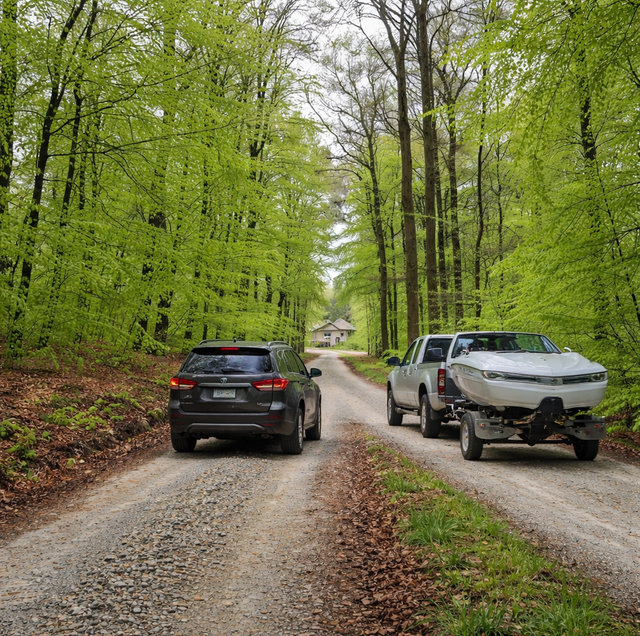
A driveway that fits a sedan every day can turn into a problem the first time a boat trailer, a moving truck, or a delivery van needs to get past a parked car on the way in. Width isn't something most people think about until two vehicles meet head-on on a narrow gravel run and one of them has to back up, or a trailer clips a mailbox on a curve it has taken a hundred times without one. How wide a driveway needs to be depends on what regularly uses it: one vehicle at a time, one vehicle plus an occasional trailer, or two vehicles that need to pass each other without either one leaving the compacted surface.
How Wide a Single-Lane Driveway Needs to Be
A single travel lane built for one full-size vehicle at a time is the narrowest a rural driveway should go, and most of these run somewhere around 10 to 12 feet of usable, compacted width. That figure isn't arbitrary: a full-size pickup or SUV runs 6.5 to 7 feet wide at the body and closer to 8 feet across the mirrors, and a lane cut exactly to the body width leaves no room for a driver to correct if they drift a few inches, or for a mirror to clear a fence post, mailbox, or overgrown shrub along the edge. The extra couple of feet beyond the vehicle's own width is buffer, not decoration.
Local fire codes or emergency-access rules sometimes set their own minimums for driveways serving a home, and those minimums can be wider than what a car alone needs. That's worth checking with the local building department before finalizing a width, since it varies by jurisdiction and isn't something a general guideline can settle.
Why a Trailer or RV Needs More Width Than the Tow Vehicle
A driveway wide enough for the truck towing a trailer isn't automatically wide enough for the trailer itself. Utility trailers, boat trailers, and travel trailers are often close to the same width as the tow vehicle, but a driver's sense of where the trailer's edges are is worse than their sense of where the truck's edges are, since a trailer doesn't turn or drift the same way the cab in front of it does. That gap between where a driver thinks the trailer is and where it actually is tends to show up as a tire riding the shoulder or a fender clipping something at the edge, not as a clean pass down the middle.
Trailer edges are harder to judge than truck edges: Most drivers correct for the truck they can see out the windshield, not the trailer trailing behind it, which is exactly why trailers drift toward the shoulder on driveways that would be plenty wide for the truck alone.
Building the lane out to 12 to 14 feet where trailers or RVs regularly use the driveway gives that margin for error room to exist without the trailer leaving the compacted surface. (That's a different question from what the base underneath a trailer needs to hold once it's parked and sitting still, which comes down to depth and compaction rather than width.)
Widening the Driveway So Two Vehicles Can Pass
A single lane works fine until two vehicles need to be on the driveway at the same time: a delivery truck meeting a car on the way out, or two residents' vehicles passing on a shared driveway. If that happens regularly enough to matter, the driveway needs enough width for both vehicles to stay on the compacted surface at once, rather than one of them easing a set of tires onto the grass or dirt shoulder to let the other by.
As a working range, two full-size vehicles passing comfortably calls for somewhere around 18 to 20 feet of usable width, close to double the single-lane figure. That's a lot more gravel and grading than most rural properties need for their actual traffic pattern, which is why full-width, two-vehicle driveways tend to make sense only where passing happens often: a driveway serving multiple households, a property with regular deliveries or service vehicles, or a long run where waiting for an oncoming vehicle to back out simply isn't practical.
Curves Need More Width Than the Straight Run
A width that works fine on the straight stretch of a driveway can be too tight the moment the driveway bends. A vehicle's rear wheels don't follow exactly the same path as its front wheels through a turn; they cut a slightly tighter arc toward the inside of the curve, an effect called off-tracking. On a short vehicle, that gap is small enough to ignore. On a longer wheelbase, a trailer, or an RV, the rear end can swing several feet inside of where the front end tracked, which means a lane that comfortably fits the vehicle going straight can still put a rear tire off the gravel on a curve.
The fix is widening the inside edge of the curve, not the whole driveway. Adding 2 to 4 feet of extra width on the inside of a bend, more for a tighter radius or a longer trailer, gives the rear wheels room to cut that tighter arc without leaving the compacted surface. A curve a car takes without issue can still be too tight for a gooseneck trailer or a longer RV, even when the straight sections on either side are plenty wide.
Turnarounds and Passing Spots As an Alternative to Widening the Whole Run
Widening an entire driveway to two-vehicle width is rarely the only way to solve an occasional passing problem, and on a long rural run it's usually more gravel and grading than the traffic pattern justifies. A smaller-scope fix is to keep the main lane at single-lane width and add a widened pull-off or turnaround at one or more points along the run, sized so that one vehicle can pull completely clear of the travel lane while another passes.
A turnaround near the house handles the most common case: Two vehicles meeting near the destination end, where a driveway sized for one to pull in, wait, or turn around solves the problem without anyone backing the full length of the run.
A mid-run passing spot handles the long-driveway case: On a longer run, a widened pull-off placed where meeting an oncoming vehicle would otherwise be unavoidable does the same job partway down the driveway rather than only at the end. Either approach needs to be wide enough for a full vehicle, including tires and mirrors, to sit entirely off the main travel lane, not just angled partway out of it.
Width and the Crown Have to Work Together
A wider driveway doesn't automatically drain the way a narrow one does: any increase in width is worth re-grading with the crown in mind, since a crown that stops short of the new edge leaves a flat strip where water sits instead of running off.
Frequently Asked Questions
Every bend where the direction changes needs its own width allowance, because off-tracking resets each time the vehicle changes direction rather than carrying over from the last curve. An S-curve, two bends in opposite directions close together, is often harder on a long vehicle than one tight curve by itself, since there's no straight stretch in between for the trailer or RV to recenter before the next bend pulls it the other way.
Yes. A gooseneck or fifth-wheel trailer's nose extends forward past the hitch point, over the truck bed, and on a turn that forward section can swing wider than the truck bed pulling it, especially on a tight curve. A bumper-pull trailer attaches at its own tongue with little forward overhang, so its equivalent risk is the front corner sweeping wide rather than the nose swinging past the hitch. That swing happens on the outside of the turn while the trailer's rear axle is cutting the inside, so a curve built with extra room on only one side can still catch a long trailer's front corner on the other.
There's no fixed number, but a common approach is placing one wherever a driver can't see if another vehicle is coming until they're most of the way to it, often every few hundred feet on a long, curving driveway, and always near the point where the driveway bends out of sight. A passing spot that's visible from the last one doesn't do much good, since a driver already committed to the stretch between them has nowhere to go if they meet someone.
Yes. Setting any fixed object at least a foot back from the graded edge line, rather than right on it, prevents it from serving as a pinch point that narrows the usable width to less than what the gravel alone measures. That matters most for longer vehicles like moving trucks or delivery trucks, which track wider through their body than a passenger car does even on a straight stretch, and have the least room to correct around an obstacle crowding the line.
Generally yes. Backing removes the driver's direct sightline to the trailer's actual position, so most drivers give themselves less real clearance than they think they have, and the trailer's rear end, now leading, can swing wider through the bend than it does going forward, when the driver can see the tow vehicle's own path more directly. A curve that's wide enough to pull a trailer forward can still be tight to back the same trailer through.
Worn or compacted tire tracks running past the edge of the gravel and onto the grass or dirt shoulder are the clearest sign, since that means a driver is already using the shoulder as a second lane. Scuffed or broken vegetation, bark rubbed off a tree, or scrape marks on a mailbox post at driveway height point to the same problem on a curve specifically, where a vehicle's overhang has been clipping the same spot repeatedly rather than just once.
Get your rural driveway width sized right — a technician can plan lane width, curves, and passing spots before the gravel goes down. Polk Services LLC serves Lakeland, Highland City, and Mulberry. Call (863) 344-5806.
