

Bad Pump Capacitor Symptoms: What That Hum Really Means
Everything a pump motor will tell you about its starting circuit, it tells you in about two seconds.
The pressure switch closes. A moment later the motor either spins up and settles into a steady working note, or it does something else: a low continuous hum that never resolves into rotation, a groaning wind-up that takes a beat too long, a start that sounds ordinary today and fails on a hot afternoon three weeks from now. Most people describe the problem by what came after: the shower that lost pressure, the irrigation zone that never came on. The information worth having was earlier, inside those two seconds.
A start capacitor lives in that window and nowhere else. It has finished its entire job before you have finished hearing it.
What the Capacitor Does in the First Instant of a Start
A single-phase motor has a problem standing still. Once turning it makes plenty of torque, but at zero rotation almost none, and something has to give the rotor its first shove.
That is the starting circuit's only purpose. A capacitor stores electrical energy and releases it into a second set of windings, the start windings, so their current is shifted out of step with the main windings. Two fields slightly out of phase produce a rotating pull, the rotor breaks loose, and the motor comes up to speed. Once it is spinning, the start components drop out, and the run windings carry the load.
Closer to a slingshot than to a battery, a capacitor stores energy briefly, releases it all at once, then reloads for the next shot.
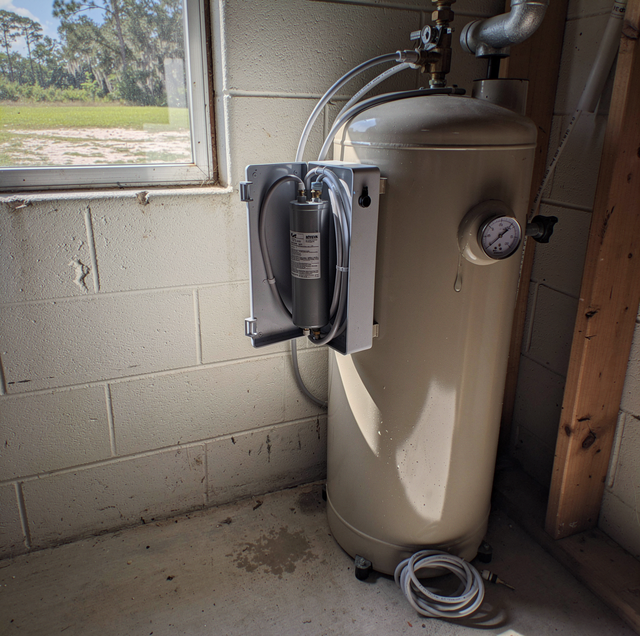
On many submersible systems, those components sit in a control box mounted near the pressure tank or on an outside wall, well above the pump itself. On a jet pump or a centrifugal booster, they sit in the motor's own terminal housing. Either way, when it weakens, the motor does not decline gradually the way a bearing does. It fails at the moment of the start.
The Hum That Means Torque Never Arrived
The classic signature is a motor that hums and does not turn.
Power reached the motor, which is why you hear anything at all: the main winding is energized. What never arrived was the phase-shifted push from the start circuit, so the rotor sits locked while current pours into a winding that has no rotation to carry it away. Pressure does not build. Nothing moves. The sound stays steady and does not change pitch, because nothing is accelerating.
A motor that hums without turning is pulling hard on a rotor that will not move. Switching the pump off at the disconnect and leaving it off until a technician arrives limits the heat that stacks up.
Left alone, that hum usually ends itself. The motor's thermal overload opens on heat and the sound stops, which reads as the problem went away. After the windings cool, the overload closes, and the motor makes another attempt, so you get a cycle of hum, silence, hum that can run for hours. Every round is another stalled start.
One distinction matters here. If what keeps interrupting the system is the breaker at the panel rather than the motor's overload, you are looking at a circuit protection question, which has a different diagnostic path.
The Hard Start That Succeeds but Shouldn't
The version that does the most quiet damage is the start that works.
A weakening capacitor does not always fail outright. It can still deliver part of the push, enough to get the rotor moving, just not cleanly. You hear it as a longer wind-up: a low growl before the motor evens out into its normal note, a second of hesitation that was not there last year, house lights that dip at the instant the pump calls. Pressure recovers, water arrives, and nobody picks up the phone.
Each of those starts holds the start windings in the circuit longer than the design intends, and start windings are built for brief use only. A motor that struggles at every start heats windings that were never meant to carry current that long. The failure that eventually shows up looks sudden from outside. It usually was not.
That pattern deserves attention precisely because the system still works. A hard start is the only warning stage this component reliably gives you.
Intermittent Failure That Comes and Goes with Heat and Load
A weak capacitor behaves differently under continuous duty than it does on a short household cycle, which is why the same system can look healthy in the morning and hum by late afternoon.
Agricultural irrigation pumps commonly run for four to eight hours a day on a watering schedule. The motor, the wiring, and the starting components sit hot for that whole stretch instead of cooling between brief household draws. A capacitor that holds up on a two-minute pressure cycle can fall short on the third restart of a long set.
Above-ground equipment has it harder. Centrifugal boosters sit out in heat and dust, and dust does what any blanket does: it traps the heat the motor is trying to shed.
Start count matters as much as run time. A pressure tank that has lost its air charge lets the pump start far more often than it should, and every start is another full cycle for a component whose working life tracks the number of starts more closely than the calendar.
Storm activity is one real factor here: surge damage is one reason a capacitor can fail weeks after a storm. It is not the only factor, and over a full year it is not even the leading one. Steady heat, long duty cycles, and high start counts do the same work quietly in every other month. Ants nesting inside a control box are a separate nuisance with their own signature, handled on their own terms.
Why This Is Not a Homeowner Part
A capacitor's job is to hold energy. It does that whether or not the power is on.
A capacitor can hold a charge after the power is switched off, and that stored energy does not care that the breaker is open. Opening a pump control box is a technician's job, not a homeowner's.
Shutting off the breaker makes the wiring safe. It does not make the capacitor safe. That single fact is why this is not a homeowner part, and why everything past listening, opening the box, checking the component, removing it, or fitting a new one, belongs to a technician working with the right instrument and the right procedure.
There is a second reason to leave it alone. A capacitor is one component in a starting circuit that also includes a relay and a pressure switch, and the same no-start can come from any of them, or from a motor that has already failed. A pump showing no sign of life at all, no hum and no attempt, points at that broader chain rather than at this one part. Swapping a guessed-at component is how people replace something that was fine while the real fault stays in place.
Your half of the diagnosis is the half you are already good at. You know what your pump normally sounds like.
What the Service Visit Establishes
The point of the visit is not to confirm the guess you arrived at from the yard. It is to settle which link in the starting chain actually gave way, because one hum covers several answers: a capacitor, a start relay, a pressure switch that is not calling the way it should, a supply problem ahead of the equipment, or a motor that has already failed. Those lead to different repairs, and most of them are not a capacitor.
The second thing the visit settles is why the part failed, which is the half that decides whether the repair holds. A capacitor that gave out under an ordinary duty cycle is a different situation from one that gave out because a waterlogged pressure tank caused the pump to start far more often than it should. Fitting a new component and leaving that alone resets the clock on the same failure rather than ending it.
A hum with no rotation, a start that groans before it settles, a pump that behaves at seven in the morning and stalls at four in the afternoon: those are three stages of one story, and the first two are chances to catch it before the motor takes the damage. If your system is doing any of them, stop retrying it and have it measured.
Frequently Asked Questions
No. Submersible motors come in two-wire and three-wire configurations. A three-wire motor uses an external control box, where the capacitor and start relay are located. A two-wire motor has its starting components built into the motor itself, down in the well, with no control box on the wall at all. If nothing is mounted near your pressure tank, you likely have a two-wire motor, and the same symptom means the pump has to be pulled from the ground to be diagnosed.
A hard-start kit adds starting assistance rather than restoring what failed. Pump start components are matched to the motor they serve, and forcing a struggling motor to turn can mask a mechanical fault: a dragging bearing, a bound impeller, or a winding that has partially shorted. A technician may choose one deliberately in specific situations. As a general answer to a hum, it treats the noise and leaves the cause.
Yes, and it is a common source of misdiagnosis. A rotor can be held still mechanically instead of electrically. Sand and grit packed into an impeller, a seized bearing, or a check valve jammed shut will all stall a motor whose start circuit is perfectly good. From outside, the sound is nearly identical, which is why it is a starting point rather than a conclusion.
The motor windings absorb most of it. A stalled motor draws locked-rotor current, well above its normal running current, and that heat builds up in the insulation, which has a limit. After enough cycles, the insulation breaks down, turning a repair at the control box into a pump-pulling job. The pressure switch takes a share as well, since its contacts pit and burn from making that heavy inrush repeatedly, and a burnt switch then produces intermittent faults of its own.
Yes. A surge can weaken the dielectric inside the component without producing anything obvious outside it, and the failure may show up days or weeks later during an ordinary start, long after anyone would connect the two events. It is one reason why "the pump ran fine right after the storm" does not rule out a surge. Surge and lightning protection for well equipment is a subject of its own.
Describe the sound and its timing, because nobody else has it. Note whether the hum is continuous or stops by itself, whether it happens on the first call for water of the day or only after the system has run for hours, whether anything changed recently such as a new irrigation schedule, and whether the noise is at the wellhead, the tank, or the box on the wall. A pattern tied to time of day narrows the diagnosis before anyone arrives.
Call before the next start attempt — a technician can measure the starting circuit and tell you which part actually failed. Perry-Pump Repair Service LLC serves Lake Butler, Gainesville, and Alachua. Call (352) 320-2412.
