

Gravel on Bare Dirt: Why It Won't Stay Put for Long
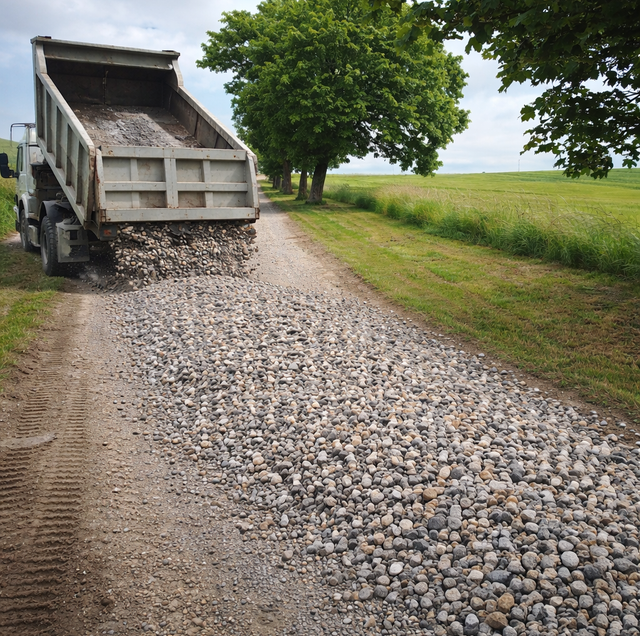
Skip the base and a gravel driveway still goes in by afternoon: truck backs up, stone spreads across packed dirt, and by evening it's driving fine. What's missing isn't visible on the surface, and that's exactly the problem: none of the layers a proper base would keep separate are there, and the ground underneath starts working against the stone almost right away. This is what happens, in order, over the weeks and months after gravel goes down with no prep underneath it.
What the First Heavy Rain Does to Bare Stone
On a properly built driveway, geotextile fabric keeps the compacted base and the native soil apart so fines from below don't pump up into the stone above. Skip that separation and the relationship runs in reverse. The first heavy rain, whether it lands the week after delivery or eight months later, saturates the loose native soil directly under the stone. Vehicle weight and vibration then act like a pump working the wrong direction: instead of stone settling neatly onto a firm surface, wet, muddy fines get worked upward into the gaps between the stone pieces from below. What looked like clean gravel starts showing a gray-brown film at the surface within days of that rain, worked all the way into the stone rather than sitting on top of it, which is why it won't rinse or brush off.
How Stone Disappears Into Soft Soil
A tire's contact patch is small, and on a driveway with a real base course, that load gets spread across a much wider footprint of compacted material before it ever reaches the native soil. Without that base, each pass presses individual stones directly into soil with nothing underneath to resist that force, the same way gravel pressed into wet sand keeps sinking instead of sitting on top. Over weeks of ordinary use- not heavy equipment, just a car and a trash pickup- stone works its way down and out of sight fastest in the two narrow bands where tires travel. A driveway that started with a full, even coat of stone ends up with bare or thin tracks running its length, while the untraveled center and edges still look fully covered, which is often the first visible sign that something below the surface was never built.
Why Ruts Form Faster Than They Should
Ruts on a bare-dirt driveway form because the ground under the wheel paths has nothing compacted underneath it to hold its shape under repeated load, so it deforms a little more with every pass and never springs back, not because the stone itself was a poor choice. Once a shallow low point exists in a wheel path, it collects the water that would otherwise run off a graded surface, and wet soil deforms under weight far more easily than dry soil does. That turns a small dip into a self-feeding cycle: water collects in the rut, the rut softens further, the next pass presses it a little deeper, and it holds even more water next time. A driveway with a properly compacted base under it resists this because the load is distributed rather than concentrated in two narrow bands, which is the main reason bare-dirt gravel tends to show visible rutting well before a properly based driveway would show any wear at all.
Water With No Path to Follow
Part of building a base right is grading the ground underneath so the finished surface has a defined high point and sheds water off to the sides in a predictable direction. Stone dropped on rough, ungraded dirt skips that step entirely, so there's no defined path for water to follow. Instead, it finds whatever the lowest point happens to be that day, which can shift as ruts deepen and the surface changes shape under traffic. Water moving without a planned route tends to concentrate along wheel tracks or against anything that blocks it (a foundation edge, a fence post, a parked vehicle), and wherever it concentrates, it carries fines and undercuts the stone at the edge of that flow. The result isn't one puddle in a predictable spot; it's shifting soft patches and small washouts that move around the driveway depending on where the last hard rain happened to drain.
Why Piling on More Stone Doesn't Fix It
The instinct once a driveway starts thinning out is to bring in more gravel and spread it over the problem spots. That buys a few more weeks of a solid-looking surface, but it doesn't address what's happening below: the fines and native soil are already working into the stone from underneath, and more stone on top just adds weight pressing down on ground that still has nothing firm to stop it from sinking. In practice, that extra weight without anything compacted underneath it can make a soft spot settle faster, not slower. A driveway that's been topped off more than once and still looks thin or shows the same ruts in the same spots is a strong sign the problem was never in the visible layer, and no amount of additional stone on top changes what's happening at ground level.
What This Means Before Stone Gets Ordered
The shortcut is tempting precisely because it looks like a finished driveway on delivery day, when nothing above has happened yet. The failure sequence, fines working up, stone pressing down, ruts deepening, water finding its own path, plays out at its own pace depending on soil type, rainfall, and how often the driveway gets driven on, but the sequence itself doesn't change. Prepping the ground first, whatever that specific site needs, is what breaks that chain before it starts instead of after stone has already been lost into the dirt.
Frequently Asked Questions
One check that doesn't need a tool: walk a stretch that's shown trouble before, right after a rain, and pay attention to how it feels underfoot. Ground with a real compacted base stays firm and doesn't visibly flex or spring back as you step on it, even wet. Bare-dirt gravel sitting on saturated soil often has a noticeable give or bounce in that same spot instead, since the stone is effectively floating on soft ground rather than resting on something dense enough to hold its shape under weight.
Yes, and the effect runs in different directions depending on the soil. Sandy, fast-draining soil doesn't hold surface water as long, so mud pumping to the surface is less dramatic, but sand also offers less resistance under a tire, so stone tends to press downward into it faster under repeated weight. Heavier, clay-rich soil resists that downward pressing better but drains slower, so it turns to slurry at the surface more quickly after rain and produces the muddy, sticky mixing effect faster than sandy ground does.
It can, and there's a way to tell it apart from the ordinary top-dressing that works fine on a driveway with a real base underneath: track how quickly each added load disappears. A properly based driveway that gets topped off periodically usually holds that fresh stone for a predictable stretch, often a few years, before it visibly thins again. A bare-dirt driveway that loses depth in the same spot within weeks or a few months of each top-off, and does it faster with every round rather than at a steady pace, is showing an accelerating subgrade problem rather than ordinary wear. That accelerating pattern is the signal that the fix needs to start below the stone, not on top of it.
If any vehicle regularly parks or drives on it, yes, the same physics apply regardless of how small or lightly used the pad is; a car sitting in one spot repeatedly can create a soft, sunken footprint in bare dirt just as reliably as a driveway that gets driven the length of it daily. A path meant only for foot traffic, with no vehicle weight at all, is a different case and generally requires far less beneath it.
Yes. Digging a utility trench across an established driveway, installing a French drain, or repeated flooding that saturates the base for extended periods can disturb or contaminate a base that was built correctly at install. The fix in that case is usually more targeted than a full rebuild, but the symptoms (soft spots, localized rutting, stone thinning in one section) can look identical to a driveway that never had a base at all.
No. Fabric only does its job when it separates clean base material from native soil before they mix; once fines are already worked through the stone above it, laying fabric on top doesn't undo that mixing; it just buries a layer that's already contaminated. Fixing a driveway at that stage generally means pulling up the affected stone-and-soil mix, not adding a layer on top of it.
Stop the stone before it disappears — schedule a base assessment before any gravel gets delivered. Polk Services LLC serves Lakeland, Highland City, and Mulberry. Call (863) 344-5806.
