

Carpet Removal From Stairs: Why Every Step Is Its Own Job
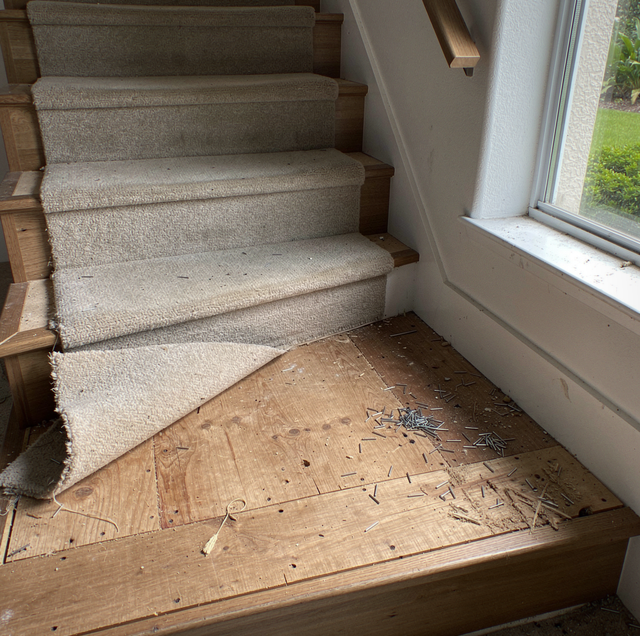
A single room has one fastening line: tack strip around the perimeter, hidden under the baseboard, holding down one continuous piece of carpet. A staircase has none of that simplicity. Count what's actually there: a fastening point at the back of every tread, another at the base of every riser, plus the full perimeter of any landing along the way. A flight of stairs can hold a dozen or more separate carpeted surfaces stacked one above the next, and each one is its own small job.
Treads: Where Most of the Fastening Lives
The tread is the flat surface you actually step on, and it bears the most direct wear of any part of a carpeted staircase. A short length of tack strip sits at the back of each tread, near where it meets the riser above, holding the carpet's edge in place. Beyond the tack strip, the carpet on a tread is typically stapled through to the wood underneath at multiple points along its width, not just along one edge, as a room's field carpet is. Add that up across a full flight, and the staple count per square foot runs far higher than in an open room, because every tread repeats the same fastening pattern rather than sharing a single perimeter. Pulling carpet off a floor is one long, continuous pull; pulling it off a staircase is more like trimming a hedge, branch by branch, since each tread is its own small fastening job rather than part of one larger surface.
Risers: The Vertical Fastening Points
The riser is the vertical face between one tread and the next, and it carries its own tack strip too, a short length set at its base where the riser meets the tread below. On many staircases, the riser is carpeted along with the tread, wrapping the corner between the two surfaces rather than stopping at the edge. That means a single step can involve carpet fastened in two directions at once: horizontally along the tread, vertically down the riser, with the two pieces meeting and often overlapping at the inside corner. Removing carpet from a riser means working a narrower, more awkward surface than a tread, and because the riser sits at an angle rather than flat, staples set into it can be harder to reach than staples set into a tread or an open floor.
Nosings: Waterfall versus Cap-and-Band
The nosing is the rounded front edge of a tread, the lip that overhangs the riser below it, and it's where the two main stair-carpet installation styles actually diverge. A waterfall installation runs one continuous piece of carpet down over the nosing and onto the next tread, so the carpet drapes over that edge rather than stopping there. A cap-and-band, or upholstered, installation wraps each tread separately and fastens the carpet beneath the nosing, so every step is finished and fastened as an individual piece rather than as part of a single running length. The difference matters for removal because a waterfall staircase comes apart into a smaller number of longer, connected sections, while a cap-and-band staircase comes apart into a full set of separate small pieces, one per tread, each with its own fastening to deal with at the nosing.
Because waterfall and cap-and-band stairs come apart so differently, a few photos of the staircase sent ahead of time make the scope accurate before pickup day.
Landings: Small Floors with Full Perimeters
A landing breaks up a run of stairs, and unlike a tread or a riser, it behaves like a small floor rather than a single fastening point. It has its own perimeter and tack strip running around the edges, just like a full-size room, but at a fraction of the square footage. Where a landing sits between two flights, it may also be the transition point where carpet from the lower flight ends and carpet for the upper flight begins, meaning two separate fastening systems can meet at the same small space.
A staircase is often the only way between floors, so once removal starts it may be the only route blocked for a while. Plan for an alternate way up or down until the treads, risers, and landing are clear again.
Where a Stair Meets the Floor
At the bottom of a staircase, the carpet on the last riser or tread has to meet whatever flooring runs into the hallway or room below, whether that's carpet, hardwood, tile, or something else entirely. That transition point usually has its own trim or fastening detail separate from the tack strip further up the stairs, because it's doing double duty: finishing the edge of the stair carpet and marking a clean line against a completely different floor surface. It's a small span, but it's a fastening condition all its own, distinct from anything found higher up on a tread or riser, and it needs to be dealt with on its own terms rather than assumed to match the rest of the flight.
Where a Stair Meets the Wall
Along the sides of a staircase, carpet often runs up against a wall, a skirt board, or an open railing rather than another tread. Where a wall runs alongside the stairs, the carpet's edge may be tucked and fastened tight against the baseboard the same way a room's carpet is, tread by tread rather than once around a single perimeter. Where the stairs are open on one side instead, there's no wall to tuck against at all, and the edge of the carpet is finished and fastened differently at every single tread along that open side, adding yet another fastening condition to a flight that already has more of them than any one room.
What the Treads Are Made of Underneath
What's actually under the carpet on a staircase isn't something you can know in advance. Some staircases have finished hardwood treads and risers underneath, wood that was cut, fitted, and finished to be seen, then carpeted over anyway. Others have unfinished, construction-grade treads and risers that were never meant to be a visible surface at all, plywood or lower-grade lumber that was always intended to stay covered. There's no way to tell which one a given staircase has until the carpet, padding, tack strip, and staples are actually off, and the wood underneath is exposed, tread by tread and riser by riser.
Frequently Asked Questions
No. A runner is fastened differently than wall-to-wall stair carpet, and it can sit over a tread that was already finished underneath rather than over plywood or unfinished lumber. That means the surface beneath a runner may already be a finished floor in its own right, not raw wood awaiting its first viewing.
A landing's perimeter tack strip is scoped as room carpet, not stair carpet, even though it sits in the middle of a staircase. Its full-perimeter fastening behaves like a small floor rather than a single tread or riser, so it's counted the way a room would be, not folded into the tread-by-tread work around it.
Usually not. Padding on a staircase is often cut and fastened step by step rather than run as one continuous sheet, as it is across an open room, since each tread and riser is its own small surface rather than part of one larger floor.
That's where two separate tack-strip systems can meet at the same small space: the perimeter strip around the landing and the tread-by-tread strip continuing up the next flight. Both terminate close together at that transition, so the edge of the landing carpet and the start of the next flight's carpet are treated as two distinct fastening jobs rather than a single continuous strip.
Not always. Some staircases have a separate nosing edge, a strip of metal or wood fastened into the front of the tread itself, in addition to the tack strip further back. Some staircases have one; it is another fastening point removal has to account for.
Yes. A bullnose or box tread wraps carpet around three sides of the step instead of the usual two, adding a fastening face that a standard tread doesn't have. That third wrapped side means one more edge to pull, staple, and fasten on every step where that tread style is used.
A staircase is the slowest carpet in the house to come up — professional removal clears every tread, riser, and landing as one scope instead of leaving the job half done. Polk Services LLC serves Lakeland, Highland City, and Mulberry. Call (863) 344-5806.
