

Draining a Pool Before Demolition: Why Empty Shells Lift
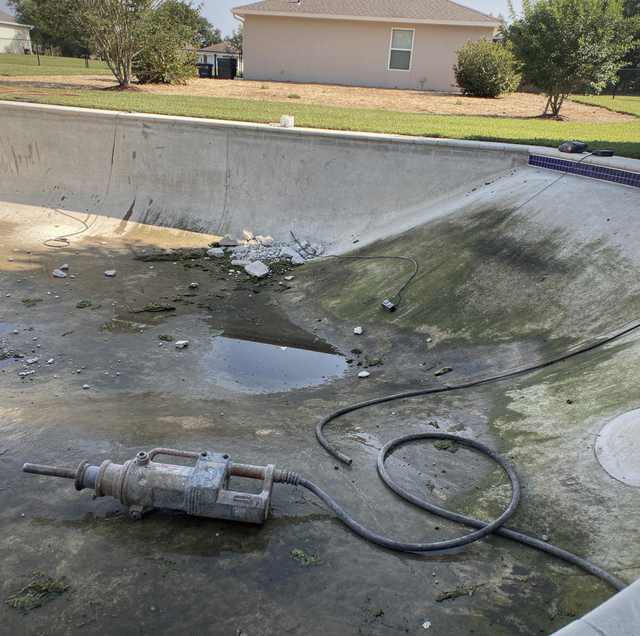
Quick Answer: A pool is never drained and then left sitting. Groundwater pushes up on the underside of an empty shell, so the water level drops and the drainage holes go through the floor in the same working sequence.
A pool full of water is the most stable it will ever be. Take the water out, and the same shell becomes something the ground beneath it can move. That reversal is why a demolition crew does not drain a pool and come back to finish it later in the week, and why the first tool that touches the structure goes to the floor rather than the deck.
The Water Is What Holds the Shell Down
Below any yard there is a depth at which the soil is fully saturated. That level rises and falls with rainfall and with how fast the surrounding ground sheds what lands on it. Where it sits above the underside of a buried pool, saturated ground presses upward against the bottom of the floor and inward against the outside faces of the walls. It is a constant push, not an event, and it is there on days when nothing at all appears to be happening.
A full pool answers that push with the weight of its own water bearing down on the floor from the inside. The two loads work against each other, the shell sits still, and a pool can hold that balance for decades without giving any sign that anything is pressing on it.
Empty the pool, and one-half of that arrangement is gone. The upward pressure is unchanged. A gunite or concrete shell is heavy on its own, but it is also a large, closed, watertight form sitting in wet ground, and the pressure works across its entire underside at once rather than at any single point.
Lift, Shift and Cracking
An emptied concrete pool can pop or float out of the ground, and that is the outcome people picture. It is not the only one, and the other two are more common.
Lift: The shell rises as a whole. The floor comes up out of its bed, the deck around it breaks its bond with the coping, and the pool ends up standing proud of the grade it was set into.
Shift: One end moves and the other does not. A deep end that sits lower in the water table takes more upward pressure than the shallow end, so the shell tips rather than rising evenly. The result is a pool that is still in the ground and no longer level.
Cracking and bulging: The shell stays put and fails locally instead. Pressure builds at the floor-to-wall transition or across the middle of a long wall, and the concrete cracks through or bows inward. Walls that have soil pressing on the outside and nothing supporting them on the inside are being asked to do a job they were never meant to carry while the pool was full.
None of the three can be timed. How many days an empty pool has before it moves is the question people ask, and it has no answer, because the driver is where the water table sits at that moment and not how long the calendar has run.
Why the Drainage Holes Are the First Cut
Cutting drainage holes through the floor of the shell is not a finishing detail somewhere in the middle of the job. It is the first mechanical step of the demolition, done before the deck is broken out and before a wall is touched.
The order follows directly from the mechanism above. The moment the water comes out, the shell is exposed to uplift, and it stays exposed for every hour it remains an intact watertight basin. Perforating the floor ends that condition permanently. It converts the pool from a sealed form the groundwater can push against into a structure water passes through, and it does so before anything else about the pool has been disturbed.
Everything downstream depends on it. The deck and coping come off, the walls are broken in, debris drops into the cavity, and fill goes back in compacted lifts. Every one of those steps loads the shell further, and none of them should be happening while the floor is still holding pressure.
The Two Jobs a Drainage Hole Does
Evacuation: once the shell is perforated, water that reaches it drains into the ground below instead of standing in the work. Rain that falls into an open cavity mid-job and water that seeps in through the walls both leave through the floor rather than needing to be pumped clear each morning.
Permanent relief: where the floor slab stays in the ground rather than being broken out, the holes are what stop it from working as a pan once fill is on top of it. A sealed floor buried under fill would still collect groundwater beneath it, which is what causes movement in the finished surface years later. Perforating it means the ground below the old pool behaves like the ground around it.
The holes are cut at the deepest point of the floor and across the shallow floor as well, because the deep end is not the only place water can sit once the shell is broken and partly filled.
Pump Down First, Cut When the Floor Is Reachable
The sequence inside this one step is fixed. The water level is pumped down before any machine works near the edge of the pool, because a loaded machine tracking along the coping puts weight on ground the pool wall is holding back, and that is not the moment to be guessing at what the wall is carrying.
Once the level is low enough for the floor to be reachable, the holes are cut through it with a hammer. By the time footsteps and voices are coming back flat off the walls of an emptied shell, the pool is at its most vulnerable point in the entire job, which is precisely why the hammer goes to the floor that same working session rather than the next one.
An emptied shell is not a safe place to stand. Algae sludge on a sloped floor is slick, the deep end offers no way out without a ladder, and a shell that has already shifted can be unstable underfoot.
Ground That Stays Wet Changes the Work
Some yards make all of this ordinary, and some make it the governing constraint. Low-lying ground, ground near open water, and ground that remains saturated for days after heavy rain all have a water table that sits high relative to the bottom of a pool. On those properties, the cavity can take on groundwater during the work itself, seeping in through floor holes and broken walls while the crew is still working on the site.
That is not a problem with the method. It is the exact condition the holes are cut for. Water arriving from below has somewhere to go and nowhere to accumulate, and the fill goes over a floor that is already draining rather than over a sealed pan that is slowly filling beneath it.
Soil type sets the pace. Sandy soil drains quickly, which means water moves away from the cavity quickly, but it also offers little cohesion, so it does not hold a shape on its own, and the walls of an open excavation tend to slough. Both of those behaviors are read on site as the work opens up, not assumed in advance from a street address.
The Water and the Sludge at the Bottom
A pool that has been sitting green for years is not simply a pool with dirty water. The water column comes down first, and where it goes is settled before the pump starts rather than during. That is a site-by-site call, and it is the crew's to make and arrange.
What is left on the floor is the part that matters. Years of leaf litter, algae, and settled organic material accumulate into a layer of sludge, which is organic. Organic material breaks down over time, loses volume, and leaves voids behind. Sealing it under the fill would put a decomposing layer directly beneath a surface meant to hold grade. It comes out of the shell and off the site instead. That work happens around and after the holes, not before them: the floor is perforated as soon as it can be reached, and a draining floor is what stops seepage re-flooding the dig while the material is being lifted out.
Frequently Asked Questions
No, and doing so removes the one thing currently holding the shell down. Many concrete pools have a hydrostatic relief valve set into the main drain sump at the deepest point, a spring-loaded plug meant to let groundwater in and equalize pressure. On an older pool, it is frequently seized shut or plastered over during a past resurfacing, in which case it does nothing at all and nobody knows it until the pool is empty.
Watch the clock less and the crew's own sequence more, because this is not something to go down and check. Nobody should be in an emptied shell to look at its floor. The movement that matters during a demolition is read from outside it: a deck slab that has lipped at the coping line since the water went down, or a gap opening between coping and deck that was tight the day before. Both mean the shell has started to move, and the floor needs to be opened now.
The pad's power and any gas feed are dead before the pump starts, and the equipment itself is cleared early. The pump, filter, heater, salt cell, and associated plumbing come out, along with the skimmers, return fittings, diving board, and its footing. Skimmer throats and return penetrations become open paths through the wall once the plumbing is pulled, providing another route water can take to leave the shell.
Never. They are permanent and are not patched, grouted, or covered before fill goes in, because a resealed floor recreates the pan the holes were cut to eliminate. Existing hairline cracks in an old floor do not count as drainage either. They are too fine to pass meaningful volume, and they are not positioned where water actually collects.
An open cavity with the floor already perforated handles rainfall on its own, which is part of why the holes go in first. The complication is fill that is already placed: saturated material will not compact properly no matter how it is worked, so standing water is pushed off, and the surface is allowed to give up moisture before the next lift goes on top of it.
It is dug out, not pumped. Settled leaf sludge is fibrous enough to blind a pump intake screen as fast as it can pull it in, so the last of the material on the floor comes out with a machine bucket and hand work rather than through a hose. That is also why the water column is dropped first: it is far easier to reach the material once there is nothing standing on top of it.
The first thing a hammer touches in a pool demolition is the pool floor itself. The deck, the coping and the walls all wait their turn until the shell has somewhere to send water.
Schedule your pool demolition — owner-operated removal from the first drainage hole through fill, compaction and final grading. Polk Services LLC serves Lakeland, Highland City, and Mulberry. Call (863) 344-5806.
