

Cut-and-Fill vs. Trucked-In Dirt: How Contractors Decide
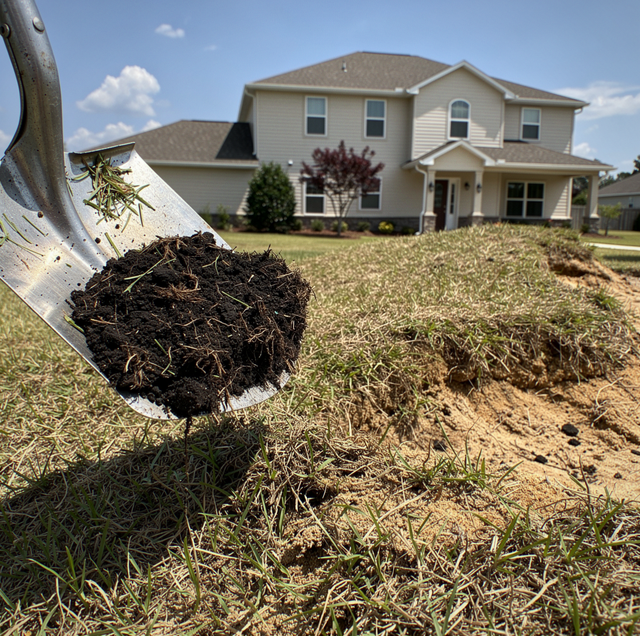
If your yard has a mound near the property line and a soggy dip on the other side, it's tempting to assume a contractor can just push one into the other and call it done. A shovel test tells the story fast: push it into the mound, and it comes back full of root hair and dark, crumbly topsoil, not the dense mineral soil a grading plan actually needs. That's often the reason a plan calls for several loads of trucked-in fill, even though the lot clearly has "extra" dirt sitting in a high spot. It's the result of an actual measurement, not upselling, and understanding how that measurement works tells you whether your project is a candidate for moving your own soil or will need material brought in.
What a Cut-and-Fill Assessment Actually Measures
A cut-and-fill assessment starts with a rough survey of the lot, not a guess based on standing in the yard and eyeballing the high side. A contractor sets a series of elevation shots across the property, typically with a rotary laser level, or an optical transit, and a grade rod, on a grid pattern tight enough to catch the actual shape of the ground, not just the obvious hump and dip. Each shot gets tied back to a benchmark elevation, usually a fixed point like a foundation corner or a manhole rim that won't move, so every reading on the lot can be compared against the same zero point. This is a working-grade survey for planning where the dirt goes, not a boundary survey or an elevation certificate, which require a licensed surveyor and a different scope entirely.
Before any digging or equipment work starts, call 811 to have buried gas, power, water, and communication lines located and marked. This applies even for shallow fill work, since utility depth varies by property.
Once the shots are in hand, the contractor plots the existing grade against the target grade and the shape the yard needs to end up in for water to move off it and away from the house. Anywhere the existing ground sits higher than the target grade is a cut area. Anywhere it sits lower is a fill area. That's the entire vocabulary of the assessment: cut is dirt that has to come out, fill is dirt that has to go in, and the question is whether one lot's cut can supply that same lot's fill.
Turning Elevation Differences Into a Volume, Not a Guess
The step that separates a real cut-and-fill assessment from a hunch is converting those elevation differences into cubic yards. A contractor breaks the lot into a grid of cells, calculates the average cut or fill depth for each cell from the elevation shots, multiplies by the cell's area, and adds the results across the whole property. The output is two numbers: total cut volume and total fill volume, both in cubic yards. If they're close, the site is a candidate to balance on its own. If cut badly outweighs fill, there's material to remove. If fill badly outweighs cut, more dirt has to come from somewhere else.
One detail that trips up a lot of people doing their own back-of-envelope math: dirt doesn't stay the same volume once it's disturbed. Soil sitting undisturbed in the ground is at its "bank" volume. The moment it's cut and loosened, it expands, sometimes by 15 to 25 percent depending on the soil type, because loosened soil has more air pockets between particles than compacted soil does. That same soil, once it's placed as fill and compacted back down with a plate compactor or roller, can end up at a volume even less than its original bank state. A contractor has to account for that swell-and-shrink behavior when comparing cut and fill numbers, or the volumes that looked balanced on paper come up short (or long) once the dirt is actually moved.
Why a Balanced Site Is the Simpler Job
When cut-and-fill volumes are close to even, moving soil within the same lot is almost always the simpler route, and the reason comes down to logistics: the dirt never has to leave the property. Nothing has to be hauled away, and nothing has to be sourced, loaded, and trucked in from elsewhere. The work becomes moving material with a skid steer or mini excavator from the high side to the low side, staging it temporarily if the grading sequence calls for it, and compacting it into place. Equipment time and labor are still part of the job, but the whole sequence remains contained on the property rather than adding delivery and haul-off logistics on top of it.
A balanced site also tends to move faster. There's no waiting on a delivery schedule for fill material, and no coordinating a truck route through a tight lot. The contractor works with what's already there, which keeps the whole job on a single continuous timeline rather than two.
Three Reasons the Numbers Don't Balance
Even when a lot looks like it has plenty of high ground, the cut-and-fill math can still come up short. Three situations account for most of it.
Not enough usable cut volume: the high spots on the lot simply don't hold enough dirt to fill the low spots, even after accounting for compaction. A property with one modest mound and a deep, wide depression on the other side is a common example. The mound might supply a fraction of what the depression needs, and the remainder has to come from off-site.
The existing soil isn't suitable as structural fill: not every cubic yard of dirt on a property is fit for reuse as fill, even if the volume works out on paper. Soil with high organic content, topsoil mixed with roots, leaf litter, old mulch, or decomposing plant matter, won't compact reliably. Organic material breaks down over time, leaving voids that settle unevenly under the fill, which is exactly the kind of soft, sinking spot a grading job is supposed to prevent. Soil with a lot of clay can also behave poorly as fill in certain conditions, holding water and compacting inconsistently compared to a more granular soil. When a contractor pulls a shovel test or two during the site walk and finds the "extra" dirt on the high side is mostly organic topsoil rather than mineral soil, that material usually gets set aside rather than reused, and the fill volume has to come from somewhere with better compaction characteristics.
The lot is too flat: on a property with very little elevation change to begin with, there isn't a meaningful high spot to redistribute from. A nearly level lot that needs several inches of fall added across its length has nowhere on-site to cut that volume without digging a hole elsewhere on the property, which usually isn't the goal. Flat lots are among the more common reasons a grading job ends up needing trucked-in material, even when nothing about the yard looks dramatically uneven.
When Trucked-In Material Becomes Unavoidable
Once the assessment shows the site can't supply its own fill, the next decision is what to bring in and how much. Fill material typically comes as a graded soil blend or a sand/soil mix suited to the area's compaction needs, sourced from a supplier rather than dug from a random spot. The contractor calculates the shortfall from the cut-and-fill numbers, adds a margin for compaction shrinkage, and orders enough material to cover it without guessing mid-job and having to schedule a second delivery.
Trucked-in fill is placed the same way as on-site cut material: spread in lifts (layers, typically 6 to 8 inches loose depth) and compacted before the next lift goes down, rather than dumped in one deep pile and compacted once at the end. Compacting in lifts is what keeps the finished fill from settling unevenly months later, since a single thick, loosely compacted mass of soil will consolidate under its own weight and rainfall long after the job is finished, showing up as a new low spot exactly where it was just fixed.
Staging the Move on Balanced Sites
On a site where the numbers do balance, the sequence still matters. Cut material usually can't go straight from the high spot into its final position in one pass, especially on a lot with structures, fences, or plantings in the way. A contractor typically stages the cut soil in a holding pile in a clear area of the lot, works through the cutting and rough shaping first, then moves the staged material into the fill areas in lifts as the grade comes up. Staging also gives the contractor a chance to screen out debris, roots, and rocks from the cut material before it goes back in as fill, the same quality check that trucked-in material gets at the source.
The staging pile itself works like a kitchen counter during a big cooking project: everything gets pulled out and set within reach before any of it goes into its final spot, rather than digging one hole and immediately trying to fill another with the same shovelful. That sequencing is what keeps a mid-sized grading job from turning into guesswork about where dirt should go next.
What This Means for Your Project
The reliable way to know which category your yard falls into is the survey and volume calculation, not a walk-around estimate. A lot with a generous high side and a shallow low side is a good candidate to balance on its own. A lot that's mostly flat, has one small mound and one deep low spot, or has cut material that turns out to be mostly organic topsoil once it's tested, is more likely to need material brought in. Either way, the number that matters is the one that comes from actual elevation shots and a real volume calculation, not from standing at the property line and guessing which side has more dirt.
Frequently Asked Questions
There's no fixed number, but a contractor generally spaces shots on a grid tight enough to catch every meaningful change in slope, often every 15 to 25 feet on a standard residential lot, with extra shots added at any distinct high or low point the grid might miss, like a mound, a drainage swale, or a depression near a downspout.
A rough field check is to dig down 6 to 8 inches in a few spots on the high side: soil that's dark, loose, and full of root matter or old leaf debris is topsoil and generally not reliable structural fill, while a lighter-colored, denser layer underneath (subsoil) usually compacts better. It's not a lab test, but it tells you whether the "extra" dirt on your property is even a candidate for a formal assessment before a contractor does one.
Yes, and it's calculated as its own separate volume rather than folded into the open-yard numbers, since a paved area has a different target grade and much stricter compaction requirements than turf. That separation matters for the cut-and-fill math specifically: fill going under a load-bearing surface generally needs to come from mineral fill or a compactible base material, not from whatever cut soil happens to balance the open-yard volume, even if the total cubic yardage would otherwise line up.
Excess cut material that isn't suitable or needed as fill gets hauled off-site rather than left in a pile, since a leftover mound just becomes a new grading problem later. Some contractors will offer to reuse clean excess soil in a different area of the same property, such as building up a planting bed, if the material is suitable and the homeowner wants it kept rather than removed.
Properly compacted fill in lifts settles far less than fill that was dumped and left, but it's still worth giving it a few weeks, ideally a full wet-weather cycle, before planting or sodding over it, the same margin that applies to any lift-compacted fill. Some contractors intentionally overbuild a fill area by an inch or two above the final target grade to account for that gradual settling, rather than coming back to add more material later.
A severely out-of-balance lot, where the fill volume needed is a large multiple of the available cut, can still be graded, but it shifts from a soil-redistribution job into more of a fill-and-build project, closer in scope to establishing a new pad than a routine regrade. At that scale, the sequencing (how much material arrives, in what order, and how it's compacted in stages) matters more than on a smaller job, since the site is essentially being rebuilt rather than reshaped.
The elevation shots settle it either way: some lots can move their own dirt; some need material brought in; and guessing from the property line often gets it wrong enough that the survey is worth doing first.
Get a cut-and-fill assessment before you commit to a grading plan — find out whether your lot can balance on its own or needs material trucked in. Polk Services LLC serves Lakeland, Highland City, and Mulberry. Call (863) 344-5806.
