

Will Sand Fix a Wet Spot? The DIY Fix That Backfires
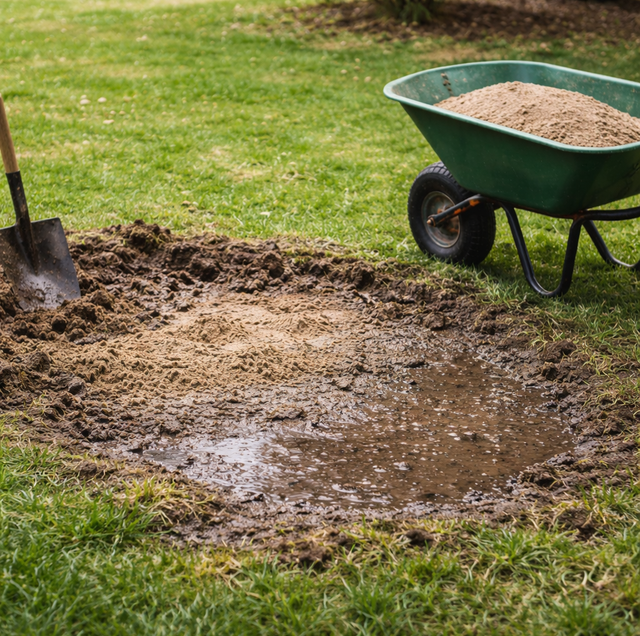
Quick Answer: No. Dumping sand into a wet low spot does not create drainage. On top of clay or compacted soil, loose sand cakes into a shallow crust, trapping water beneath. It does nothing to correct the slope causing water to collect.
The Instinct That Makes Sense on Paper
A soggy patch shows up in the lawn, the ground stays soft for days after every rain, and someone remembers that sand feels "well-draining" at the beach or in a garden bed. So a few bags go down, maybe a wheelbarrow load if the spot is bigger. It seems reasonable: sand is porous; it doesn't hold water in your hand the way clay does, so more of it in the wet spot should soak things up and firm the ground back up.
That logic works for a bag of sand sitting by itself. It falls apart the moment sand meets the soil already there, because the soil beneath is the one actually controlling where the water goes.
Why Loose Sand Alone Isn't the Same as a Sand Base
Grain size and drainage are related, but only in a uniform material: A pile of clean sand drains quickly because water has a straight, open path between the grains. The mistake is assuming that property carries over once you dump that sand onto ground that isn't sand. A wet low spot is almost never sitting on sand already; it's usually sitting where fine silty soil, dense clay, or a compacted subgrade is slowing the water down. Add a layer of sand on top of that, and you haven't built a sand base; you've built two different materials stacked on each other, and water behaves very differently at a boundary like that than it does inside either material alone.
Why Sand Caps Over Compacted Clay Instead of Draining It
Fine clay particles are dramatically smaller than sand grains, and they pack together tightly enough that water can only move through them at a slow trickle rather than a flow. Pour loose sand over that surface, and the direction of movement runs the opposite way most people picture: rain softens the clay surface, and foot traffic or a mower rolling over the sand presses the sand grains down into that softened clay while pumping fine clay and silt particles up into the open space between the sand grains. Instead of an open, well-draining layer, you end up with a caked skin, a mix of sand and clay fines that sheds water almost as poorly as bare clay did, sometimes worse, because now there's also a slight mound holding water in rather than a flat surface it could at least spread out over.
If a wet spot needs more than surface leveling, such as a trench for a French drain or corrugated pipe, call 811 before any digging. The locate marks buried gas, power, water, and communication lines so you're not cutting into one blind.
The Perched Water Layer Problem
Even where the sand doesn't fully cake over, a coarser layer sitting on top of a much finer, denser layer creates what's called a perched water table: water moving down through the sand hits the clay boundary, and because the clay lets water through far more slowly than the sand lets water in, water backs up and pools right at that seam instead of continuing downward. From the surface, the ground can look and feel dry, while a saturated layer sits an inch or two down, which is often why a "fixed" spot still feels spongy or squishes underfoot days after the rain has stopped elsewhere in the yard. The sand hasn't drained the water away. It's created a shelf for the water to sit on.
Sand Does Nothing About the Slope
Even setting the caking and perched-water issues aside, a wet low spot is usually a symptom of grade, not a symptom of the wrong soil texture. If that section of yard sits lower than the ground around it, or the overall slope pushes water toward it instead of away from it, water is going to keep arriving there no matter what material fills the depression. Sand has no way to change the direction water flows across a yard. It can raise the surface a little in the short term, but grass, foot traffic, and settling from repeated wet-dry cycles will compress a thin sand patch back down within a season or two, and the low spot returns because the underlying slope was never touched.
Where Sand Does Belong in Yard and Hardscape Work
None of this means sand is useless outdoors; it just isn't the right tool for a wet low spot. Leveling sand (sometimes called bedding sand or paver sand) has a legitimate job under a paver patio or a gravel path: it fills small surface irregularities in a properly compacted base so the pavers sit flat, and it's screeded to a precise, even thickness rather than dumped in a mound. Polymeric sand serves a different purpose again, locking paver joints together at the surface. Both of those uses put sand on top of soil that's already been excavated, graded, and compacted to the right shape first. That's the opposite order from tossing sand into a depression and hoping it corrects the shape for you.
Sand Topdressing After Aeration Is a Different Practice
There's a legitimate lawn-care technique that gets confused with the wet-spot myth: core aeration followed by a thin sand topdress. That method pulls small plugs of soil out of the lawn first, then spreads a thin, even layer of coarse sand (a fraction of an inch, not a mound) that works down into the aeration holes rather than sitting as a solid cap on the surface. Done over several seasons, it can improve how the top few inches of a compacted lawn handle water. It is not the same as piling sand into a standing puddle: the aeration holes are what allow the sand to work into the soil profile rather than caking on top of it. But even done correctly, that improvement stops at the top few inches of soil texture. It doesn't address a slope problem or an actual low spot where water is collecting due to grade.
Fixing a Persistent Wet Spot for Real
The starting point is almost always regrading: removing enough of the low spot's soil, or bringing in and compacting proper fill dirt, so the area matches the fall of the surrounding yard, and water moves across it instead of stopping there. Fill material matters: A compactable fill dirt or a sandy loam blend, brought in and compacted in shallow lifts (typically a few inches at a time, not dumped all at once) holds its shape far better than sand poured loose over the existing grade. Compaction is what sand alone skips entirely; without it, any fill material will settle unevenly, and the low spot can come back.
A quick way to tell texture from grade: if the low spot still holds standing water a full day after a rain, the problem is structural, not the soil type — no amount of sand changes that answer.
Grading alone can't solve every wet spot. Where the slope truly can't be corrected, or the soil underneath won't drain no matter how it's shaped, the answer shifts from moving soil to moving water on purpose with a swale or a drain — that's a separate decision from anything sand can do, and it's covered in more depth elsewhere. What matters here is simpler: sand never gives water a path out of a low spot. It just sits in place and either seals over or gets saturated in the same spot it was meant to fix.
Frequently Asked Questions
It changes how fast the failure shows up but not the outcome. Coarse construction or sharp sand resists caking a bit longer than fine play sand or mason sand, whose smaller, more uniform particles wash into clay pores and compact faster. Polymeric sand (the kind used to lock paver joints) is a different product entirely; it's mixed with a binder and isn't meant to be loose-filled anywhere, so it isn't a substitute for any of these either.
That's a different product than what most people mean by "adding sand," and it has a real, narrow use: a blended sand-compost-topsoil mix is sometimes used to build up a shallow, gently uneven area before laying new sod, mainly to get an even planting surface. It's applied in a thin, even layer over ground that's already reasonably graded, not poured into an actual depression, and it still won't correct a slope problem or a compacted subgrade underneath.
Amending soil texture at any meaningful depth takes a lot more material and effort than most people expect, generally tilling sand in to a depth of eight inches or more across the whole affected area, at a ratio high enough to actually change how the blended soil drains. Doing that over even a modest low spot usually means moving more sand by the yard than by the bag, and it still leaves the slope problem untouched, so it's rarely worth it compared to regrading the spot properly.
Those aren't loose sand dumped on native soil. A properly built bunker or athletic field has an engineered profile underneath: a compacted subgrade shaped to shed water, a gravel or perforated-pipe drainage layer, sometimes a geotextile fabric to keep the layers from mixing, and only then a specified sand cap on top. A backyard sand patch skips every one of those layers, which is exactly why it caps over instead of draining as a built system does.
Often within the very first rain event, and almost always within a season or two of normal weather. The sand may look fine and feel firm the day it's laid, but the caking and settling process is driven by rain soaking through it and traffic compacting it, so the same conditions that made the spot wet in the first place are what undo the fix fastest.
Yes, but it's a different problem than a wet spot. A shallow cosmetic divot from a settled sprinkler line repair, a sunken sod seam, or minor mower-rut leveling on ground that already drains fine can reasonably take a thin sand-and-soil top-dress. The distinction is whether water is actually collecting and standing there after rain. If it is, the issue is drainage and grade, not a shallow cosmetic dip, and sand alone won't touch it.
Sand is a fine material for the jobs it's actually built for: a level bed under pavers, a joint filler, a thin top-dress on ground that already sheds water. Used as a patch for a spot where water is actually pooling, it works against you instead of for you, hiding the problem under a crust for a season before the same low spot reappears. Figuring out whether a spot needs regrading, added and compacted fill, or a drain usually takes an actual look at how the yard slopes and how the soil underneath behaves, not another bag of sand.
Get your wet spot properly diagnosed and graded — no more guessing with bags of sand. Polk Services LLC serves Lakeland, Highland City, and Mulberry. Call (863) 344-5806.
