

Fire Ants in a Pump Control Box: The No-Start Culprit
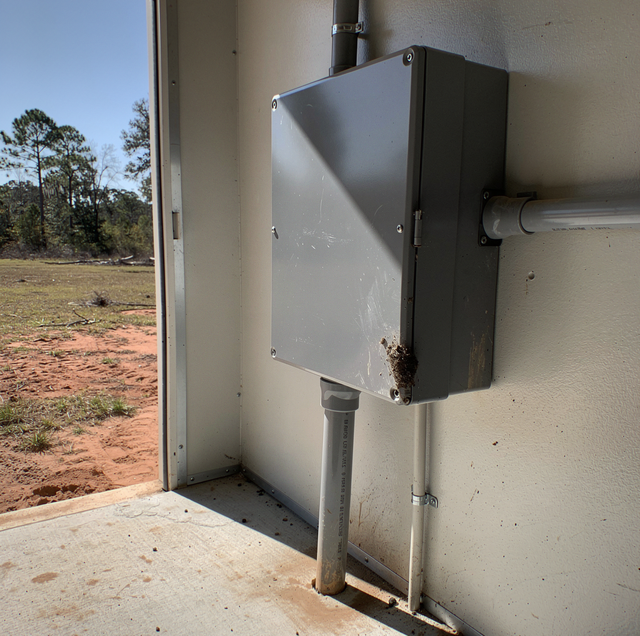
Every well pump and every irrigation controller on your property sits behind the same plain box: grey or almond plastic, mounted on a treated post or bolted to the pump house wall, latch closed, a narrow vent slot cut low on one face. Inside, once a technician opens it, sits a relay or contactor, a run of terminal connections, and sometimes a capacitor, all held in a few cubic inches of dry, still air. Dark, warm, dry, raised off wet ground, and sealed against rain: that combination is exactly what a fire ant colony looks for once its mound floods. This turns out to be the single most common cause of a sudden, unexplained well pump failure across this service area: not a burned-out motor, not a bad breaker, but ants packed into the box that controls it.
A well pump or irrigation control box contains live 240-volt wiring, and internal parts can retain a charge even with the power off. Never open the enclosure, spray inside it, or touch anything inside — call a licensed technician.
Why Fire Ants Get In
Rainy season in North Central Florida raises the water table fast, and a mound built at grade can flood within hours of a heavy storm. Colonies respond by relocating to whatever nearby structure stays dry and off the ground, and a control box sitting a few feet up, vented, and holding a trace of warmth from the coil inside it, reads to the colony as prime ground. Ants travel in through the same gaps a technician uses for wiring: a conduit knockout that was never sealed, the small ring around a cable gland, a lid gasket gone stiff and warped with age, or a mounting screw hole left open. Once one scout finds a way through, the rest of the colony can follow within days, carrying workers and larvae straight into the enclosure.
This isn't limited to well pumps. An irrigation controller box mounted on the same post, or on its own stake out near the valve manifold, is just as attractive, and often more exposed, since it tends to sit lower and closer to the soil the colony is already relocating across. A property can end up with a well pump that won't start, an irrigation zone that won't fire, or both, from a single colony working its way between two enclosures a short walk apart.
What They Do to the Contacts
The failure is mechanical before it is electrical. Once a colony is established inside a control box, ants and nest debris build up directly across the contactor: the mechanical switch that has to close fully for the pump or an irrigation zone to get power. A contactor packed with ant bodies behaves the same way a light switch would with a wad of paper jammed between the contacts: power reaches the box, the relay tries to close, and the circuit still doesn't complete. The same buildup fouls a pressure switch's contact points when ants nest around it instead of, or along with, the contactor. Neither failure looks like a wiring fault from outside the box, and neither trips a breaker, because current never gets the chance to draw enough to trip one. The system simply goes quiet, with every gauge and display reading normal right up until the point nothing runs.
What You'll Notice First
The first sign is almost always a no-start that doesn't match anything else in the system. A well pump won't cycle on when a fixture opens, or a pressure tank stops refilling, with no drop shown anywhere else and no breaker tripped. On the irrigation side, a zone, or the whole controller, simply stops firing, even though the timer display still shows power and a normal schedule loaded. Some owners hear an intermittent clicking from the box, the contactor attempting to close but failing, before the system goes fully silent. Others notice nothing audible at all; the pump or zone just doesn't turn on the next time it's supposed to.
None of this requires visible ant activity in the yard. A colony can be fully established inside a sealed box with no mound and no trail anywhere near the post outside, which is exactly why this failure gets misread as a bad switch, a bad capacitor, or a wiring problem until someone actually opens the enclosure.
Ants inside the box don't always leave visible trails outside it. A pump or irrigation zone that suddenly won't start, especially after several days of heavy rain, is worth a professional look even if the yard shows no ant activity nearby.
What a Technician Finds
Opening a de-energized control box is a licensed technician's job, never a homeowner's, because the enclosure carries line voltage and some components hold a charge after the power is cut. Inside, a technician typically finds a visible ant trail leading from an entry point to the contactor or the pressure switch, packed nest debris across the contact surfaces, and in older cases, corrosion or pitting on the contacts themselves from activity that had been building for a while before it caused a full failure. Clearing the debris and confirming the contacts close and hold is usually enough to restore power to the pump or the irrigation zone on the spot, though a contact set that's already pitted or burned from repeated fouling may need to be replaced rather than just cleaned.
Working the same property for years across North Central Florida, this pattern shows up on service calls again and again: a homeowner assumes the pump itself has failed, and the pump turns out to be fine once the box in front of it is cleared and sealed. The pump motor, the switch, and the wiring downstream of the box are frequently untouched; the failure starts and ends at the contacts ants managed to reach.
What Stops It From Coming Back
Clearing one nest doesn't close the door the colony used the first time, and a box that got in once tends to get a repeat visit unless the entry points are sealed. As part of the repair, a technician packs the conduit runs entering the box with pest-blocking foam and runs a bead of silicone around the lid gasket, cable glands, and any mounting holes or seams ants could use to get back in. Sealing the wiring path and the box seams together is what actually keeps a colony from reestablishing, rather than just delaying the next no-start call. On properties with both a well pump control box and a separate irrigation controller, the same sealing gets done at both enclosures in the same visit, since a colony pushed out of one will simply try the other next.
Frequently Asked Questions
A submersible pump's underwater motor is sealed and out of reach, so ants don't affect it directly. But a heavy nest built around a capacitor's terminals can pack in tight enough to cause arcing and a visible burn mark, which is a separate repair from a simple contact cleaning.
When an ant is crushed inside the enclosure, such as by getting caught as the contactor closes, colonies are widely reported to respond to the alarm pheromone that is released, converging on that exact spot. A cleanout that doesn't also seal the entry points can attract a fresh wave faster than an undisturbed box would.
Yes, both produce the same symptom: the pump won't start, and the breaker never trips. A technician tells them apart by checking continuity across the switch points versus finding physical ant debris packed into the contactor housing; the two point to different repairs.
Temperature swings between summer heat and cooler winter nights expand and contract the conduit and box material over time, which can eventually crack a silicone seam. It's worth having the seal checked during a routine well inspection rather than assuming it's permanent.
Not quite, because the circuits are different sizes. A controller switches a 24-volt signal to each valve solenoid, so debris packed across those station terminals usually takes out one zone or causes the controller to report a fault on that station while the rest of the schedule still runs. A well pump's 240-volt contactor is a single mechanical switch feeding the whole motor, so fouling there stops everything at once, with nothing partial about it.
Not on its own, and dust applied inside an enclosure creates a second problem: the residue settles on contact faces and terminal screws, where it can insulate the exact surfaces the repair was meant to leave clean. Treating the soil and the post is pest control work, a different trade from pump service, and it still leaves the entry points open. Sealing the box is what changes the outcome.
Schedule a well pump or irrigation control box inspection — catch a fire ant problem before it causes a full no-start. Perry-Pump Repair Service LLC serves Lake Butler, Gainesville, Alachua. Call (352) 320-2412.
