

What a Mini Skid Steer Can Reach That Full-Size Can't
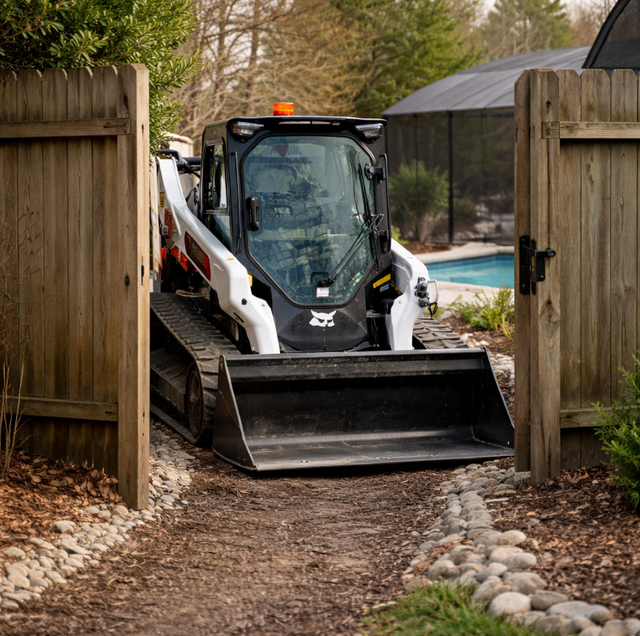
Quick Answer: A mini skid steer typically runs 34 to 44 inches wide, narrow enough for a standard gate. A full-size skid steer runs 60 to 75-plus inches and won't fit through most gates. A mini's smaller bucket means more passes to move material.
A full-size skid steer shows up for a grading job, and it never makes it past the gate. Sometimes it fits through the opening but can't turn around once it's inside, wedged between a fence line and a pool cage with nowhere to pivot. That isn't a skill problem for the operator. It's a machine that's physically too wide for the space, and no amount of careful driving can alter the equipment's dimensions or the gap it's trying to pass through. A mini skid steer, also sold as a compact utility loader or a stand-on loader, exists specifically to solve that problem: a frame narrow enough to get to work areas a full-size machine can't reach at all.
The Access Problem a Full-Size Machine Can't Solve
Turning radius is the part people underestimate. A full-size skid steer doesn't just need to fit through a gate; it needs enough clear width on the other side to skid-steer through a turn (pivoting by driving one side forward and the other in reverse), and that maneuver eats up lateral space fast. A machine that's 68 inches wide might technically clear a 6-foot gate opening, but if the fenced area beyond it is only 10 or 12 feet across, there's no room left to rotate the machine once it's through. The gate was never the only constraint. Everything past it has to be wide enough, too, and a side-yard strip, a narrow path between a pool cage and a property-line fence, or a backyard boxed in on three sides by structures rarely gives a full-size machine that room.
A mini skid steer's compact frame doesn't mean a smaller hazard zone. In a fenced yard with limited sightlines, keep kids, pets, and bystanders well clear of the machine's full swing and turning radius while it's running.
How Much Narrower a Mini Skid Steer Actually Is
The gap in width between the two equipment classes is larger than most homeowners expect. Mini skid steers generally run 34 to 44 inches wide across the frame, with some of the narrowest stand-on models built right around 34 inches specifically to clear a standard gate. A typical full-size skid steer, by comparison, runs 60 to 75 inches or more depending on the model and whether it's on tires or tracks. That's a difference of two to three feet, and in a fenced yard, two to three feet is frequently the entire margin between a machine that fits and one that doesn't. Standard residential gates run 36 to 48 inches wide, which lines up with a mini's frame width with only a few inches to spare on either side, not with a full-size machine's, which usually exceeds even the wider end of that gate range before an operator ever gets near it.
What That Narrower Frame Actually Gets Into
The width difference translates directly into which parts of a property are reachable by machine at all, rather than by hand. A mini skid steer can pass through a standard fenced-yard gate, work in the gap between a pool cage's kickplate and a boundary fence, move through a side-yard strip between two houses, and still have enough room inside a fenced backyard to turn, back up, and reposition for another pass. A full-size machine handles none of those situations, not because it lacks power, but because its footprint simply doesn't fit the opening or the working room beyond it. On an open lot with no fencing, no side yards, and no tight corners, that width advantage disappears and stops mattering, which is exactly why the choice between the two machine classes comes down to the access at a specific property, not a general preference for one over the other.
The Trade-Off: Smaller Bucket, More Passes
A narrower frame comes at a real trade in how much material moves per pass, and that trade-off is worth naming honestly instead of glossing over. A mini skid steer's bucket typically holds somewhere in the 0.15 to 0.4 cubic yard range, while a full-size machine's bucket often runs 0.5 to 1 cubic yard or more. Moving the same volume of fill or spoil with the smaller bucket means roughly two to five times as many passes, and each pass still takes time to load, travel, dump, and return. It's the same difference as carrying mulch to a bed one five-gallon bucket at a time instead of wheeling it over in a loaded wheelbarrow: both get the material where it needs to go, but one takes a lot more trips to move the same pile. For a tight-access job, that added time isn't a downside to work around; it's the trade being made deliberately: more passes in exchange for a machine that can physically reach the work area in the first place, instead of the alternative, which is no machine access and the same volume of material moved entirely by hand.
Ground Weight Changes: What the Machine Can Do, Too
Width isn't the only dimension that matters once a machine is inside a fenced space. A mini skid steer typically weighs 2,500 to 4,000 pounds, well under half of a full-size machine's usual 6,000 to 9,000-plus pounds, and that lighter weight spreads across the ground differently, especially on tracked models. Less weight per square inch means less compaction and less rutting on the lawn the machine has to cross just to reach the actual work area, which matters on a property where the path to the low spot or the pool cage boundary runs straight through turf that's staying. A full-size machine crossing that same lawn to reach a work area can leave rutting that becomes its own repair, on top of whatever grading it was there to do.
Matching the Machine to the Job
A mini skid steer isn't the automatic right call just because one is available. On an open lot with wide, unobstructed access and a large volume of material to move, a full-size machine's bigger bucket and faster cycle time make it the more direct tool, and there's no access problem forcing a trade-off. The decision point is specific: can a full-size machine actually get to the work area and turn once it's there? If a gate, a fence line, a pool cage gap, or a side-yard strip stands in the way, the answer is often no regardless of how much material needs to move, and that's the situation mini skid steer work as a service exists to cover: reaching the spot a bigger machine can't, even if it takes longer to finish once it's there.
Frequently Asked Questions
Sometimes. Most grading attachments (a box blade, a rake attachment, a standard bucket) are built close to the machine's track width, but a wide rake or a grapple can extend two to four inches past the frame on each side. Measure the attachment's outer edge, not just the machine's stated width, against the gate opening before assuming a fit, and check gate hinges and posts too, since hardware can shave an inch or two off the usable clear width.
Most mini skid steers handle a grade transition of roughly 15 to 20 degrees, or a low curb of a few inches, without needing a ramp, and tracked models generally hold traction across an uneven lip (like where a pool deck meets turf) better than a wheeled full-size machine, whose tires can spin or scuff the edge trying to climb the same transition.
Cycle time matters as much as pass count: a mini's shorter travel distance to a small staged spoil pile inside a tight yard can partly offset the extra passes, since a full-size machine hauling material from the same yard often has a longer, more awkward route to its own staging area. A crew working a tight-access job will sometimes set up a spoil pile just inside the gate specifically to shorten that per-pass travel time, trimming some of the extra time the pass-count difference alone would suggest.
Many mini skid steers are stand-on platforms rather than enclosed cabs, which is part of why the frame stays narrow; there's no cab structure to build around. The trade-off is less weather and debris protection for the operator than a full-size machine's enclosed cab, which is more of a crew consideration than a homeowner's.
With a box blade or a grading rake attachment and a laser or manual grade check, a mini skid steer shapes fine grade the same way a full-size machine does on an open lot, just across a smaller footprint per pass. The rake attachment also pulls loose roots and debris out of the top few inches, which is useful prep in a tight space where a separate pass with different equipment often isn't practical.
Some of the narrowest mini units run close to 34 inches at the bare frame, tight enough for a 36-inch pedestrian gate on paper, but the workspace on the other side still has to be wide enough to turn once the machine is through. A gate that's technically wide enough to clear doesn't guarantee the yard beyond it is, so confirm both numbers, not just the gate, before counting on machine access.
A gate that stops a full-size machine cold still leaves a path forward: swap the equipment class, not the plan. Once something narrow enough can actually reach the work area, the grading itself follows the same fundamentals as any other job: reading the ground, setting the right fall, finishing a grade that holds, just accomplished in smaller passes than an open lot would need.
Ask about mini skid steer access for a tight yard — get grading done in spots a full-size machine can't reach. Polk Services LLC serves Lakeland, Highland City, and Mulberry. Call (863) 344-5806.
