

Grading a Shed Pad After Removal: What's Left Behind
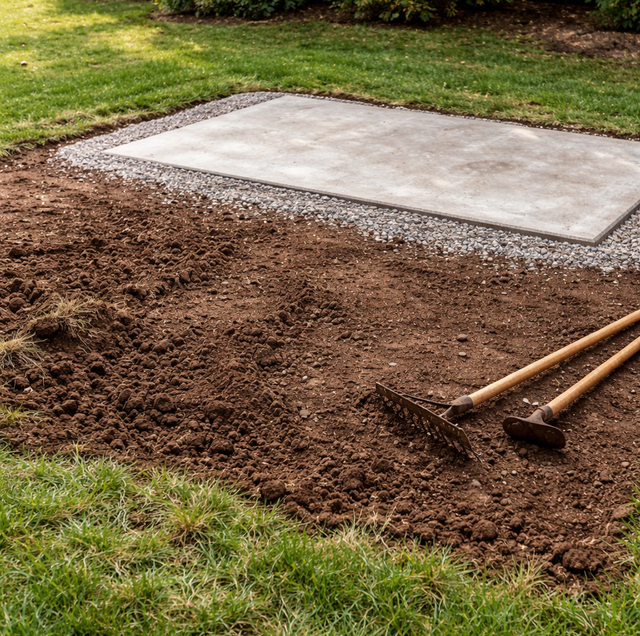
Quick Answer: A shed's old footprint isn't bare ground; it's a compacted pad over soil shaded and undisturbed for years. Grass won't take evenly until the base is broken up, shaded soil blended with the lawn, and any dip graded to match the slope.
Once the shed itself is hauled off, most of what's left behind isn't dirt; it's the base the shed sat on. Depending on how it was built, that could be a bed of compacted gravel, a run of paver blocks on a sand layer, a poured concrete slab, or a scatter of individual footer piers where a wood floor once sat on posts or deck blocks. Whatever the material, it was put there specifically to be hard, flat, and stable, which is the opposite of what grass roots need to establish.
Compacted base material: Gravel or crushed stone spread and tamped down to carry the weight of a structure for years, often 4 to 6 inches deep, packed tight enough that a shovel barely dents it.
That density doesn't go away on its own once the shed is gone. It has to be physically broken up before anything is expected to grow through it.
Why the Old Base Won't Just Grow Grass on Its Own
Grass roots need loose soil, air pockets, and a path for water to move downward rather than sit on the surface. A compacted gravel or crushed-stone base does the opposite of all three: it's dense enough to shed water sideways rather than letting it soak in, and any roots that try to push through it stop cold at the packed layer a couple of inches down. Seed dropped straight onto that surface either washes off in the next rain or germinates in a thin skin of dust that dries out and dies within a week.
A poured slab or a set of footer piers is a more extreme version of the same problem: there's no soil at all where the concrete sat, only whatever thin layer of dust and debris settled on top of it. Seeding that directly is really seeding a rock, not a lawn.
What's Different About the Soil Under the Pad
Even once the hard base material is out of the way, the soil underneath it isn't the same as the soil three feet to either side. It's been shaded and covered for however many years the shed stood, cut off from direct rain, sun, and the normal wet-dry cycling that keeps the rest of the yard's soil loose and workable. Press a thumb into that soil next to a patch of the surrounding lawn, and the difference is obvious by feel alone: the covered soil tends to be dry, fine, and almost powdery, while the lawn soil an arm's length away holds together in a loose clump because it's had years of rain, roots, and biological activity working through it. That texture difference isn't cosmetic. Fine, compacted, biologically depleted soil drains and holds moisture differently than the living soil around it, which is exactly why new grass planted only in the footprint often struggles even after the base is broken up, unless that soil is physically blended with the surrounding soil.
When breaking up the footprint, work the blending zone at least a foot or two past the pad's actual edge, not just inside the old outline. A hard border left at the edge shows up as a visible ring in the grass.
The Mound or Dip Nobody Notices Until the Shed Is Gone
Two things commonly happen to the ground right under a shed's footprint, and they pull in opposite directions. If the shed sat on a raised gravel pad built up to keep water off the floor, that footprint is now a slight mound proud of the surrounding grade. If the shed sat directly on the soil with no built-up base, years of covered ground with no rain reaching it, combined with the weight of the structure itself, can leave a shallow depression instead. Either way, the footprint won't be flush with the surrounding yard, and grading it flat within its own outline, while ignoring how it ties into the rest of the slope, just relocates the problem: a slight mound sheds water onto the surrounding lawn; a slight dip collects it.
Breaking Up and Removing What's Underneath
For a gravel or crushed-stone base, the material generally needs to be brought in rather than tilled into the existing soil as a shortcut. The gravel is screened or scraped off, the compacted layer underneath is broken up with a pick, a garden fork, or a light attachment on a skid steer, and only then does new topsoil go down.
A poured slab or footer piers are a different job entirely: the concrete has to be broken out and hauled off, not covered over. A thin slab poured directly on grade with no rebar can sometimes be broken with a demolition hammer or a heavy attachment; footer piers set below grade often need to be dug out individually. Either way, what's left afterward is a hole or a bare patch that needs to be brought back up to grade with fill, not just leveled in place.
Blending the Repaired Area Into the Rest of the Yard
This is the step that separates a footprint that grows in evenly from one that shows as a permanent patch. After the old base is out and the compacted layer beneath it is broken up, the loosened soil needs to be mixed with topsoil that matches what's around it, not just capped with a layer of new dirt on top of the old dead layer like a bandage. A few inches of screened topsoil worked into the top of the broken-up native soil with a rake or a tiller pass gives new grass roots something consistent to grow through, instead of a distinct boundary a few inches down where roots hit the old compacted layer and stop.
The final grading pass is what ties the footprint's surface into the yard's existing slope rather than leaving it as its own flat island. That means matching the same gentle fall the rest of the lawn already has, not just making the patch level with itself. A rake, a drag mat, or a box blade on a skid steer for a larger area works the loosened soil down to match the surrounding contour, checking with a straightedge or a level laid across the seam between old lawn and new soil to confirm there's no ridge or dip right at the boundary.
Before breaking up a slab, footer piers, or the compacted base, call 811. Power often runs to a shed for lighting, and irrigation lines commonly run along a former structure's footprint, both shallow enough to be caught with a pick or an attachment.
Getting Grass to Actually Take on the New Ground
Once the base is out, the soil is blended, and the grade matches the surrounding yard, the footprint still isn't quite equal to the rest of the lawn on day one. The soil there hasn't had years of root activity, organic matter, or biological life built into it the way the surrounding turf has. A light pass with a core aerator once grass is established, and working in a thin layer of compost or a starter fertilizer appropriate for the grass type going in, helps close that gap faster than leaving the area to catch up entirely on its own.
Frequently Asked Questions
Probe the ground with a metal rod or a long screwdriver in a grid pattern across the footprint; a footer will stop the probe hard within a few inches, where undisturbed soil lets it push through. Individual footer piers under a post-and-floor shed are often round concrete discs, roughly 12 to 18 inches across, set a foot or so below grade, with four to eight of them spaced under the old floor joists.
Remove and screen it out rather than tilling it in. A gravel-and-soil mix still drains unevenly, tends to work its way back to the surface as the ground settles, and can damage a mower blade or a tiller for seasons after the shed is gone. Screened-out gravel can usually be reused elsewhere, such as in a drainage bed or a path base, rather than being hauled off entirely.
Paver and brick pads sit on a leveling layer of bedding sand, usually an inch or two thick, over their own compacted base. Once the pavers come up, that sand layer needs to be broken up and mixed in along with the base below it. Left in place as a thin, undisturbed lens, sand behaves almost like a slab: water perches on it instead of moving down through the soil.
Even after visible grading, soil that sat compacted and shaded for years usually still has some density below the depth of a rake or a light till pass, and it lacks the microbial activity built up in soil that's had years of root growth and organic matter. That combination slows early root development, which shows up as thinner, paler grass compared to the surrounding lawn until the soil catches up, typically over a full growing season.
No. Loose material piled over an unbroken compacted layer or a partial slab remnant doesn't bond with what's underneath it. It settles unevenly, cracks open in dry weather, and can leave a thin shell over a small air gap that collapses under foot traffic or a mower. The compacted layer has to be physically broken up before new material goes on top of it.
A footprint on a slope usually means the pad itself was built up unevenly to stay level, gravel packed thicker on the downhill side, or footer piers set at different depths to keep the old floor level. Breaking that base out often leaves more depth to fill on the low side than the high side, so the final grading pass has to taper the new soil to match the yard's existing slope rather than leveling the footprint into its own flat shelf, which would just create a small terrace that catches water on the uphill side.
Grading a footprint back into the rest of the yard isn't a cosmetic step after the shed is gone; it's what actually determines whether the grass grows evenly there or that patch stays visible for years. The base has to come out, the soil beneath has to be reworked to match the surrounding area, and the surface has to tie into the yard's existing slope rather than stand as a flat or sunken island on its own.
Get the old shed footprint graded and blended into your lawn — the base broken up, the area regraded to match your yard's slope, and left ready for grass. Polk Services LLC serves Lakeland, Highland City, and Mulberry. Call (863) 344-5806.
