

Pet Urine in Carpet Padding: Why New Carpet Isn't Enough
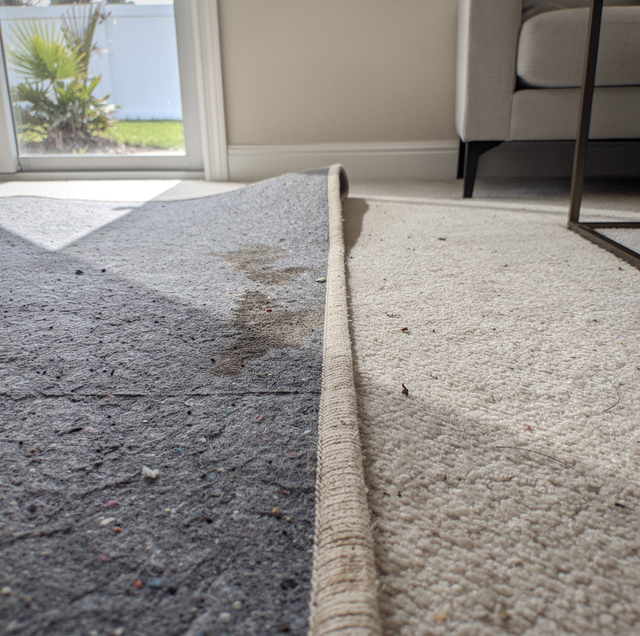
Padding is the layer of a carpeted floor that nobody looks at. It doesn't get pulled up for a routine cleaning, it isn't visible under normal wear, and when worn carpet finally gets replaced, the padding underneath is often the one piece that gets reused rather than swapped, since nothing about its surface hints at what it's holding onto beneath the carpet sitting on top of it. A pet accident changes what that padding is holding without ever making the change obvious: what soaked down into it during the event stays there long after the carpet above it looks and smells fine again.
Carpet Face and Backing Take the First Hit
Carpet face fiber is often treated to resist staining, which sounds like protection but works against you here: the treatment keeps liquid from being held at the surface, so instead of sitting in the fibers where you could see and reach it, the liquid passes on through to whatever is underneath. Underneath the visible pile, the backing is built in two layers, a primary layer woven around the fiber and a secondary layer laminated to it with a latex layer in between. That backing is permeable enough to let liquid through, and repeated wetting can weaken the bond between the two layers over time until they start to separate where you'd never notice it from the top.
By the time you notice a stain or odor coming from the carpet, it has usually already passed most of what it received down to whatever is below it. The fiber and backing are the layers you see and touch first, and they're also the layers that don't hold onto liquid the way the material underneath them does. A stain the size of your hand on the surface does not mean the problem underneath is the same size.
What the Padding Underneath Absorbs and Holds
Padding is open-cell material, which means it is built to absorb, and it can hold many times its own dry weight in liquid before it even starts to feel saturated to a hand pressed against it. Most padding installed under residential carpet is bonded padding, sometimes called rebond, made from shredded foam scrap of different colors and densities pressed and glued back together into a single sheet. That construction matters here: instead of one solid, uniform material, you have thousands of small pieces bonded at their edges, with tiny gaps running between them, and liquid moves along those gaps rather than staying put in one spot the way it might in a denser, more uniform foam.
Padding sits directly against whatever is beneath it, with no barrier layer in between, so what it holds does not stay isolated. Of everything a deposit passes through on its way to the floor, the padding is built to absorb more than the layers around it and to hold what it absorbs the longest, both because of its open-cell structure and because it's positioned to catch what the carpet above it already let through. Pulling the carpet up and leaving the padding in place does not remove that; it just exposes it to the air.
Replacing the carpet and pad without addressing the tack strip and sub-floor leaves the layer built to hold liquid the longest still in place, so the smell can return after the new flooring goes down.
Tack Strip and Sub-Floor Absorb What Gets Past the Padding
What makes it past the padding does not stop moving once it gets there. Tack strip is untreated wood, nailed or glued down to hold the carpet's edge in place, and it absorbs liquid directly with nothing between it and whatever reaches it. Below that, a plywood or OSB sub-floor absorbs into the wood fiber itself, and it also travels along the seams where individual sheets meet, since those seams are the path of least resistance across an otherwise solid surface. The wood fiber pulls moisture along the grain as it absorbs it, which can spread the affected area wider underneath than the stain on the tack strip above would suggest.
None of this is something a removal visit corrects. Remediation, sealing, encapsulation, antimicrobial treatment, and sub-floor refinishing are different trades, and that work gets referred out rather than performed on-site. A remediation professional is who assesses what's salvageable in those layers, using proper instruments, not the crew hauling the carpet. What removal does is take the contaminated material away; it does not treat what the material left behind in the wood underneath it.
Why the Same Spot Rarely Gets Hit Just Once
A pet returning to the same spot isn't accidental. Scent left behind by a previous accident serves as a marker that draws the same animal back to the same location, meaning one spot in a carpeted room often accumulates several separate deposits over weeks or months rather than a single event. Each additional deposit lands on padding that never fully dried out or was never treated after the one before it, so the material at that spot is holding compounded saturation, not one contained amount. That's a different problem than a single spill: the volume the padding holds at that location is the sum of every accident that happened there, and there's no way to look at the surface and tell how many separate events are represented beneath it.
A repeat spot near a wall or doorway compounds sideways too, since the perimeter gap under the baseboard and a doorway's transition strip give it room to spread past the padding directly underneath.
What a Partial Replacement Actually Removes
New carpet over the same padding, tack strip, and sub-floor changes what you see without changing what's underneath it. New paint over a water-stained wall changes the color, not the source of the stain. The material producing the odor is still sitting in the layers that were never touched, and it does not need a fresh event to make itself known again: humidity alone can be enough to bring the smell back, on top of any future wetting of the same area.
A partial job takes out only the layer that was already carrying the least of what happened here, and leaves the padding, the tack strip, and the sub-floor exactly as contaminated as they were before the new carpet went down. The visible layer and the retained problem were never the same size to begin with, and swapping one for the other does not shrink the other down to match.
Frequently Asked Questions
A black light only shows fluorescence where a deposit sits on the surface it last touched, not how far it traveled downward from there. A reading that looks contained on top can still sit above padding or a sub-floor that took on far more than the visible mark suggests, since depth isn't part of what the light reveals.
Yes, though differently. Wood absorbs along its grain, pulling moisture inward and along the fibers; concrete absorbs through its pore structure instead, taking in liquid while also carrying it sideways across the slab's surface. That lateral spread can carry a deposit outward beneath the padding in a direction the visible stain on the carpet never indicated, since concrete moves moisture both into itself and across itself simultaneously.
Plywood is layered wood veneer, so it tends to absorb evenly across the grain of each layer. OSB is compressed wood strands bound with adhesive, and it tends to swell and soften at the surface where a deposit sat rather than absorbing evenly through its thickness. Both hold liquid, but they show the damage differently once the flooring is opened up.
Yes. Padding does not distribute what one spot absorbs to the rest of the room, so a second location develops its own compounded saturation independent of the first. A room with three or four repeat spots effectively has three or four separate padding problems sitting under the same piece of carpet, not one larger version of a single problem.
Not reliably. An enzyme treatment applied to the carpet face has to travel down through the backing, which resists it the same way it resisted the original deposit, so most of what's applied stays higher in the stack than the contamination it's meant to reach. Treating the surface can mask odor for a while without doing anything to what's saturated several layers down.
Not necessarily worse, just newly noticeable. Humidity, temperature swings, and normal foot traffic can reactivate a smell that was always still there in the untouched layers; it isn't spreading or growing on its own, it's the same contamination becoming detectable again under different conditions.
The smell a new carpet cannot fix is still sitting in the layer underneath it — have that layer taken out rather than covered over. Polk Services LLC serves Lakeland, Highland City, and Mulberry. Call (863) 344-5806.
