

Alachua County Horse Paddock Irrigation: A Pump That Never Rests
On a horse property, the water system doesn't get evenings or weekends off. Automatic waterers refill through the night; water is drawn at the barn at unpredictable hours; and if the property irrigates pasture or a hay field, that line runs on its own schedule on top of everything else the well is already carrying. The shop schedules a fair amount of its Alachua County agricultural and equestrian work around that calendar: which paddocks are drawing hardest in July, which wells are carrying barn and pasture load together through a cold snap in January, and which pumps have been cycling without much of a break in between. None of that changes because a season does. What changes is which part of the system is under the most strain.
The Year-Round Demand a Horse Paddock Puts on a Pump
A single-family home draws water in a handful of predictable bursts: a shower, a load of laundry, running the sprinklers for twenty minutes. A horse property doesn't work that way. Multiple automatic waterers across separate paddocks each call for water independently; someone draws water at the barn at an hour that nothing predicts; and a pasture or hay-field irrigation line adds a second demand stream to the same well. The well pump isn't responding to one request and is resting. It's answering many small ones, staggered across the day, month after month, with no real off-season.
That pattern matters more than any single hot day or cold night. A pump built and sized for occasional residential draws behaves differently under this kind of constant, overlapping demand than one that's actually matched to a working horse property. Continuous, overlapping cycling is simply a heavier-duty cycle than most residential wells ever see, and it's the baseline condition on a property like this, not an exception.
Summer Heat and Constant Cycling Wear a Pump Just as Hard
Summer is when this demand peaks. Horses drink more in the heat, waterers refill faster and more often, barn draws come more often, and if the property irrigates pasture or hay ground, that line is running through the hottest, driest stretch of the year to keep grazing viable. The pump is doing its heaviest, most continuous work exactly when ambient heat is already highest around the equipment.
Heat and constant cycling stress a system in ways that are easy to underestimate because nothing looks dramatic in the moment. A motor running near-continuously through a Florida summer, on top of ambient temperatures that are already high, puts real wear on the same components that a cold night threatens on the other end of the year: bearings and shaft seals wear faster under sustained duty than they do under the light, intermittent cycling a typical house sees. A horse property's water system works more like a full-time crew member than a household fixture, expected to perform without complaint, unsupervised, in every month of the year, including the ones that get none of the attention.
The Handful of Hard-Freeze Nights Alachua County Actually Gets
January is the other end of that same year, not a separate problem. North Central Florida gets only a handful of nights each winter cold enough to put any real stress on well equipment, not a season's worth. That's worth saying plainly, because it changes how a horse property owner should think about it: this isn't a months-long condition to manage the way a northern property manages a real winter. It's a short list of specific nights, scattered through one part of the calendar, layered on top of a system that's already working hard the rest of the year from heat and cycling alone.
Treating those few nights as the system's only real threat misses the bigger picture. The pump and its exposed connections are under load in July too. January just adds a different kind of stress, briefly, to a system that never actually gets a season off.
What Above-Ground Exposure Actually Means for Pumps and Pipework
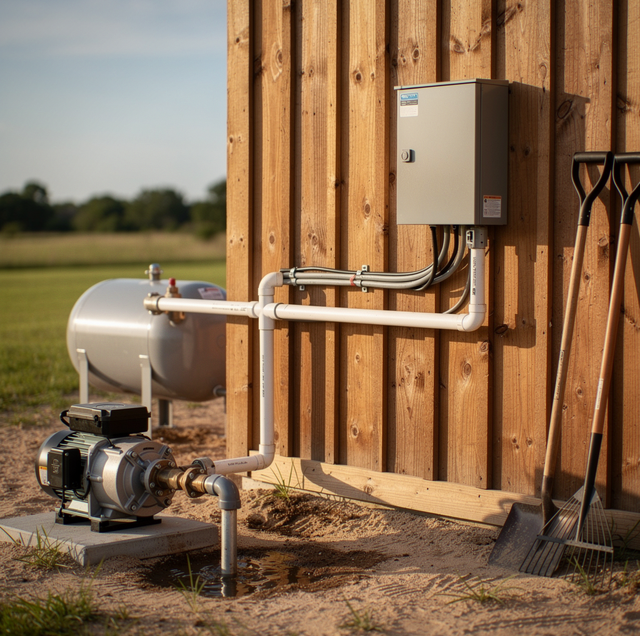
Cold doesn't reach a well system evenly. A submersible pump sitting well below grade, and buried supply lines running underground between the well and the barn, are insulated by the surrounding earth and largely unaffected by a single cold night. What a hard freeze actually reaches is whatever sits above ground or close to it: an above-ground pump housing, the wellhead itself, the short exposed run where the well ties into the service line, and the pressure tank, pressure switch, and control box mounted alongside them.
A pressure switch or control box mounted in the open collects dust, insects, and moisture year-round, not just in January. A routine well inspection is the natural point to have that enclosure and its wiring checked.
That's the practical distinction that matters here: it isn't "the well" that's vulnerable to a January night; it's specifically the above-ground, exposed portions of the plumbing and equipment. On most horse properties, that's a defined, findable list, not the whole system, which is exactly why a technician who knows what to look for can address it without treating every fitting on the property as equally at risk.
The Whole-System Look a Working Horse Property Needs
A visit built around a working horse property looks at the whole picture, not just whatever season it happens to be. That means assessing the pump itself for signs of wear consistent with heavy, near-continuous cycling, checking the pressure tank, pressure switch, and control box that sit above ground, and looking at the wellhead and the well-to-service-line connection, which are the parts of this system a cold night can actually reach. Depending on what's found, that can mean well pump repair, submersible pump repair, pressure switch and control box replacement, or a well inspection to establish a clear baseline before flagging anything as urgent.
Control boxes and pressure switches carry live 240V circuits. Never open a control box or handle a capacitor. Electrical work on a well pump system is licensed-technician-only, every time, regardless of season.
For a property running paddock waterers and a pasture or hay-field line off the same well, irrigation pump repair is often part of the same visit, since the mechanism straining that pump, constant cycling under real demand, is the same one working on it the rest of the year. What is actually at stake here is the continuity of water for the animals. A horse drinks somewhere in the range of five to ten gallons a day, more in heat and more again on hay, and a trough that stops refilling becomes a welfare problem inside a single afternoon rather than an inconvenience that can wait for a convenient morning. That is the argument for looking at a system while it is still running, rather than after the paddocks have gone dry.
Frequently Asked Questions
A pump sized and rated for continuous or near-continuous cycling is built to handle sustained run time without the thermal buildup that would trip a standard residential unit's overload protection. On a property with multiple waterers and a separate irrigation line, matching the pump to that duty cycle, rather than to occasional residential-style draws, is often the actual fix behind what looks like a random shutdown.
The pump itself, sitting below grade, is largely shielded by the surrounding soil. The vulnerable points are the components at or near the surface that connect to it: the pitless adapter where the underground line meets the wellhead, and any check valve mounted above ground, both of which sit right at the transition between buried and exposed plumbing.
Each waterer has its own float valve that opens independently whenever its trough drops, so several paddocks refilling at different times throughout the day and night trigger separate, short cycling events rather than one longer draw. That staggered pattern is what pushes total daily cycle count well above what a single-tap household ever sees.
A capacitor helps the motor start under load and can hold a charge even after the system's power is switched off. That's a separate hazard from the live 240V wiring itself, and it's part of why control box work is left strictly to a licensed technician rather than something a property owner should open.
Pressure at the troughs sags for the length of that set. The irrigation line is the steadier, larger draw, so the float valves are refilling against whatever pressure is left over, and a trough that normally fills in a minute can take several. That is tolerable most of the time. Where it stops being tolerable is when several waterers call mid-set and barely trickle, which is usually the point a second, dedicated pump for the field line becomes a more workable answer than pushing one pump harder.
A pressure tank holds a cushion of air that lets small draws be served without waking the pump at all. Once the bladder fails or the air charge is gone, the tank absorbs nothing, and the pump starts on every small call instead. On a property where float valves are opening at all hours, that converts a few dozen daily starts into several hundred, and a motor wears through start current far faster than through run time. It is one of the first things worth checking when a pump on a working property starts dying years early.
Schedule a well system check for your horse property — get the pump, pressure components, and exposed pipework looked at before hard demand or a cold night finds the weak point first. Perry-Pump Repair Service LLC serves Lake Butler, Gainesville, and Alachua. Call (352) 320-2412.
