

Gravel vs. Asphalt Driveway: Which Holds Up Better?
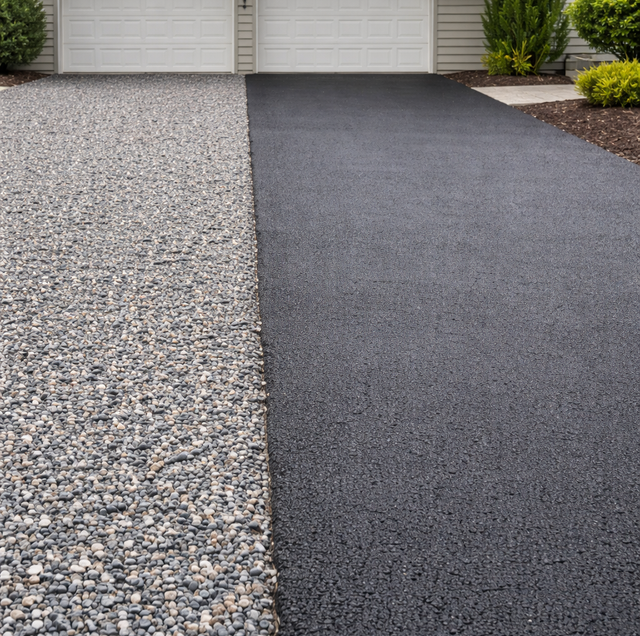
Choosing between gravel and asphalt for a driveway usually comes down to one question you don't think to ask until you already own the surface: how much upkeep are you signing up for? Both materials can serve a home well for years, but they wear differently, respond to rain differently, and require different kinds of attention on different schedules. Understanding those patterns before you commit or decide whether to keep maintaining what's already there saves you from surprises down the road.
How Asphalt Wears Down Over Time
Asphalt is a petroleum-based binder holding aggregate together in a solid sheet, and that binder responds to heat and sunlight more than most homeowners expect. Prolonged sun exposure gradually dries out the binder's oils, making the surface more brittle and prone to cracking earlier than in cooler, cloudier climates. In the meantime, high daytime temperatures can soften asphalt enough that a vehicle parked in the same spot for days, especially something heavy like a boat trailer or a work truck, leaves a shallow depression or rut. That's the surface deforming under the weight while it's at its softest, though repeated or deep rutting can also indicate a thin mix design that was never built for parked heavy loads.
Temperature swings between a hot afternoon and a cooler night cause the material to expand and contract repeatedly. Over enough cycles, that movement opens hairline cracks, usually first at the edges of the driveway or wherever the base underneath isn't perfectly uniform. Left alone, a hairline crack doesn't stay hairline. It widens a little each season, and once it's wide enough to let water sit inside, the crack starts working against the base layer rather than just the surface.
Because of this, asphalt has a maintenance rhythm built around sealcoating, a protective layer paving contractors generally recommend reapplying every few years to slow UV drying and keep small cracks from turning into edge failures. Skipping that cycle doesn't cause immediate damage, but it does shorten the window before patching or a full resurface becomes necessary instead of routine upkeep.
What Gravel Asks of You Instead
Gravel, whether it's compacted limerock, crushed concrete, or angular stone, doesn't fail the way asphalt does because there's no solid surface to crack in the first place. Instead of one material degrading as a sheet, gravel loses its shape gradually: traffic pushes stone toward the edges and low spots, tire paths compress and develop shallow ruts, and the surface loosens on top even as the compacted base underneath stays sound. That's the normal behavior of a surface made of loose material, and it's managed with periodic regrading and topping off with fresh stone rather than resurfacing or patching.
That maintenance pattern is lower-effort per visit but more frequent than asphalt's. Where asphalt mostly sits untouched for years between sealcoat cycles, a gravel drive benefits from a look every season or so, especially after a stretch of heavy use or heavy weather, to redistribute stone and knock down any ruts before they deepen. Skip that for a long stretch, and the driveway doesn't fail outright, but it does get progressively rougher to drive on and loses depth in the wheel paths.
How Heavy Rain Affects Each Surface Differently
Heavy, sustained rainfall is common in Central Florida for a good stretch of the year, and it exposes each surface's weak point differently. Asphalt is solid, so water runs off the top the way it's designed to, right up until a crack opens a path into the base. Once water gets under a solid surface, it can erode or soften the compacted base material, and that's how a small surface crack turns into a soft spot, then a pothole, over a few rainy seasons. The crack is the vulnerability; the water finds it and does the real damage below where you can't see it happening.
Gravel handles bulk rainfall differently because water passes through the surface itself rather than running off the top. That's an advantage in a downpour: less standing water, less sheet runoff carrying stone toward the street. The trade-off is that heavy, fast-moving water can wash finer material out of the mix or carve shallow channels if the driveway isn't graded with a sufficient crown or slope to shed water evenly. A gravel driveway on a flat or poorly graded base is more prone to this kind of washing than one that's been graded correctly from the start.
Why the Base Layer Matters More on Sandy Soil
Central Florida's sandy soil shifts and compacts differently from clay-heavy soil in other parts of the country, which changes what each surface needs beneath it. Asphalt needs a stable, well-compacted base because the solid surface above it has no give: if the base settles unevenly, the asphalt cracks or dips right along with it, since it can't flex to absorb that movement. That's part of why an asphalt driveway installed over a poorly prepared base tends to show problems earlier than one installed over sand that was properly compacted and stabilized first.
Gravel is more forgiving of minor base settling because the surface itself is loose and can be redistributed. A low spot in a gravel driveway gets topped off with more stone; the same low spot under asphalt means cutting out and repairing a section of solid material. That difference in base sensitivity is a big part of why gravel's maintenance stays incremental, a bit of regrading, some added stone, while asphalt's maintenance tends to arrive in bigger, less frequent jobs.
Matching the Surface to How the Driveway Gets Used
Neither surface is the automatic right answer; it depends on what the driveway sees day to day. A long driveway that gets light, regular passenger traffic and doesn't see standing heavy equipment tends to hold up fine either way, and the choice comes down to how much routine attention you want to put in versus how much you want maintenance concentrated into occasional bigger jobs. A driveway that regularly parks something heavy in one spot, or that sits on a noticeable slope, tends to show each surface's weak point faster: rutting and softening under parked weight for asphalt, washing and displacement on a slope for gravel that isn't graded well, and in gravel's case that's usually a regrading and topping job rather than a rebuild.
Frequently Asked Questions
It varies by material as much as by traffic and rainfall. A looser, rounder stone that shifts and displaces easily under tires often needs a top-off every year or two, while a denser, well-compacted material like crushed millings can go several years or longer between full toppings, since its bound surface sheds less material to begin with.
It can, if there's no fabric barrier laid under the stone before it's placed. A woven geotextile fabric blocks most weed growth from below; without it, seeds settle into the gaps between stones and take root over time. Asphalt mostly avoids this because its surface is sealed, though weeds can still find a foothold in an established crack.
Small, isolated cracks can often be filled as a stopgap, but a cold-patch fix is temporary. It doesn't bond to the surrounding asphalt the way a proper hot-mix repair does, so the patch edge tends to separate again within a season or two, especially with repeated expansion and contraction. Asphalt paving, patching, and sealcoating are a separate specialized trade from what this comparison covers.
Gravel over a properly built, deep compacted base generally holds up better under a stationary heavy load, not because loose stone spreads weight on its own, but because a dip that develops gets topped off and re-compacted rather than cut out and patched. Asphalt can develop a shallow rut under a heavy trailer left in the same spot for an extended stretch, particularly during the hottest part of the year when the surface is softest and has the least resistance to a fixed point load.
Yes. A driveway with a noticeable grade lets gravel wash downhill during heavy rain unless it's graded with a slight crown or edged with a header to hold stone in place. Asphalt holds a slope without shifting, but it channels all that runoff to one low point, which needs somewhere to drain or it pools there repeatedly.
It can, and there are two routes: breaking up and hauling off the old surface entirely, or breaking the failed asphalt down in place and folding it into the new base once any large cracked or heaved sections are broken up first. Which route fits depends on how thick the existing surface is and how far gone it is; either way, it's more involved than a routine gravel refresh.
Schedule a gravel driveway assessment — we'll look at your climate exposure and traffic before recommending a build. Polk Services LLC serves Lakeland, Highland City, and Mulberry. Call (863) 344-5806.
