

How Long to Wait Between Grading and Sod Before It Sinks
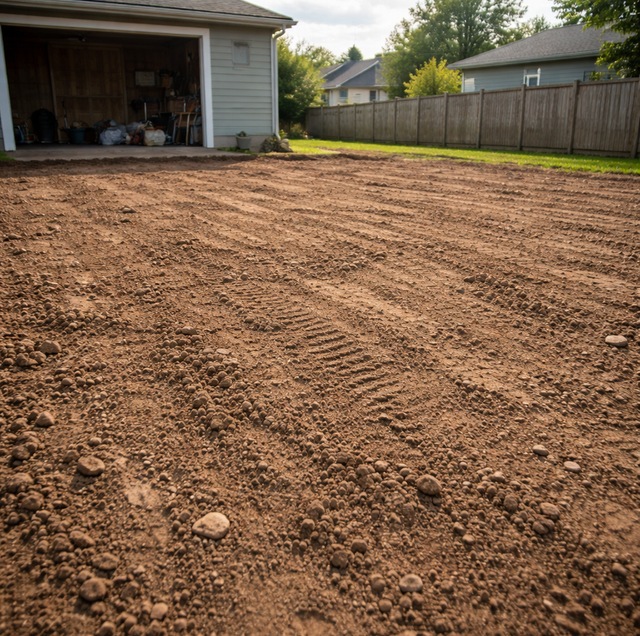
Quick Answer: There is no single number that fits every job. Plan on two to four weeks between a regrade and laying sod, enough to catch one rain event. Test the ground: has settling stopped, and is it damp enough to root sod without saturating?
You just had a yard regraded, or you're about to. The soil looks smooth, the slope looks right, and it's tempting to get sod down on it within a day or two so the bare dirt doesn't sit there. Rushing that step is one of the more common ways a brand-new grading job ends up with a soft dip or a dead patch of turf a few months later, and by then the sod is already rooted over whatever the ground was hiding.
Why Freshly Graded Soil Still Needs Time to Move
Grading and compacting a yard rearranges a large volume of soil, and even well-compacted soil doesn't settle the moment the equipment leaves. Water works into the small gaps between soil particles, air pockets get pressed out gradually rather than all at once, and the soil's own weight keeps pulling it down a little further every time it gets wet and dries out again. None of that shows up as a dramatic sink. It shows up as an inch here, half an inch there, in spots that were never quite as compacted as the rest.
Freshly graded fill still behaves a little like a mattress pulled out of its packaging: pressed flat by a hand, it looks and feels done, but it keeps settling a little more with every bit of real weight and moisture that comes to rest on it over the following weeks, until it finds where it's actually going to sit.
That's the entire reason for the wait. Giving the ground a stretch of time, ideally one that includes a real rain event, lets any spot that's still moving show itself as a shallow dip you can still see and fix while the soil is bare. Lay sod over that same spot too soon and the new turf doesn't stop the settling underneath it. It just hides it. The dip still shows up eventually, but now it's a soft spot in an otherwise established lawn, and fixing it means cutting into finished sod rather than running a rake over open dirt.
If a test hole or settled spot runs deeper than a few inches, fresh fill may need to be added and compacted before the ground is ready. Call 811 before digging beyond a shallow test hole to locate buried utility lines first.
What the Wait Actually Depends On
Two to four weeks is a reasonable planning range, not a fixed rule, because several things push it shorter or longer:
How the fill was placed: Soil spread and compacted in thin layers during the regrade has already had most of the air mechanically removed, so it needs less time to settle on its own. Soil that was dumped and graded in one thick pass has more hidden settling still ahead of it and deserves the longer end of the range.
How much new fill went in: A light regrade that reshaped existing soil without adding much material can be ready closer to the two-week mark. A job that brought in several inches of new fill across a low area has more material working its way into place and should get closer to a month, especially over the deepest sections.
Rainfall since the grading finished: A real rain event, not a light sprinkle, is what actually tests the ground. If nothing but dry weather has passed since the grading was done, the wait needs to stretch until either a real rain happens or an equivalent watering routine is run in its place.
Soil type: Sandy, fast-draining soil settles and reveals problems faster because water moves through it quickly and repeatedly. Denser, clay-heavy soil holds water longer and can take an extra week or so to show whether a spot is still moving, since each wet-dry cycle takes longer to complete.
Soil Moisture at the Time of Laying Matters As Much As the Wait
Timing the wait correctly still isn't enough if the soil is in the wrong condition on the day the sod actually goes down. Moisture at that moment affects the sod as directly as the settling issue does, in two opposite directions.
Sod laid on bone-dry, hard graded soil: roots have to push down into the soil beneath the pad to establish, and dry, crusted ground resists that the same way any hard, sun-baked surface resists anything trying to get through it. Roots that can't penetrate stay shallow, and shallow-rooted sod is the sod that curls at the edges and browns off in the first stretch of hot weather.
Sod laid on saturated, waterlogged ground: the opposite problem. Roots need oxygen in the soil around them, and soil that's still holding standing water or is soaked through has pushed most of that air out. Roots sitting in that condition can suffocate and rot before they ever get a foothold, and the sod pad itself can slide or shift underfoot on ground that's too soft to support it.
The target sits between those two: soil that's evenly moist a few inches down, holding together loosely when squeezed in a hand rather than crumbling to dust or running water between the fingers. If a real rain hasn't fallen close enough to install day, watering the graded area the day or two before delivery, rather than flooding it right before the sod crew arrives, gets it into that range without oversaturating it.
The Practical Test for "Ready"
The most reliable check doesn't need a tool. It needs one real rain event and a pair of boots.
After a rain, walk the graded area and look at how it behaves. Water should soak in within an hour or two across the entire surface, not pool in one section while the rest drains away. Press a boot heel into several spots, including any area that got new fill. Ground that's finished settling gives about the same firm resistance everywhere. A spot that sinks noticeably deeper than the ground around it, or that stays soft and spongy well after everywhere else has firmed back up, is still moving and isn't ready yet.
Run that same check again after the next rain if a spot fails it. Most yards pass on the first real rain event within the two-to-four-week window. A section that's still soft after two separate rain events usually means the fill under that spot needs to be dug out, checked, and re-compacted before sod goes anywhere near it, rather than waiting through a third cycle and hoping it settles on its own.
What to Do If a Spot Fails the Test
If the boot-heel check turns up a soft or sinking area, don't patch it from the top with a thin layer of new soil and try again next week. A shallow patch over loose fill underneath doesn't fix what's actually moving down there. The spot needs to be opened up, the loose material worked out or added to, and properly compacted, then run through the same rain-event test again before sod covers it. It's a slower step than skipping straight to installation, but it's a lot less work than pulling up sod that's already rooted in over a spot that never finished settling.
Frequently Asked Questions
Only on a very light job, such as a topdressing pass that reshaped existing soil without bringing in new fill. Anything that added several inches of fill across a low spot needs the full wait, because that's the material with the most settling still ahead of it. There's also a limit working the other direction: sod is a cut, living product, and most sod suppliers recommend it go down within 24 to 48 hours of harvest and delivery, since a pallet left rolled up longer than that can start heating and yellowing inside the stack. That means the ground's readiness and the sod's own shelf life both have to line up on delivery day, not just the settling timeline.
It can substitute for a natural rain event, but one long soak isn't the same test. Running a sprinkler over the area for a shorter session every other day over the course of a week, then checking with a boot heel after each one, mimics how a real rain event works the soil over several cycles rather than just showing how fast the water drains on a single pass.
Dig a small test hole, about six to eight inches deep, in the questionable spot. Ground that was simply graded a little unevenly shows the same soil structure and resistance all the way down, because it never moved after the initial pass. Ground that's still settling usually shows a looser, more crumbly texture in the fill layer compared to the firmer, undisturbed soil just below it, and the boot-heel test on that spot will keep giving a softer reading than the surrounding area after each rain.
It can, depending on what soil the sod was grown in. Sod grown on a sand-based farm root system tends to knit into slightly looser, still-settling ground faster than sod grown on a heavier clay-based farm soil, which needs a firmer, more finished base to root well. Ask the sod supplier what base soil their sod was grown in before deciding how much buffer to build into the wait.
A final pass with a plate compactor or roller after shaping can press some of the settling out of the top several inches ahead of time, which can trim a few days off the wait on a light regrade. It doesn't replace the rain-event check, since a compactor tests resistance under a static load, not how the ground drains and holds up once water moves through it, which is the condition sod actually has to survive.
That's common on a job with uneven new fill across the site, where a shallow section settles faster than one that received several inches of new material. It's fine to hold off on sodding the deeper section a little longer while the rest of the yard is ready, rather than treating the whole yard as one single wait. Match the timing to each area's own boot-heel test result, rather than to the fastest or slowest spot in the yard.
There's no calendar date that settles this. A real rain event and a hands-on check show what the ground will do before sod locks the surface in place, and that test is worth more than any fixed number of days.
Schedule a post-grading readiness check before you order sod — a walk-through that confirms the ground has settled and is holding right where it needs to. Polk Services LLC serves Lakeland, Highland City, and Mulberry. Call (863) 344-5806.
