

Gunite vs Fiberglass vs Vinyl — What Changes at Demolition
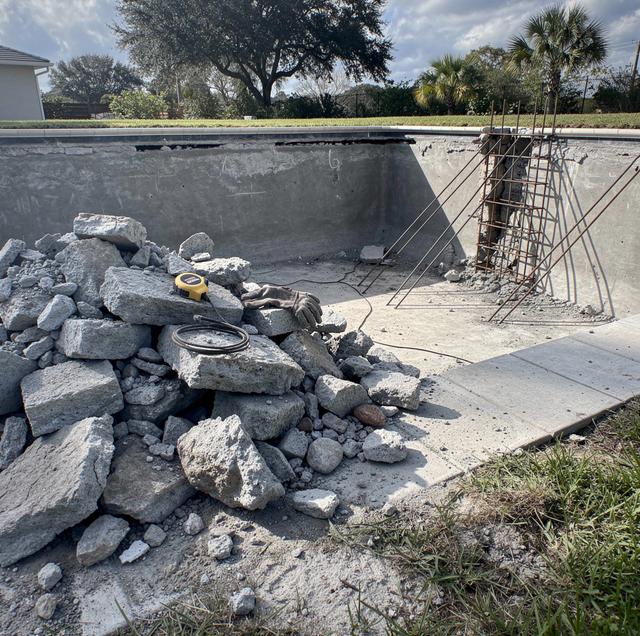
Quick Answer: The shell type, gunite, fiberglass, or vinyl-liner, decides the demolition method more than anything else about the pool. Gunite is broken apart, fiberglass is cut into sections, and vinyl-liner pools come apart at the panel seams.
The surface you see when a pool is full or newly drained tells you almost nothing about what is actually holding it up. A troweled white plaster finish, a pebbled aggregate finish, and a smooth gelcoat finish can all sit on completely different structures underneath the waterline, and the structure underneath is what decides how the demolition actually goes: what has to be cut, what has to be broken apart, and what can stay in the ground once the job is done versus what has to leave the property. Three shell types account for almost every residential pool: sprayed concrete (also called gunite or shotcrete), fiberglass, and vinyl-liner. Each one comes apart by a different method, and each one leaves a different kind of debris behind.
How a Gunite Pool Comes Apart
A gunite or shotcrete pool starts as a cage of steel rebar, tied together in a grid and shaped to match the pool's exact walls and floor. Concrete is then sprayed over that cage under pressure: dry-mix, which is what gunite properly refers to, or wet-mix, which the trade usually calls shotcrete. Either way, it cures into a single continuous mass, with the steel locked inside. There is no seam between the wall and the floor, as there can be with a panel system; it is one sprayed, reinforced structure from footing to coping. Whatever finish you see on the surface, whether a troweled plaster coat, a quartz aggregate blend or a pebble aggregate finish, is a thin layer applied over that structural shell. It changes the texture underfoot and the color of the water. It does not change what is holding the pool up.
Demolition on a gunite shell means working the mass apart with a breaker or hammer attachment, breaking the concrete down in sections rather than trying to lift it out whole the way a fiberglass shell can be. As each section opens up, the embedded rebar gets cut or sheared free so it does not snag equipment or leave hooks of exposed steel sitting in the debris. What is left is angular broken concrete with steel fragments mixed through it, which is a very different material to manage than what comes out of a fiberglass or vinyl-liner pool, and it is the reason gunite and the other two-part company on what goes back into a pool cavity.
Freshly cut or sheared rebar leaves sharp, jagged ends that can puncture skin or gear. Anyone walking the excavation while gunite demolition is underway should stay clear of the active break zone until the crew has cleared the exposed steel.
What a Fiberglass Shell Means for the Job
A fiberglass pool is a different animal from the ground up. The whole shell is molded as one piece in a factory, with a gelcoat finish on the inside face that gives you the smooth, often blue-tinted surface most people recognize. That shell is set into a prepared bed in the ground, and backfill material is packed in against the outside walls as the pool is filled with water, so the shell and the backfill end up supporting each other. On its own, the fiberglass is not built to resist soil pushing in from outside. Drain the pool and release the water pressure from the inside face; the shell is relying on the backfill alone to hold its shape.
That changes the demolition approach completely. Instead of breaking a mass apart, the contractor cuts the shell into manageable sections and removes them piece by piece. The material is lighter than broken concrete and not granular fill, so it contributes almost nothing usable to the cavity and is normally loaded out instead. The equipment inside the pool comes out ahead of the shell itself.
How a Vinyl-Liner Pool Is Built, and Why That Changes Everything
A vinyl-liner pool looks the most substantial of the three and is the least. A vinyl-liner pool's walls are steel, aluminum, or polymer panels, bolted end to end around the perimeter and set on top of a concrete footing collar that anchors the bottom edge. The floor underneath is not concrete at all; it is a troweled bed of vermiculite or sand, shaped to the pool's contours. The vinyl liner is a membrane that is clipped into a track running along the top edge of the panels. It holds water, but it is not load-bearing.
A vinyl-liner installation usually has no concrete shell at all, aside from the footing collar and any concrete deck that surrounds it. Demolition here starts by pulling the liner out of its track, then freeing the wall panels section by section rather than breaking them as a gunite wall is broken. Steel panels usually unbolt at the seams once they are accessible; polymer panels are more often cut through at the seams instead, since the fasteners can be harder to free cleanly after years underground. The footing collar is the one piece of actual concrete in the whole structure, and that gets broken out last, once every panel is clear of it.
Cutting fiberglass laminate throws glass fibers and fine dust that irritate skin, eyes, and airways. Anyone near the cut needs respiratory protection, and bystanders belong well back from the work while it is underway.
Shell Type at a Glance
Whoever is doing the work will confirm your shell type before the scope is set, but this is the general pattern:
| Shell Type | What Is Underneath | Demolition Method | What Can Stay in the Cavity |
|---|---|---|---|
| Gunite/shotcrete | Steel rebar cage inside sprayed concrete | Broken apart with a breaker attachment; rebar cut free as it is exposed | Broken concrete, once it is broken down |
| Fiberglass | One-piece molded shell relying on backfill and water pressure | Cut into sections and removed | Effectively nothing usable as fill |
| Vinyl-liner | Bolted steel, aluminum or polymer panels on a concrete footing collar, sand or vermiculite floor | Liner pulled, panels unbolted or cut, collar broken out last | Only the footing collar concrete |
What Stays on Site and What Has to Leave
The practical difference between these three shell types comes down to one question: what can go back into the hole. Broken gunite concrete is inert granular material, so once it is broken down to a manageable size, it can be used to fill the cavity, alongside the compacted soil and stone that make up the bulk of the backfill. Steel rebar fragments are pulled out and hauled off separately; the concrete itself can stay.
Fiberglass laminate, vinyl wall panels, and liner material do not work the same way. None of it compacts or drains the way soil and broken concrete do, so it leaves the property rather than staying in the hole. That is a real difference in how much material leaves a property depending on which shell type is underneath the surface, separate from the size of the pool itself. A large gunite pool can end up sending less material off-site than a smaller fiberglass one, simply because so much of the gunite mass is reusable as fill, which is also part of what decides the size of a pool demolition job.
This is also part of why a contractor's advertised scope of work usually lists gunite pool removal as a standard job and treats fiberglass removal on a case-by-case basis. That is a scoping reality tied to how differently the two materials behave during removal rather than a general rule about one shell type over another. A crew that regularly handles gunite demolition has the breaker equipment and the process settled; fiberglass and vinyl-liner jobs call for a different sequence and a different hauling plan, which is the thing to confirm before any equipment shows up on site.
Frequently Asked Questions
No, and the one real difference it makes is a handling detail. A pebble or exposed-aggregate finish produces coarser, more abrasive debris than a smooth plaster coat, which wears breaker points and bucket edges faster over a full day of work. The method, the sequence, and the scope are unchanged.
A small magnet held against the wall through the liner will stick to a steel panel and not to a polymer or aluminum one, so a magnet rules steel in or out rather than telling you which of the other two you have. Original construction or permit paperwork, where it is available, usually names the panel material directly and is the more reliable source.
Some fiberglass installations have a poured concrete bond beam around the top edge of the shell, added after the shell is set, to anchor the coping and deck. That beam is separate from the shell itself, gets broken out like any other concrete component, and behaves like any other concrete once it is down, while the fiberglass body of the pool is still cut into sections rather than broken.
Often, yes, and the quickest check is sound. Rap a knuckle on the wall above the waterline: a vinyl-liner panel gives a hollow, drum-like response because there is a void behind it, while gunite returns a dead thud with no ring at all. Fiberglass is the easiest of the three to spot: a molded gelcoat surface has no grout lines, no tile-to-plaster transition, and a visible radius where the wall rolls into the floor. The skimmer faceplate helps too, since a vinyl pool's skimmer is bolted through the panel with a gasket and a visible ring of screws, and a gunite skimmer is cast into the wall.
Breaking a gunite shell with a hammer attachment is the loudest of the three methods, since it is impact work against a solid mass. Cutting fiberglass panels and unbolting or cutting vinyl-liner wall panels are both quieter processes because neither involves repeated impact against a load-bearing structure.
No. The collar is a shallow perimeter footing running under the base of the wall panels, not a full structural shell, and it typically contains isolated anchor dowels rather than the continuous tied rebar cage that runs through every wall and floor section of a gunite pool. Breaking it out is a much smaller task than breaking a comparable-sized gunite shell.
If nobody knows what the shell is, the useful thing is not to guess out loud. A wrong guess sets the wrong expectation for how much material ever leaves the property, and that is the figure people remember from the first conversation, long after the actual shell has been identified and the plan has changed to match it.
Schedule a pool demolition walk-through — the crew will confirm your shell type and scope before any breaker or cutting equipment shows up. Polk Services LLC serves Lakeland, Highland City, and Mulberry. Call (863) 344-5806.
