

Grading Around a Pool Cage: Where Not to Pile Fill
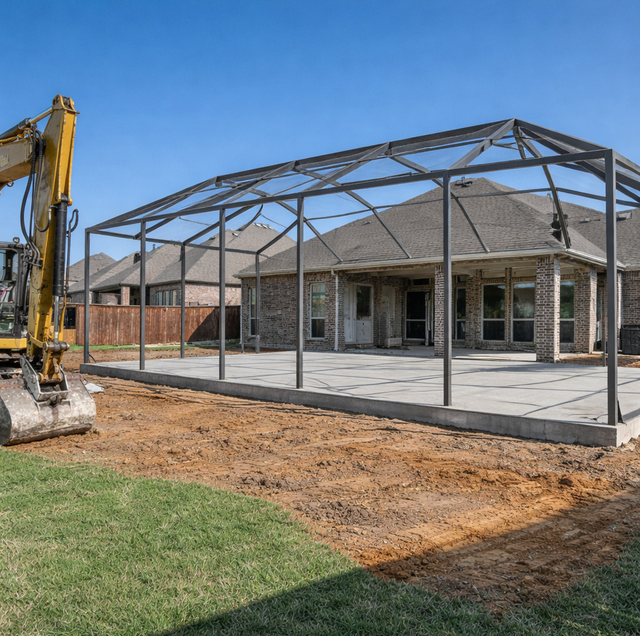
Quick Answer: A pool cage's footers and frame track anchor into the deck slab, which has its own pitch to shed water. Don't cut soil under the deck edge, or pile fills against the frame track. New grade outside must match the slab's pitch.
A screen enclosure looks like it's just sitting on top of the concrete deck, but the aluminum frame is bolted into the slab, and the slab is handling its own drainage whether anyone thinks about it or not. Regrade the yard right up against that structure without understanding how the two systems work together, and you can end up with water sheeting back onto the deck, a track that stays wet for days, or a footer that's lost the soil it was counting on for support.
How a Pool Cage's Frame Connects to the Deck
Most screened enclosures aren't just resting on the patio. The vertical aluminum posts sit on a low horizontal member, often called the base track or kick plate, and that track is fastened down with an anchor schedule: an engineered spec that sets bolt spacing, embedment depth, and how close to the slab edge each anchor is allowed to sit. In many installations, the frame is set on a dedicated concrete footer poured along the deck's perimeter, a thickened edge specifically there to carry the enclosure's weight and hold the anchors. In others, the anchors go straight into the existing deck slab.
Either way, the soil directly under and beside that footer or slab edge is doing real structural work. It's not just yard dirt anymore; it's the bearing surface the anchor system depends on to stay put.
Never cut, trench, or excavate closer to a pool cage footer than needed, and call 811 before digging near any enclosure. Some cages carry wiring or conduit along the footer line, and undermining it can loosen anchors or crack the edge of the slab.
Why Cutting or Piling Against the Frame Backfires
Two mistakes cause most of the damage, and they're opposites.
Cutting too close: Aggressive regrading, especially with a machine, that scoops soil away from directly beneath or beside the deck's edge removes the lateral support the compacted base under the slab is relying on. Once that support is gone, the edge of the slab has nothing left to bear on, and it settles, cracks, or drops slightly out of level with the rest of the deck. That shift telegraphs straight into the frame bolted to it: posts rack out of plumb, screws back out of the track, and the cage's own weight starts finding the path of least resistance through whatever's now unsupported.
Piling fill against the base: The opposite problem is just as common. Someone builds up soil, mulch, or sod right against the aluminum track to blend the new grade into the enclosure, so now that track sits buried rather than exposed. Aluminum holds up fine against water that drains away; it does not hold up well against soil and organic mulch that stay damp against it for weeks at a time. The fasteners corrode, the track pits, and moisture works its way up into the screw holes and the sealant bead that's supposed to keep the joint between the track and the concrete watertight. None of that shows up right away. It shows up two or three years later as a track that flexes, screens that sag, or water finding a new gap it didn't have before.
What the Deck's Joints and Pitch Are Already Doing
A poured pool deck isn't flat by accident. It's typically finished with a gentle pitch away from the coping toward the outer edge, just enough fall to keep water moving off the surface without making the deck feel like a ramp. Built into that same pour are two kinds of joints, each doing a different job. Control joints, tooled or saw-cut in a grid across the slab, are there to control where shrinkage cracking occurs, so it forms a straight, hidden line rather than a random spider crack. The expansion or isolation joint that runs between the deck and the pool's bond beam or coping is a different animal: it's a flexible gap, usually filled with a backer rod and sealant, that lets the deck and the pool shell move independently without cracking each other.
Both of those joints assume the deck is the highest point in that immediate area and that water is leaving, not arriving. That assumption is the whole reason the drainage works at all.
Some decks add a third drainage feature: a linear deck drain, a slim slotted channel set into the concrete along the low edge, that collects the sheet flow the pitch is sending downhill and carries it through a pipe to an outlet somewhere past the enclosure. If your deck has one, that outlet is a fixed point the new yard grade has to respect. Piling fill over it, or grading so the outlet sits below the new soil line instead of daylighting clear of it, backs water up inside the pipe and defeats the drain even though the slab's own pitch is still working exactly as built.
When Yard Grading Doesn't Match the Deck's Pitch
The failure shows up the moment someone regrades the yard outside the enclosure without checking where the deck's own edge sits. Build the new grade up even slightly above the deck's own grade level, or slope it toward the deck instead of away, and the deck stops being the high point. Water that used to run off the slab now runs onto it, pools against the frame's base track, or finds the isolation joint and starts working its way underneath instead of over the top.
It's a similar setup to a bathtub apron: raise the surrounding tile line above the tub's own lip, and water that used to run down the drain starts running behind the tile instead. The deck's pitch and joints only do their job as long as everything around them respects the height and pitch they were built around.
Once water gets under a slab edge repeatedly, it doesn't just sit there. It erodes the compacted base course the slab is resting on, whether that's crushed limestone, a stabilized sand base, or plain compacted fill, and a void starts forming. The slab above a void has nothing to bear on, so it eventually settles or cracks under its own weight, right at the spot where the enclosure's anchors are carried.
How a Grading Contractor Works the Boundary Correctly
The fix isn't avoiding the deck edge altogether; it's working it deliberately. A contractor grading up to a pool cage typically keeps larger equipment, a mini skid steer with a smooth bucket, for instance, working parallel to the deck rather than butting straight into it, then finishes the last stretch by hand with a rake and a tamper. That hand-graded zone matters because it's the only way to feel where the footer or slab edge actually sits instead of guessing.
A contractor should leave the last 12 to 24 inches next to the deck or footer for hand grading, and keep a visible 1- to 2-inch reveal of the track above the soil line so nothing sits buried against the aluminum.
New fill gets tied into the deck at the same finished height as the slab edge, checked with a laser level or a story pole rather than eyeballed, and then feathered outward with a gentle taper or a shallow swale that carries water away from the enclosure rather than damming it at the boundary. The goal is a smooth transition where the deck stays the local high point, the same relationship the original pour was built around. Building the new grade higher than that, even by an inch, reverses the deck's own pitch and starts the whole backup problem over again.
If landscaping calls for mulch beds or plantings near the enclosure, a narrow strip of gravel, paver base, or other inorganic material directly against the track buys a buffer that organic mulch can't offer, since it doesn't hold moisture against the aluminum the way bark or soil does.
Frequently Asked Questions
Yes. The backfill placed around a footer when it was originally poured is usually looser and more permeable than the surrounding native soil, so it acts as a preferential path for water even when the surface grade looks acceptable. Raising the soil against that footer line gives water a low-resistance route along the footer itself rather than running off the surface.
The sealant bead between the aluminum track and the deck is a maintenance item, not a permanent seal. It shrinks, hardens, and cracks with age, and once a nearby grading change keeps that joint wetter than it used to be, the seal fails faster than it would on a dry edge. Replacing it means a polyurethane sealant rated for concrete-to-metal joints, not general-purpose caulk.
It can be, with the right approach: rubber tracks rather than wheels to spread ground pressure more evenly and reduce point loading on the soil near the footer; a smooth-edged bucket rather than a toothed one; and passes run parallel to the frame instead of head-on, so a mistimed turn doesn't catch a post. Most contractors still switch to hand tools for the final foot or two next to the structure rather than trusting a machine that close.
That's a concrete repair, not a grading fix, and the two are often confused. A settled section of slab can sometimes be releveled with polyurethane foam injection under the slab (often called slabjacking) rather than replacing the concrete outright, but that's enclosure or concrete contractor work. It should happen before any yard regrading is finalized around it, since a new yard grade tied into a still-sunken deck edge will just repeat the same problem.
You can, but skip organic mulch directly against the track, and check two more things before you plant: aim any drip irrigation or sprinkler heads away from the base track instead of letting them spray directly onto it, and choose shallow-rooted plants for that strip, since a woody shrub's root system can grow into and lift a footer over several years the same way it lifts a sidewalk. A 6- to 12-inch strip of gravel, crushed rock, or paver base between the planting bed and the frame keeps moisture-holding material off the aluminum while still allowing the bed to come close to the structure visually.
If the grading work is going to expose, undermine, or come within a few inches of a footer or anchor line, it's worth having the enclosure installer or a structural contractor confirm the footing is intact before and after the work, since a grading crew isn't typically qualified to assess frame anchoring itself, only the soil and drainage around it.
Treat the boundary deliberately, and it stops being a recurring problem: the deck keeps shedding water the way it was built to, the frame stays dry at its base, and nobody's back out there next year chasing the same puddle from a different angle.
Schedule a grading assessment around your pool cage — get the fill and slope worked right up to the deck edge without disturbing the enclosure's footing. Polk Services LLC serves Lakeland, Highland City, and Mulberry. Call (863) 344-5806.
