

Inherited a House With an Old Pool? Weigh Your Options
Quick Answer: A pool you inherit gives you three real choices: restore it, remove it permanently, or leave it standing with minimal upkeep. What the pad, the water, and the deck show you, before you drain or treat anything, points toward which one fits.
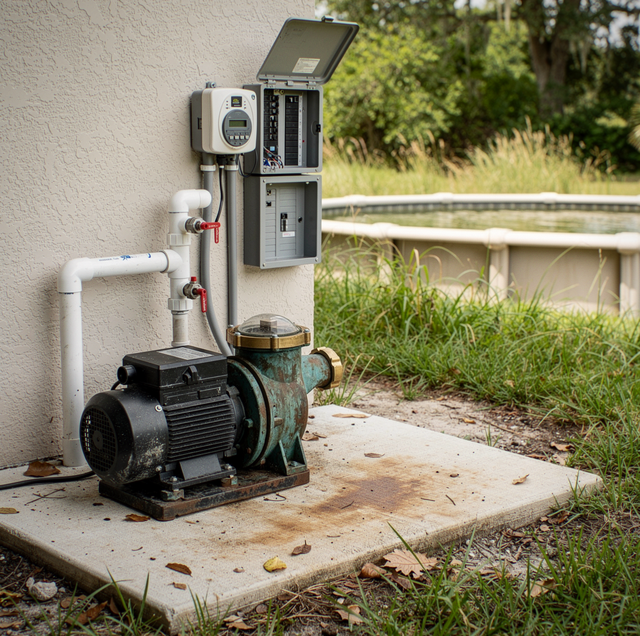
The equipment pad is the first thing that tells you how long this has been going on. A pump with a chalky bloom across the housing, a timer with its cover hanging open, a breaker panel door nobody has closed properly in years. Across the yard, the ground drops into a pool sunk low behind a hedge nobody has trimmed in longer than you can guess. The water sits somewhere between green and brown, thick enough that the steps disappear a few inches down, and a skin of leaves and small branches rides across the surface. This yard ran on someone else's routine for years. The routine stopped, and the property is now yours to sort out.
None of those three choices announce themselves from a set of keys or a listing photo. They come from walking the yard and reading what is actually in front of you.
What the Deck Tells You Before You Open Anything
Everything worth reading here is visible without a ladder, a pump primer, or a step into the shell, and what you are reading is duration rather than condition. Start with the water. Its level relative to the tile band around the top tells you how long it has been since anyone topped it off or covered it, and the tile above the waterline is worth a close look on its own. Debris load matters too. A scatter of leaves is a different situation from a solid mat that has been breaking down in place for one or more seasons.
Keep off the coping and the deck edge of a pool nobody has maintained for years. Ground can settle or hollow under a slab with nothing at the surface to show it, and looking will not tell you.
The deck itself has one read-worthy point, and it is about upkeep rather than structure. Weeds standing in the expansion joints and control joints, and a seam line gone soft and dark with organic matter, date the last time anyone worked on the surround. A joint that was sealed and swept within the last couple of years does not grow anything; a joint carrying an inch of soil and a stand of grass has been left alone for a long while.
Then go back to the pad and read it properly. Unions that have gone from bronze to a dull green-black, a motor that has weathered through its paint, a timer with its cover cracked open: these say the same thing: nobody has run this system on a schedule in a long while. A pool that was closed with intention looks different on that pad than one that was simply walked away from.
Photograph the pad before you touch anything, including the label plate on the pump motor. A model number and date code tell a service tech what is still worth reviving and what has been out of production for years.
Fork One: Bringing It Back into Service
Restoring a neglected pool to working order is a legitimate choice, not just the default for anyone who feels bad taking a pool out of a house. It also carries a specific set of obligations that begin the day the water returns to clear. The mechanical side, in particular, sits outside what a demolition and property crew handles. Pump and filtration repair, shell resurfacing, and any electrical work at the pad are jobs for people who specialize in exactly that, and bringing a dormant system back online usually means calling more than one of them before the pool is swimmable again.
Choosing this fork also means choosing the routine that goes with it: regular attention to water balance, a gate and cover you keep in working order, and periodic servicing of the equipment you just brought back online. None of that changes because you inherited the house instead of buying it planning to swim. If the property was never going to be a full-time residence, or if nobody in the household actually wants a pool, this fork deserves to be named honestly as the one that adds the most ongoing responsibility rather than the one that removes it.
Fork Two: Removing It for Good
Removing the pool ends the obligation instead of managing it. Once the shell is gone, there is no more water to balance, no equipment pad to maintain, no cover to check, and nothing in the yard anyone can fall into. For a property you inherited rather than chose, that finality is often the appeal: one job, and afterward the yard behaves like an ordinary yard for as long as you own the place.
The decision between full and partial removal, and the factors that determine the size of that job, are already their own article and do not need repeating here. What belongs in this fork is the honest trade: removal is permanent in a way the other two choices are not. Once the shell comes out, putting a pool back in that yard later means starting from open ground instead of a dormant system waiting to be reactivated.
Fork Three: Leaving It and Maintaining It at a Minimum
Leaving the pool in place without restoring it or removing it is a real third choice, not a way to avoid the other two. Done properly, it means keeping a secure cover or fencing in place, keeping the water treated enough that it does not turn into standing organic sludge, and checking on the site at some regular interval rather than forgetting it exists until the next time you walk the yard.
That upkeep is less than running a pool day-to-day, but it is not nothing, and it does not stop being your responsibility just because nobody is swimming in it. Standing, untreated water attracts insects, and a deck slicked with algae is a slip hazard for anyone who crosses it, including you checking on the property. A pool left with no plan at all, uncovered, unbalanced and unvisited, is the version of this fork that causes problems. A pool left with a minimal, consistent plan is a legitimate long-term choice for an owner who is not ready to decide among the other two.
Why the Pool Is Rarely the Only Job on the Property
An inherited pool almost never shows up alone. Walk past it, and there is usually a shed with years of accumulated tools and containers, a screen room that stopped being a sitting area and became a storage room somewhere along the way, a garage packed floor to ceiling, yard debris nobody hauled off, and sometimes furniture left sitting exactly where the previous owner last used it. The pool is the most visible problem in the yard. It is rarely the only one on the property.
Handling the pool and the rest of the property as one mobilization is a different job than handling them separately, and not just in scheduling terms. A crew already on site with equipment, a dump trailer, and a plan for the yard can move from the pool to the shed to the garage in the same visit, working from one property assessment instead of two. Splitting them into separate jobs months apart means walking the same ground twice, forming two separate plans, and often re-explaining what is going where a second time.
This is exactly the kind of situation whole-property cleanup, estate cleanout, and foreclosure and REO cleanup exist to cover: a property where you inherited someone else's accumulated decisions along with the house itself, and where the pool is one piece of a larger job rather than an isolated project. If that describes the yard you just walked into, the pool and the rest of the property around it make more sense assessed together than as two separate calls months apart.
Frequently Asked Questions
A pool closed with intention usually has the water level dropped a few inches below the skimmer mouth, the return lines capped or plugged, and either an air pillow or a float sitting under the cover to absorb pressure. An abandoned pool is more often left at full operating level with the skimmer basket still in place and never emptied, because nobody took the extra step of shutting it down on purpose.
That paler band is mineral scale left behind as water evaporated, depositing calcium and other dissolved minerals on the tile each time the level dropped a little further. You can usually run a fingernail across it and feel a slightly rough, chalky texture, and a thicker, more built-up ring generally points to a longer stretch of neglect than a thin one.
Yes, and clarity tells you more than color does. Near-black or tea-colored water is water in which organic matter has broken down into the water itself, changing its chemistry from the inside. A cloudy, pale green pool is more often a surface algal bloom on water that is otherwise clearer underneath, which points to a shorter-term problem than water that has gone dark.
Not necessarily. A solid safety cover that has held rain, leaves, and debris for an extended stretch puts ongoing weight on its anchor straps, and by the time a property changes hands, those anchors are often corroded or pulled loose from the deck. A cover that looks intact from a distance can be an unreliable barrier once you actually check how it is holding on.
Usually, yes, as part of the same mobilization, with one practical split. A garage or shed almost always turns up items the ordinary debris stream will not take: half-full fuel cans, old paint, pool chemicals, propane cylinders, car batteries. Those get set aside as they surface and are pointed out to you for household hazardous-waste drop-off rather than being loaded with the rest, which is why a packed garage gets a brief look of its own before loading begins.
It can change the site over time rather than freeze it in place. Ground under a shell that is standing but no longer being attended to keeps moving through wet and dry cycles, which is part of why hairline cracks in the surrounding deck tend to show up during a long dormant stretch. Choosing to wait does not close off removal later, but the site you eventually remove will not be identical to the one you first walked into.
None of the three forks has to be chosen this month. What does have to happen is an honest read of which one you are already drifting toward, because a pool with no decision behind it defaults to the third fork without the upkeep that makes the third fork legitimate.
Book a property assessment — one visit covering the pool, the shed and whatever else came with the house. Polk Services LLC serves Lakeland, Highland City, and Mulberry. Call (863) 344-5806.
