

Partial vs. Full Pool Removal: What Each One Leaves Behind
Quick Answer: Full removal breaks out the entire shell and deck so the ground can carry a lawn, garden, or hardscape, and, with more of the debris hauled off, a future structure. Partial removal leaves the lower shell in place and is faster.
You are standing at the edge of a pool you haven't swum in for two summers, maybe three. The water's gone green, or maybe it's already drained, and the shell just sits there collecting leaves. You've got two scopes of work in front of you for two completely different jobs, and neither one makes it obvious that one job leaves something behind in the ground and the other doesn't.
That difference is the whole decision. Partial removal and full removal use different amounts of time and equipment, but what actually separates them is what's still down there once the crew leaves and the yard goes green again.
How Full Removal Works
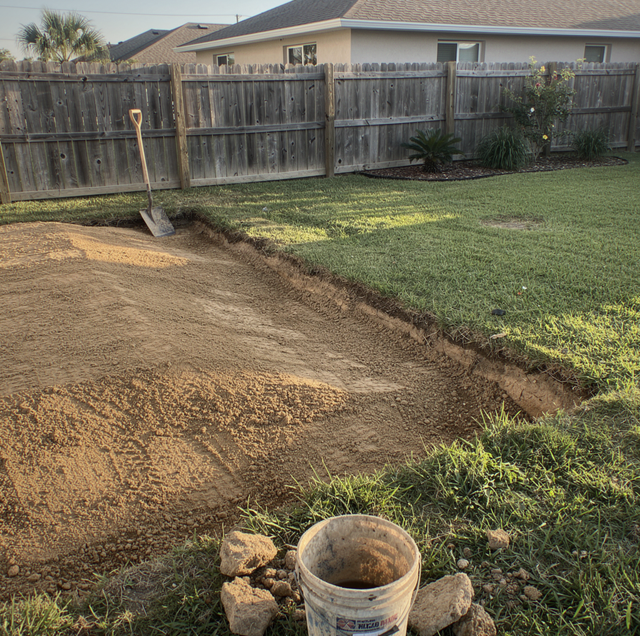
Full removal takes the shell out of the equation completely. Holes are jackhammered through the floor first, so any water still sitting in the shell drains away rather than turning the work area into a pond. The crew then breaks the concrete or gunite shell into pieces small enough to handle and pushes that broken material down into the cavity where the pool used to hold water. The poured deck concrete around the pool is handled the same way: broken up and pushed in rather than hauled off separately. Clean fill dirt goes on top of that broken material and is brought up to grade in compacted lifts, roughly six to eight inches at a time, each packed down before the next is placed. By the time the job is finished, there's no intact structure left underground at all, just broken material capped by dirt that's been compacted layer by layer. The whole point of doing it that way is that compacted fill carries real weight afterward: a lawn, a garden bed, a paver patio, and, where more of the shell is hauled off the property instead of buried, the uniform ground a foundation wants.
How Partial Removal Works
Partial removal takes a lighter touch. Instead of breaking out the whole shell, the crew removes the top portion and stops there. Holes get broken into the floor of what's left. In a full removal, those openings only have to get the standing water out before the shell itself comes apart. Here, they are permanent because the intact lower shell remains in the ground and has nowhere for water to go except through them. Without them, water that gets underneath the fill has nowhere to drain and just sits against the underside. Once the holes are in, the remaining bowl gets covered with fill, and the surface is brought back up to grade. The lower shell, walls, and floor all stay exactly where they've always been, just buried instead of holding water. It isn't hidden carelessly. The drainage holes are the whole reason a buried shell can sit safely under a lawn instead of turning into a hidden cistern, since a sealed bowl with no way for water to escape would just fill back up underground every time it rains.
Buried shell walls sit a few feet down around the old pool's edge. Anyone digging there later for a fence post, a tree, or a drain line can hit concrete and cut rebar without any warning from the surface.
Full Removal vs Partial Removal at a Glance
Laid out side by side, the practical differences line up cleanly:
| Full Removal | Partial Removal | |
|---|---|---|
| What stays in the ground | Nothing intact; shell is broken into the cavity | The lower shell stays in place, buried under fill |
| Disruption to the rest of the yard | More equipment and time on site | Less equipment and time on site, since less material is broken out |
| What the ground will support afterward | Lawn, garden, hardscape; a future structure where more debris is hauled rather than buried | Lawn or garden; not a reliable base for building on later |
| Main risk to watch for | Minimal once fill is compacted correctly | Voids around the buried shell, uneven settling if fill isn't compacted evenly against it, and buried structure a later dig can hit |
| Best fit for | An owner planning to build, expand, or sell soon | An owner who wants the hazard gone and the space back as yard |
What Each Choice Means Five and Ten Years Later
The difference between the two doesn't show up on move-in day. It shows up years later, after the sod has rooted and nobody's thinking about the hole that used to be there anymore. Walk across a full removal a decade on, and the ground reads as ordinary lawn underfoot, no dip, no give, nothing to tell you a pool was ever there, because there's no intact structure left to settle against. Partial removal can read the same way for years, right up until it doesn't: an intact shell under compacted, well-drained fill can sit undisturbed for a very long time, but if water finds its way under the fill without a clear path out through the drainage holes, or if the fill wasn't compacted evenly against the shell's edges, a soft spot or a shallow boggy patch can show up in that one section of yard, and only that section, while the rest of the lawn is fine. Sandy soil makes this more likely, not less: it offers little cohesion and settles into voids readily when it isn't packed down in layers, so a corner that wasn't compacted as carefully as the rest can quietly slump years after everyone's forgotten there was ever a project out there.
Ask whichever method you choose whether compaction near the shell's buried edges gets extra attention. That transition line, where old structure meets new fill, is where uneven settling shows up first, years before the rest of the yard tells you anything.
The Honest Case for Partial Removal
None of that makes partial removal a lesser choice. It isn't a shortcut, and for many owners, it is the right call. It disturbs less of the surrounding yard while the crew is on site, and there is less material to break out and move. If what you want is the hazard gone and the space back as open lawn, garden, or play space, and you're not planning to add a structure or a pool over that same footprint down the road, partial removal delivers exactly that, done sooner, with less disruption to everything around it. The buildability difference only matters to the owner who's going to test it. If you never plan to put weight or a foundation on that specific patch of ground, the fact that it wouldn't reliably hold one is close to irrelevant.
How to Decide Which One You Are
The honest way to sort this out is to ask what that patch of yard needs to do for you next, not this year but eventually. If there's any real chance you'll want a shed, an addition, a new pool, or anything else with a foundation sitting where the old pool was, full removal is the one that can give the ground back cleanly, and it is worth saying so at the walk-through, because a foundation changes how much of the shell leaves the property rather than going back in the hole. If the answer is closer to wanting the yard back with no structure ever planned for that spot, partial removal gets you there with less time and less mess, and there's nothing wrong with choosing it for exactly that reason. The one thing worth avoiding is picking partial removal without knowing that's the tradeoff you're making, since two scopes of work sitting side by side can look similar on paper while describing very different outcomes underground. Ask directly what stays buried under each one and what the ground will carry afterward, and let that answer, not the paperwork's length or the crew's schedule, be what actually decides it.
Frequently Asked Questions
Yes, in one direction. If the top of the shell has already been broken out and the drainage holes cut for a partial job, breaking out the rest of the shell and the deck concrete afterward uses the same equipment already on site, so switching from partial to full mid-job is a simple change of scope. It doesn't work in reverse: once shell material has been broken up and pushed into the cavity as part of a full removal, there's no scaling back to a partial job.
Not exactly. A gunite or poured concrete shell breaks into workable pieces that are pushed into the cavity, which is what makes both the full and partial methods possible in the first place. A one-piece fiberglass shell doesn't break down the same way, so fiberglass removal is handled on a case-by-case basis rather than being sorted into the same partial-versus-full choice.
That is a settling question rather than a scheduling one. Compacted fill is walkable and mowable as soon as the surface is graded and planted, so the practical wait is for grass roots rather than for the ground. Confidence takes longer than use does: a full wet season of rain moving through the footprint is what actually tells you whether the fill was placed properly, which is why anything with a foundation tends to get planned rather than rushed.
That depends on their condition, and it's handled separately from the poured deck concrete. Deck concrete is broken up and pushed into the cavity as part of a full removal, but pavers around the deck are salvaged for reuse or hauled off, decided on a case-by-case basis rather than automatically going one way or the other.
No. An above-ground pool doesn't have a shell buried in the ground to break out or leave behind, so there's no partial-versus-full decision to make. Removing one is a separate, simpler job.
After a full removal, the footprint is open ground, and a new excavation starts from scratch. After a partial, the buried shell walls must be broken out and hauled away before anything can be dug, which turns the new pool's excavation into a demolition job first. If a replacement pool is even a distant possibility, that is the clearest argument for taking the whole shell out the first time.
Most owners already know, once they think about it honestly, which of the two they are. The ones who hesitate are usually the ones who haven't decided whether that ground has a second life ahead of it, and that's a fair thing to sit with for a day or two before the machines are booked.
Get your pool removal assessed — a walk-through will tell you whether partial or full removal fits your yard plans, including pool demolition in Auburndale. Polk Services LLC serves Lakeland, Highland City, and Mulberry. Call (863) 344-5806.
