

Irrigation Pump Noise: What That Sound Is Telling You
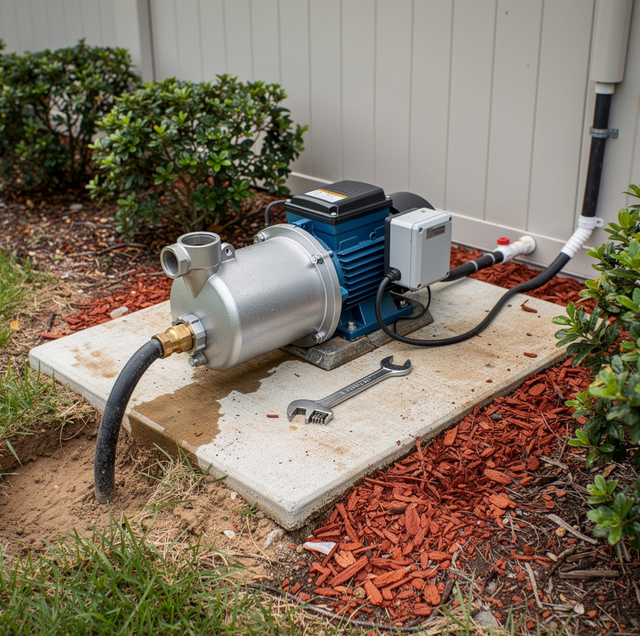
Your irrigation pump doesn't hand you a diagnostic printout when something goes wrong. What it hands you is a sound, and that sound is often the only evidence you have before you pick up the phone. The impeller is spinning inside a sealed housing you can't see into, and the control box isn't something you should be opening yourself. But you can stand near the pump and listen, and what reaches your ear narrows the problem down before a technician ever touches a wrench.
Two sounds get mixed up more than any others: a rattle that sounds like gravel or marbles bouncing around inside the housing, and a whine or grind that shows up specifically when the pump starts. They come from different parts of the pump; they point to different repairs, and treating one like the other wastes a service visit chasing the wrong part. Here's how to tell them apart, sound by sound.
The Marble Rattle: Cavitation Inside the Pump
A rattling that sounds like a handful of marbles or gravel bouncing around inside the pump housing is cavitation. It happens when pressure inside the pump drops low enough, usually on the suction side, that water forms vapor bubbles, and those bubbles collapse violently the instant they reach a higher-pressure area inside the pump. Each collapse is a tiny concussion against metal, and hearing them run together continuously is what registers as a rattle.
Cavitation usually traces back to the pump being asked to move more water than the suction side can actually supply: a lift past the practical ceiling, a fouled strainer, or an undersized intake line all starve it the same way and produce the same vapor-collapse rattle. One tell separates it from a bearing problem. The rattle shifts as suction-side conditions shift, growing more pronounced as demand or draw increases and easing off as conditions improve, where a bearing whine stays essentially the same no matter what the suction side is doing.
That tracking also separates a cavitation rattle from the rougher, demand-varying noise worn impeller vanes make, which is the closest sound-alike and the easier of the two to misattribute. Cavitation follows suction conditions, so it quiets when the suction side is made easier, and it disappears on a flooded suction. Vane-wear noise follows the load instead, and it is present at any lift, including flooded suction, because the vane edges are already gone before the water ever reaches them.
A cavitating pump is pitting its own impeller every minute it runs. What starts as a rattle you could ignore becomes a chewed-up impeller needing full replacement. Shut it down and call rather than let it run another cycle.
The marble rattle is the sound that costs the most if it's ignored, because the damage compounds while the pump keeps working.
The Startup Whine: Bearing Wear
A whine or grind that occurs only when the pump starts, rather than during steady running, points to bearing wear. The bearings support the shaft and let the impeller spin freely; as they wear, that support gets sloppy, and the extra friction announces itself loudest right at startup, when the shaft has to overcome the most resistance to get moving.
This is a wearing part reaching the end of its service life, not a sudden failure. It's worth calling in when the sound is new, because a technician can typically confirm bearing wear and plan the repair as a routine parts swap, rather than waiting for it to progress into a harder failure. A whine that only shows up at startup and fades once the pump is up to speed is usually the earliest stage of this, and letting it run week after week is what turns an early catch into a bigger repair.
The Rotation-Locked Clatter: A Cracked Impeller Hub
A clattering that keeps one fixed rate, and that you can sometimes feel as a slight vibration through the pump housing itself, can mean the impeller hub has cracked. The hub is what keys the impeller to the shaft; once it cracks, the impeller no longer spins perfectly true, and the off-balance rotation produces a clatter tied to shaft speed rather than to flow. Because the motor holds one speed, that clatter holds one rate, and it carries on at that rate whether one zone is open or three, which is what sets it apart from the marble-rattle of cavitation that rises and falls with the suction side.
This kind of clatter tends to get worse, not better, because an impeller that's already spinning off-center puts more stress on the crack with every rotation. Because the hub sits behind the impeller itself, the crack is rarely visible without pulling the assembly apart, which is one more reason the sound is usually what gets noticed first, long before anyone lays eyes on the part.
The Knocking Sound: Debris Against the Impeller Blades
A knocking that sounds like something loose hitting metal, especially if it comes and goes rather than staying constant, often means debris has gotten into the housing and is striking the impeller blades as they turn. Sand, small stones, or scale that's broken loose from inside old piping can all end up in that space, and every rotation sends a blade into it again.
Debris knocks, and a cracked hub can sound close to identical from outside the housing, which is exactly why this one needs a hands-on look rather than a guess over the phone.
Note whether the knock happens on every rotation or only now and then before you call. That single detail, steady versus intermittent, helps a technician narrow the cause before they even open the housing.
Vibration in the Pipe: A Loose or Cracked Mounting
Not every noise starts inside the pump. If you're hearing or feeling vibration in the pipe itself, sometimes at a fitting or elbow well away from the pump, the more likely cause is loose mounting bolts or a cracked mounting pad underneath the unit. Once the pump isn't anchored solidly, ordinary running vibration that would otherwise stay contained transmits straight into the connected piping, and rigid pipe carries that vibration a surprising distance before it reaches something loose enough to rattle audibly.
This one is worth flagging early, because a pump that's rocking slightly on a failing mount is also putting uneven stress on the pipe connections themselves. That transmitted vibration can also loosen fasteners over time, so a rattle that starts faint at a distant fitting often grows more noticeable rather than staying at one steady level.
A Hum with No Rotation: Not a Mechanical Sound at All
A steady hum with no accompanying whine, rattle, or clatter, especially if you can tell the shaft isn't actually turning, isn't a mechanical sound at all. That's an electrical symptom, not a worn part or debris in the housing, and it belongs to a different diagnosis than everything above. Don't try to free it up or reset it yourself. Shut the pump off at the breaker and call it in rather than let a motor that's humming but not turning keep drawing current.
None of these sounds require you to open anything or diagnose the fix yourself. The point of learning them is knowing which words to use when you call, and knowing which one, the marble rattle most of all, means the pump needs to come off right away rather than wait out the week.
Frequently Asked Questions
One step is throttling the discharge briefly on site, which raises back pressure and quiets a genuine cavitation rattle for as long as the valve stays partly closed. That response identifies the noise as suction-side rather than mechanical. It is a reading taken during diagnosis, not a fix and not a homeowner step, and it changes nothing about an undersized intake line or a lift beyond the pump's rating.
There's no fixed timeline, but bearing wear is progressive: a whine at startup tends to extend into a continuous grind, and a bearing that finally seizes can stall the motor hard enough to trip its overload protection, which is a more disruptive shutdown than a routine service call.
A keyway that has worn oversized lets the impeller lag the shaft for an instant every time torque changes, so it knocks once at startup and again whenever a zone valve opens or closes, then goes quiet at steady speed. A cracked hub is an imbalance rather than a lost motion, so it stays audible throughout the run. A technician tells them apart by checking for rotational play between the impeller and the shaft when the assembly is turned by hand.
Yes. On a multi-bolt base plate, even a single loose anchor lets the whole pump rock slightly with each revolution, and that small rocking motion is enough to transmit vibration through rigid piping to an elbow or union well away from the pump itself.
A turning rotor moves air across the frame and settles to running current once it's up to speed. A rotor that can't turn keeps drawing locked-rotor current, several times running current, with none of that cooling happening. The thermal overload opens and drops the motor off line, but it resets as the frame cools and closes back into the same stalled condition, so the winding gets reheated on a loop until someone opens the breaker.
Yes. Rigid PVC or galvanized supply line carries mounting vibration into surrounding framing far more readily than a flexible connector would, which is why the sound can sometimes be heard several rooms away from the pump itself rather than staying isolated at the source.
Call for a pump sound inspection — catch cavitation, bearing wear, or a cracked impeller before it gets worse. Perry-Pump Repair Service LLC serves Lake Butler, Gainesville, and Alachua. Call (352) 320-2412.
