

How Much Gravel Do I Need? Do the Math Before You Order
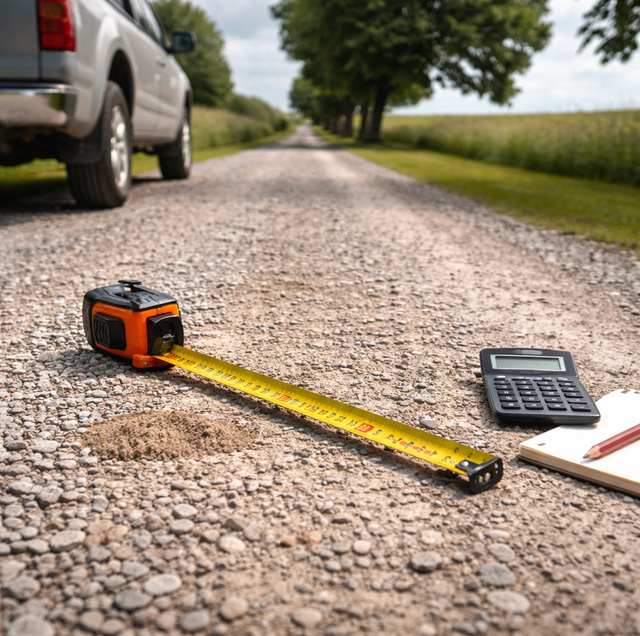
A cubic yard of crushed stone weighs somewhere around 2,700 to 3,000 pounds, more than most half-ton pickups are rated to carry. That's the number most people miss when they try to eyeball a gravel order. A driveway that looks modest standing on it can easily call for ten or more of those truck-sized loads once you actually run the numbers. Working out your own tonnage before you talk to anyone means you go into that conversation with a figure you calculated, not a guess someone else has to correct.
The math itself takes five steps: measure the area, pick a target depth, convert to cubic yards, account for compaction, then convert to tons. None of it requires anything more than a tape measure and a calculator.
Measure the Area First
Start with length times width in feet to get square footage. Walk the driveway's full run and measure the widest consistent section, then measure the length from where it starts (garage, carport, or property line) to where it ends at the road or parking pad.
Two things trip people up here. First, if the driveway flares or widens near the street for a turnaround, don't fold that into your main rectangle's average width, since that undercounts the flare and overcounts the narrow run. Measure the flare as its own shape (a triangle or trapezoid) and add its square footage separately. Second, decide whether the apron, the short transition section where the driveway meets the street or garage slab, is part of this job or not. If it's getting covered too, measure it and add it in. Skipping it is the single most common reason people come up a half-ton to a full ton short on delivery day.
Pick a Target Depth for the Job You are Doing
Depth depends on what you're actually building, not just what looks nice, and it should be the FINISHED, compacted depth you want on the ground once everything is done, not the loose depth before compaction.
Base layer: a structural layer of larger, angular crushed stone or crushed concrete, generally run 4 to 6 inches deep once compacted, is what gives a new driveway the load-bearing strength to resist rutting and pumping under vehicle weight, especially over sandy or loose subgrade.
Finish layer: a smaller, tighter material like limerock screenings or fine crushed stone, generally 2 to 3 inches once compacted, sits on top of the base to fill voids, lock the surface together, and give you the smooth, walkable top you actually see and drive on.
A brand-new driveway built from bare ground generally needs both layers, so figure a combined compacted depth in the 6- to 9-inch range. A refresh on top of an existing, already-compacted base usually only needs the finish layer, so 2 to 3 inches is enough. Guessing the wrong scenario is the fastest way to over- or under-order, so be honest about which one you're actually doing before you calculate anything.
Turn Square Footage Into Compacted Cubic Yards
Once you have square footage and a target compacted depth, convert the depth to feet (divide inches by 12), multiply by the area to get cubic feet, then divide by 27 (the number of cubic feet in a cubic yard).
Compacted cubic yards = (square footage x depth in feet) / 27
A 4-inch depth is 0.33 feet; 2 inches is about 0.17 feet; 6 inches is 0.5 feet. Keep those conversions handy, and you can run this formula for almost any driveway job.
Why You Have to Order More Than the Compacted Number
This is the step that trips up a lot of first-time calculations. The figure from the last step is the volume you want sitting on the ground once it's spread and compacted, but gravel doesn't arrive compacted. It arrives loose on the truck, with more air space between the particles, and it loses somewhere around 20 to 25 percent of its loose volume once it's spread and run over with a plate compactor or roller. Order exactly the compacted-volume number, and you'll come up short once the material settles into place.
To account for that, multiply your compacted cubic yards by roughly 1.25 to get the loose cubic yards you actually need to order.
Loose cubic yards to order = compacted cubic yards x 1.25
From Loose Cubic Yards to Tons
Gravel and crushed stone are sold by weight, so the last step converts your loose order quantity to tons using a density figure. This varies by material: angular crushed stone, crushed concrete, and asphalt millings all pack and weigh differently depending on particle size, moisture, and the amount of fine material mixed in. As a general, well-established ballpark for loose, as-delivered material, most crushed aggregate runs roughly 1.35 to 1.5 tons per cubic yard. Use 1.4 as a reasonable working average when you don't know your specific material yet.
Tons = loose cubic yards x 1.4 (adjust within the 1.35 to 1.5 range for your material)
Three Driveway Sizes, Worked Out
A short single-car driveway getting a finish-layer refresh: Measured at 10 feet wide by 30 feet long, that's 300 square feet. At a 2-inch compacted finish depth (0.17 feet): 300 x 0.17 = 51 cubic feet, or 51 / 27 = about 1.9 compacted cubic yards. Order quantity: 1.9 x 1.25 = about 2.3 loose cubic yards. At 1.4 tons per cubic yard, that's roughly 3.2 tons.
A two-car driveway built from scratch, base plus finish: Measured at 16 feet wide by 40 feet long, plus an 80-square-foot widened turnaround near the street, comes to 720 square feet total. At a 6-inch combined compacted depth (0.5 feet, the low end of the 6 to 9 inch range): 720 x 0.5 = 360 cubic feet, or 360 / 27 = about 13.3 compacted cubic yards. Order quantity: 13.3 x 1.25 = about 16.7 loose cubic yards. At 1.4 tons per cubic yard, that lands around 23 tons.
A long rural driveway getting a single base layer: Measured at 12 feet wide by 300 feet long, that's 3,600 square feet, more area than most people expect once they walk it off. At a 4-inch compacted base depth (0.33 feet, the low end of the 4 to 6 inch range): 3,600 x 0.33 = 1,188 cubic feet, or 1,188 / 27 = 44 compacted cubic yards. Order quantity: 44 x 1.25 = 55 loose cubic yards. At 1.4 tons per cubic yard, that's roughly 77 tons.
Notice the pattern: length matters more than most people assume, and a long, narrow run can outweigh a shorter but wider one by a wide margin.
What Can Shift the Number
A few things push your real order above the raw math. Irregular shapes (curves, tree roots forcing a detour, an oddly angled garage) waste material at the edges, so add roughly 10 percent as a buffer on anything that isn't a clean rectangle, on top of the 1.25 compaction factor already built in above. Soft or sandy subgrade sometimes calls for a deeper base than the 4 to 6 inch range above, which changes your depth input, not the formula. And material choice matters: crushed concrete can run lighter and more variable than quarried limestone because of mixed particle sizes, while asphalt millings tend to run denser because residual asphalt binder holds the fines together. If you know which material you're using, ask for its actual weight-per-yard figure rather than relying on the 1.4 average.
Bringing a Number, Not a Guess
Once you've measured, picked a realistic target depth, and run through the compaction and density conversions, you have a defensible number to work from, one you calculated yourself rather than took on faith. That number can still shift once someone sees your subgrade, drainage, and access in person, but it gives you a real starting point rather than a blind spot.
Frequently Asked Questions
Break it into separate shapes and calculate each one on its own, then add the results together. A triangular flare at the street uses area = 0.5 x base x height; a curved section can usually be approximated as a trapezoid (average the narrow and wide widths, then multiply by length). Run the full formula for each section separately rather than averaging a width across the whole driveway, since averaging tends to undercount the wide parts.
Yes, separately from which material you choose. Aggregate sitting in an outdoor stockpile after rain or a humid stretch can weigh noticeably more per yard than the same material dry, sometimes enough to shift a delivery scale ticket by a few percent even when the volume delivered looks the same. That's a normal variance tied to weather at the yard, not a sign your calculation was wrong.
Beyond the 10 percent buffer for irregular shapes mentioned above, add a bit more if you're spreading by hand or wheelbarrow rather than machine, since hand spreading tends to leave more material along edges and low spots than a graded, machine-compacted surface does. A 10 to 15 percent overage on top of the compaction math is a reasonable cushion for most driveway-sized jobs.
The math is identical, but the depth usually differs. A pad that only needs to support foot traffic or occasional light equipment, rather than daily vehicle weight, can often get by with a single 3- to 4-inch compacted layer instead of a full base-plus-finish build, since it isn't absorbing repeated wheel loading the way a driveway does.
A standard dump truck delivering aggregate typically carries somewhere in the 10 to 14 ton range per load, depending on the truck and local weight limits. So the two-car driveway example above, at roughly 23 tons, would generally take two truckloads, while the long rural driveway example, at roughly 77 tons, would take six or seven.
How much a material shrinks when compacted depends on its particle mix. A well-graded material with a range of particle sizes, like crushed asphalt millings or crushed concrete, packs down tighter and can shrink closer to the 25 percent end, while a more uniform, single-sized stone has less room to close up and may land closer to 20 percent. Using 1.25 as a working multiplier is a reasonable middle ground, and any leftover material is far easier to deal with than coming up short mid-job.
Get your gravel driveway measured and planned right — we'll walk through your numbers and plan the delivery, from gravel driveways in Plant City to Winter Haven. Polk Services LLC serves Lakeland, Highland City, and Mulberry. Call (863) 344-5806.
