

Irrigation Pump Repair in Gainesville: What Really Fails
Quick Answer: Most Gainesville-area irrigation pump failures trace back to five regional conditions: aquifer sand wear, storm-season electrical damage, iron and hardness fouling, long summer duty cycles, and pest intrusion in control gear, not one universal cause.
Across the 17 North Florida communities the shop covers from its Gainesville base, irrigation pump calls come from more than one kind of property. A homeowner's residential sprinkler zone, a hobby farm's pond-fed line, and a row-crop operation pulling from a deep well all land on the same service schedule, and each pulls water through a different kind of system under different stress. The service area itself spans everything from tight in-town residential lots to open pasture and row-crop acreage, and that range is part of why no single irrigation pump story applies evenly across it. What fails on one is rarely what fails on the next, but the reasons trace back to a short list of regional conditions: how deep the local aquifer sits, what's dissolved or suspended in the water coming up, what the electrical grid does during storm season, how long a pump runs each day through summer, and what finds its way into a control box left outdoors.
Aquifer Depth and Florida Sand Set the Baseline
Most private wells in this part of North Central Florida draw from the Floridan Aquifer, typically somewhere between 100 and 400 feet down depending on the property and the community. That depth matters less for whether water comes up than for what rides along with it. Florida's sandy soils put a steady trace of fine grit into the water column on nearly every well in the service area, and an irrigation pump pushes that gritty water through tight impeller clearances for hours at a stretch, week after week, all growing season.
Impeller Wear Is Cumulative, Not Sudden: A pump doesn't typically fail from sand in a single afternoon. Grit works on an impeller, and its wear rings the way steady sanding wears down a wood edge: a small amount of material removed each cycle, until clearances open up, pressure drops, and the pump has to strain harder to move the same volume. On agricultural systems and larger residential zones alike, that gradual wear is one of the most common reasons a system that used to hit full pressure now runs weak, long before anyone hears a dramatic failure.
Storm Season Turns Electrical Components Into the Weak Link
North Florida's hurricane and tropical storm season runs from June through November, and it puts stress on two different parts of an irrigation setup. On properties that draw from a pond, ditch, or river rather than a well, heavy rain events wash sediment and debris straight into the intake, and a system that ran clean in May can be pulling in silt by July. On every system in the service area, well-fed or surface-fed, storm season also means lightning. A strike doesn't have to hit the pump directly to cause damage; a surge traveling down a wire is often enough to take out a control box, pressure switch, or starter relay while the pump motor itself sits untouched.
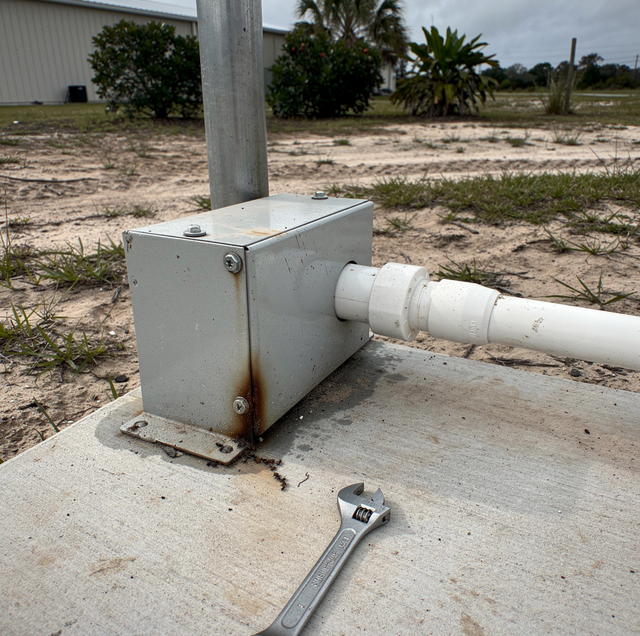
Why Electrical Damage Gets Blamed on the Pump: When a control component fails, the pump usually just stops, and it's easy to assume the motor is the problem. Sorting out a fried control circuit from an actual motor failure calls for on-site testing, not a guess from the yard, and that distinction is worth confirming before anyone replaces the wrong part. The same enclosure is also where fire ants turn up: a control box or irrigation controller sitting at ground level, with a gap at its base, can fill with nest debris until the contacts inside stop closing, on a property where the pump itself is perfectly healthy.
A control box and its capacitor can stay energized even after a storm knocks a pump offline. Never open a control box or touch a capacitor. Both 240V circuits and stored capacitor charge are professional-only work, storm damage or not.
Iron, Sulfur, and Hardness Fouling Lines Long Before a Pump Fails
Iron, sulfide, and general hardness are common in North Central Florida well water, and they rarely stop a pump outright. What they do is coat and narrow everything downstream of it. Discharge lines and zone valves lose usable diameter to scale and iron buildup over time, and a system that seems to be losing pressure is often losing pipe diameter, not pump capacity.
Zone Valves Are Often the First Casualty: Mineral deposits tend to collect where flow changes direction or slows down, which is exactly what happens inside a zone valve. A valve that sticks partway open or won't fully close is frequently a fouling problem showing up well before the pump itself shows any real sign of strain. On larger agricultural set-ups with multiple zones running off one pump, a single fouled valve can throw off pressure readings across the whole line, making the problem look like it's coming from the pump when it isn't.
Continuous Summer Duty Cycles Push Motors Past Their Design Point
Florida's long growing season means irrigation pumps here run extended, continuous cycles through the hottest months, not the short bursts a pump might see in a milder climate. Heat combined with sustained run time raises a motor's operating temperature, and insulation and bearings that would hold up for years under lighter, intermittent use age faster under a full summer of continuous duty. Every property type in the service area shares this stress, from a residential sprinkler zone to an agricultural pivot line, even though the systems themselves look nothing alike.
Duty Cycle Matters as Much as Ambient Heat: Outdoor temperature is only part of the picture. How long a pump runs without a break in a given day, not just how hot it is outside, is what determines how much thermal stress a motor actually absorbs over a season. A pump cycling on and off throughout the day handles heat differently than one running in one long stretch, even at the same peak temperature.
None of these five conditions point to a single fix, and that's the point: an irrigation pump repair call in this region is rarely due to a single cause. The shop has spent 13-plus years pulling irrigation pumps across North Central Florida's mix of residential, hobby-farm, and agricultural properties, and diagnosing which of these conditions is actually behind a specific system's symptoms is where that experience matters most. That's true whether the call comes from a quarter-acre yard in town or a multi-zone field system on the edge of the service area. Getting an accurate read on the actual cause, rather than swapping parts and hoping, is what an on-site diagnostic call is for.
Frequently Asked Questions
Less through the rock itself than through where the water actually sits when the pump is working. A well has a static level at rest and a lower pumping level after an hour of pumping, and the gap between the two widens during a dry stretch when recharge to the Floridan Aquifer is low. A pump set for the level it saw on installation day can end up lifting from noticeably deeper by late spring, which reads at the heads as weak pressure even though nothing in the pump has failed. Long-term change in a specific well is worth measuring against its original well log rather than assumed.
The shop holds FL Water Well Contractor License #5016 and is a member of the Florida Ground Water Association, the National Ground Water Association, and the North Central Florida Water Association: credentials specific to well and pump work, not general landscaping or handyman licensing.
Shop hours are Monday through Friday, 8 AM to 5 PM. Calls that come in after hours go to a message line and are returned during business hours; there is no round-the-clock emergency dispatch.
All work is performed by the shop's own trained, certified technicians. Irrigation pump repair, like every service the company performs, is never subcontracted to an outside crew.
It shows up as a pump that still sounds healthy and draws close to normal amperage, but delivers less volume than its performance curve indicates it should at that pressure. That combination points to widened impeller and wear-ring clearances letting water slip backward inside the pump, rather than to a motor problem or a leak. Caught at that stage, it is often a wet-end rebuild; left long enough, the same wear takes the motor with it through sustained overwork.
Yes. A surface-fed system pulls through an intake screen sitting in open water, and that screen needs to be checked for debris and buildup far more often than the sealed intake on a well-fed submersible pump, especially in the months following a heavy storm.
Schedule an irrigation pump inspection — get an accurate read on which of these regional conditions is actually behind your system's symptoms. Perry-Pump Repair Service LLC serves Lake Butler, Gainesville, and Alachua. Call (352) 320-2412.
