

Irrigation Pump Repair in Lake City: 3 Acreage Warning Signs
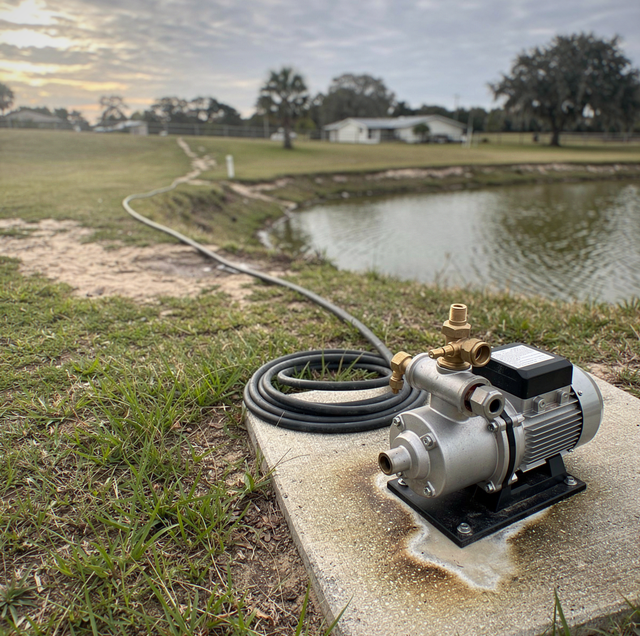
An acreage irrigation system in Lake City doesn't behave like the setup on a quarter-acre lot in town. The pump is often stationed well away from the house, near a pond edge or a dedicated shallow well close to the field it feeds. The pipe run to the far corner of the property can stretch the length of several town lots end to end, and more zones are usually drawing from that same source. Every extra foot of run and every added zone is another place for a problem to hide, and on acreage, nobody is standing next to the pump when it happens. The first sign is usually a dry stretch of pasture or a controller that quietly stopped doing its job days ago.
Why Acreage Changes the Rules for Irrigation Pumps
Private wells and self-supplied irrigation systems are common across rural North Central Florida, and Columbia County acreage properties are a different animal from a subdivision lot even when the pump hardware is identical. On a small in-town property, the pump, the pressure tank, and the first zone are often within sight of each other. On acreage, the pump might sit at a pond a hundred yards from the house, the suction line runs uphill before it ever reaches level ground, and the discharge side splits into zones that cover pasture, a garden block, and a row of trees near the property line.
That layout changes what actually fails and how a failure shows up. A short, tight system either works or it doesn't, and the cause is usually close at hand. A long, branched system can develop a fault at any point along the run, and the symptom you notice, whether that's weak pressure at the far zone, a pump that won't hold prime, or a controller that goes dark after a storm, doesn't always point straight at where the problem started. Three fault families come up again and again on Lake City acreage: pressure that drops off the farther the water has to travel, prime that won't hold on a long suction line, and equipment damage from storms because so much of the system sits outside, unprotected, far from the house.
Low Pressure Across a Long Run
Friction loss increases with each additional foot of pipe, each fitting, and each grade change between the pump and the sprinkler head. On a short in-town run, that loss is minor. Stretched across an acreage property, it adds up to a noticeable pressure drop by the time water reaches the last zone, even when the pump itself is running fine. Fittings compound it: every elbow, tee, and gate valve adds its own equivalent length to the straight pipe, so a run with two grade changes and a pair of tees yields more pressure than its footage alone would suggest.
A pump sized correctly for a smaller property is often the wrong size for an acreage layout with more zones and more distance to cover. An undersized pump is another common cause of underperformance on these systems. Florida's fine sand and grit work into the system over years and wear down impeller surfaces, which quietly reduces output long before anyone notices a full failure. On acreage, that gradual wear shows up first in the zone farthest from the pump, because that's where the remaining pressure is lowest.
Cranking the pressure switch higher to compensate for low pressure doesn't fix a long-run problem: it just makes the pump work harder against the same friction loss, which shortens motor life without solving the real cause.
Loss of Prime on a Long Suction Line
Losing prime is a different problem from losing pressure, and it's more common on acreage because more of these systems draw from a pond, ditch, or shallow well through a suction line rather than pulling straight from a pressurized source. Foot valve failure is the single most common reason a pump won't hold prime: the valve is supposed to keep water in the line when the pump shuts off, and once it starts leaking, the line drains back down, and the pump has to fight air instead of water on the next start.
Suction lift itself has a hard physical ceiling, right around 25 feet at sea level, and less than that once friction loss from a long horizontal run eats into the margin. A suction line that would hold prime fine at that lift on a compact lot can struggle to hold it at the same lift once it's stretched out over a few hundred feet of pipe to reach a pond at the far edge of an acreage parcel. That's the acreage-specific twist: the same components that work reliably on a short run can fail on a long one, purely because of distance.
Storm and Surge Damage on Exposed Equipment
What separates acreage equipment here is simply where it sits. A pump tucked against a garage wall has a wall, a roof line, and a short service run standing between it and the weather. A pond-side pump pad, a wellhead in open pasture, and a control box on a post at a field edge have none of that. They sit unsheltered, well back from any structure, with nothing nearby tall enough or better grounded to take a hit first.
The buried runs feeding them account for the rest. Every additional hundred feet of conductor between the house disconnect and the pump is more length available to collect an induced surge from a strike that landed elsewhere on the parcel, and more length to trace when the far end stops working. That is why acreage systems so often lose control gear while the motor itself checks out fine, and why the failure point can sit at the disconnect, at a splice partway out, or in the box at the pump.
On acreage, the buried run between the disconnect at the house and the wellhead can be several hundred feet of conductor. That length acts as a collector, so the surge reaching the control box is rarely the one that entered.
How Acreage Layout Changes the Fix
On a compact property, a technician can usually stand at the pump and see the whole system at once. On acreage, diagnosing a fault means isolating where along the run the problem actually sits, near the source, in the buried line, or at the far zone, before touching anything, because the same symptom can trace back to different causes depending on distance. A pressure drop that shows up only at the last zone points somewhere different than a drop that shows up everywhere at once.
The fix itself often has to account for the layout, not just the failed part. Replacing a foot valve on a suction line that runs a few hundred feet to a pond calls for confirming the whole run afterward, not just the valve, because a line that long can mask a second, smaller problem behind the first big one. That's the practical difference acreage makes: more of the diagnostic work happens along the length of the system, not just at the pump itself.
When to Call for an Acreage System Check
Weak pressure that gets worse the farther a zone sits from the pump, a pump that won't hold prime after sitting overnight, or a system that went dark after a storm are all reasons to have an acreage system looked at before the problem gets worse or takes out a bigger component. Acreage systems are also worth a periodic check even without an obvious symptom, simply because there's more buried pipe and more fittings along the way for a small leak or a failing gasket to develop unnoticed.
Shop hours are Monday through Friday, 8 AM to 5 PM; after-hours calls go to voicemail and receive a callback the next business day. Given the distances involved on a Lake City acreage parcel, catching a developing fault during a scheduled visit is generally simpler than diagnosing it after several zones have already gone dry.
Frequently Asked Questions
No. Low pressure means the pump is running and moving water, just not enough of it, usually from friction loss or a worn impeller. A prime problem means the pump isn't moving water at all because the suction line has gone dry. In the long run, an undersized suction pipe can also cause chronic pressure issues even when priming is fine; upsizing that pipe's diameter is sometimes the actual fix, not just chasing the pump itself.
Not usually. Most acreage properties in Columbia County run the irrigation pump off a pond, ditch, or a dedicated shallow well that's entirely separate from the well supplying the house. Troubleshooting the irrigation system as though it's tied to household water pressure is a common mistake; the two systems can fail independently of each other.
Rather than starting at the last zone, the usual approach is to compare pressure readings at the pump head with those at a midpoint and at the far zone. That comparison shows whether the loss is happening at the source, somewhere along the buried line, or only past a specific junction, which narrows the search before any part gets replaced.
Not necessarily. A surge that fries a capacitor or relay can shut a pump down completely while leaving the motor itself undamaged. Just as often, the failure point after a storm is the pressure switch or the wiring at the disconnect box near the wellhead, not the motor housing, and those are worth checking before assuming the whole pump needs replacing.
Yes. A foot valve that's starting to fail but hasn't given out yet often lets a system prime fine first thing in the morning, then lose prime again after the pump sits idle for several hours. That intermittent pattern, fine at first use but trouble on the second, usually means the valve is sticking rather than sealing, well before it fails outright.
Joint type and age drive the interval more than acreage does. Buried PVC assembled with solvent-weld couplings usually holds until ground movement or a root loads a joint. A run put together with barbed insert fittings and stainless worm clamps loosens on its own schedule, because the clamp relaxes and the poly takes a permanent set around the barb. A system on insert fittings, past its first decade, earns a shorter check cycle than a welded pipe of the same age.
Schedule an acreage irrigation pump check — catch low pressure, lost prime, and storm damage before they cost you a season of coverage. Perry-Pump Repair Service LLC serves Lake Butler, Gainesville, and Alachua. Call (352) 320-2412.
