

Sandy Soil, Flat Land, Heavy Rain: What a Grading Plan Needs
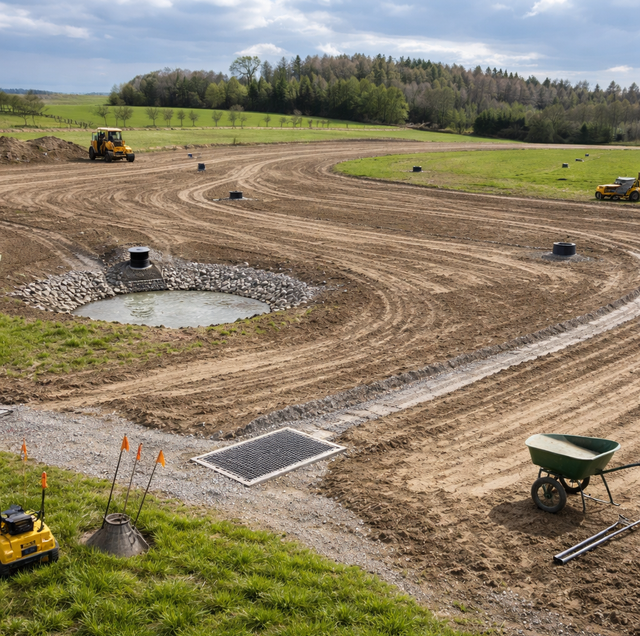
Quick Answer: Three conditions determine most of a grading plan: how quickly soil moves water, how much natural fall the terrain has, and whether rain arrives spread out or in a few concentrated storms. A plan built around only one usually falls short.
Most homeowners size up their yard by one thing at a time. The soil feels sandy, so drainage seems like less of a worry. The ground looks flat, so there's nothing obvious to grade. The rain comes and goes, so it's just weather. Treated separately, all three read as minor. Read together, they describe a specific and fairly common combination that changes what a grading plan actually needs to prioritize, and it's rarely the combination a homeowner expects when they first start asking what their yard needs.
Why These Three Conditions Have to Be Read Together
A grading plan is really answering three different questions at once. Soil type decides how water behaves once it lands: how much soaks straight down and how much sits on top. Terrain decides how water moves sideways across the surface before it soaks in. Rainfall patterns determine how much water arrives at once and how long the ground has to recover between events. A plan that only answers the terrain question, because that's the one people can see, ends up guessing at the other two.
That guesswork matters because the three factors don't add up neatly; they interact. Fast-draining soil is only an advantage if the water gets time to move down before more arrives. Flat ground is only a problem if water sits on the surface long enough to notice. Heavy, concentrated rain is only a stress test if the ground and the fall across it can't keep pace with how fast it shows up. Change any one of the three and the other two behave differently.
What Fast-Draining Soil Changes, and What It Doesn't
Sandy soil earns its reputation honestly. The individual grains are larger and blockier than clay particles, leaving bigger gaps and pore space between them for water to travel through. Squeeze a handful of damp sand, and it still crumbles apart in your hand; squeeze a handful of damp clay, and it holds the shape of your fist. That difference in how the particles pack together is the whole reason one soil drains in minutes and the other can take a day or more to give up standing water.
What that advantage doesn't do is remove the need for a plan. Percolation, water moving down through the soil, has a rate limit even in sand. A hard, fast storm can drop water faster than loose ground can absorb it, and once that rate is outpaced, the extra volume behaves the same as it would on clay: it sheets across the top looking for somewhere to go. Sandy soil also isn't always sandy all the way down. A shallow band of denser soil, sometimes a natural clay lens, sometimes old fill or a compacted layer from prior construction, a foot or two below the surface can perch water even when the topsoil is loose and fast-draining.
Any regrading, swale cutting, or fill work digs into ground that may have buried gas, power, water, or communication lines. Call 811 before digging starts, regardless of how shallow the planned cut looks.
Sandy soil also moves more easily once disturbed than clay does. A freshly graded slope or swale cut into loose sand needs sod, seed with an erosion blanket, or filter fabric under any rock lining fairly quickly, because the same quality that makes it drain fast also makes a bare, graded surface vulnerable to washing out before roots or groundcover lock it in place.
Why Flat Ground Leaves No Margin for Small Mistakes
On sloped ground, a grading plan has room to absorb minor errors; there's enough natural fall that a slightly-off cut still moves water, just less efficiently. Flat ground doesn't offer that cushion. When a lot sits within a few inches of level, the difference between water running off and water sitting in place can come down to less than an inch of elevation over a stretch of yard, well within the range of what a shovel and a bad eye can get wrong without anyone noticing until the next storm.
That's the real cost of flat terrain: it removes the tolerance for guessing. A laser level or transit stops being optional and becomes the only reliable way to confirm a few tenths of an inch of fall actually exists where the plan says it does, since flat ground hides that kind of difference from the eye. Cut-and-fill decisions get more sensitive too. Moving a modest amount of soil on sloped ground spreads out and barely registers; moving that same amount on flat ground can flip a known low spot into a new high spot a few feet away.
How Concentrated Storm Rainfall Changes the Volume Math
Total yearly rainfall isn't the number that stresses a grading plan. Peak rate, how many inches fall in a short window during the worst storm of the season, is. A climate with rain spread fairly evenly throughout the year allows a plan to work with smaller, steadier volumes and longer recovery windows between events. A climate where a large share of the yearly total lands in a handful of intense, concentrated storms asks a swale or discharge point to move far more water in far less time, even with similar totals by year's end.
Concentrated storm patterns usually come paired with real dry stretches in between, not constant dampness, and a plan has to account for both. Built only around the wet extreme, graded slopes sit without groundcover during dry weeks, when wind and loose soil movement do their own damage. Built only around the dry extreme, discharge points end up sized for an average that the worst storm of the season blows past.
Run a percolation test at three or four spots across the yard, not just one near the house. A hardpan or old fill pocket under part of a lot can pass one test hole while hiding a slower-draining layer nearby.
Where the Three Conditions Sharpen Each Other
This is the part a single-factor look misses. On sloped, denser soil with steady rainfall, mistakes tend to be forgiving in both directions: the ground holds water at the surface long enough to be caught by a swale, and the slope carries the excess away gradually. Flip all three conditions at once, and that forgiveness disappears from both sides. Sandy soil's main strength, fast percolation, gets neutralized by a storm that outpaces it, with no slope waiting to pick up the slack because flat terrain has almost no fall to lean on. Flat ground's usual weakness, minimal natural runoff, has nothing offsetting it either, since the ground can't soak up the surplus fast enough during the window it needs to. Each condition removes the other's backup option instead of adding to it.
A quieter version of the same interaction runs the other way. Sandy soil erodes easily once water moves across it, and flat ground allows only a small, deliberate amount of fall to begin with, so there's little room between not enough grade to move water and too much grade for loose soil to hold together without cutting a rut. A sloped, denser lot tolerates being graded a little steep or shallow without much consequence. A flat, sandy lot doesn't have that margin either way, which is why this combination asks more precision of a plan than any one condition would alone.
What to Prioritize When All Three Are Present
In practice, that means working in a specific order rather than tackling whichever piece is easiest to picture. Confirm the actual fall with a level or transit first, since flat ground hides a difference the eye can't judge on its own. Size any discharge point, a swale or a pipe, for the worst storm of the season rather than a seasonal average, since a concentrated-rain climate can send more water through in an hour than a steadier climate sends in a week. Get groundcover or an erosion blanket down on any cut or fill fast, before the first hard rain finds bare, loose sand still unstabilized. Build in a small amount of deliberate slope even where the ground looks close enough to flat that it seems unnecessary, since level ground with fast-draining soil is the exact combination most likely to pass in ordinary weather and fail in the one storm that actually tests it.
A grading plan built around only one of these three conditions treats the other two as background noise until they show up on their own schedule. Working through soil, terrain, and rainfall patterns together from the start is what holds up when the combination is tested by real weather rather than an average one.
Frequently Asked Questions
Yes, and how the hole is pre-soaked matters as much as how many spots get tested. A dry test hole gives an artificially fast first reading, since thirsty surrounding soil pulls water in faster than it will once it's already damp from a recent rain. Filling the hole once, letting it drain, then timing a second fill gives a more realistic number, and running that two-step test at three or four points spaced fifteen to twenty feet apart catches a slower-draining pocket a single near-house test would miss.
Often. Instead of one deep pass, contractors working loose sand on flat ground commonly take several shallow passes with a box blade or grading rake attachment, since clean sand lacks cohesion to hold a shaped edge, and an aggressive single pass can overcut a low spot rather than fill it evenly.
Depth comes down to installation method and frost-line requirements more than soil type itself, and in a climate with no meaningful frost line, many residential systems get installed shallow everywhere, sandy or not, often with a vibratory pull-plow that pulls pipe in at a consistent shallow depth rather than a trench dug to a specific target. What sandy soil changes is how easily that shallow line gets found by accident: loose ground gives less resistance and less warning to a blade or a fork than denser soil does, so a shallow line is easier to cut into without realizing it until it's already happened.
Yes. A swale on flat, sandy ground generally needs to be wider and shallower than the same swale on sloped, denser soil, since it has to carry the same peak storm volume with far less fall to help move it. A narrow channel cut into loose sand beneath that volume tends to erode into a rut rather than function as a shaped drainage feature.
Usually, and that gap matters for planning. Sandy soil sheds surface moisture faster than groundcover meant to stabilize a fresh grade can root in. That's why erosion blankets or fast-establishing sod, rather than seed alone, are common on newly graded sandy slopes in a concentrated-storm climate: the dry gap isn't long enough for seed to anchor the soil before the next hard rain.
Yes, after the single heaviest storm of the season rather than on a calendar schedule alone. Lay a straightedge or level across a spot you suspect has flattened, since sandy soil that has washed or migrated even slightly can erase the fall a swale or slope depended on well before an annual walkthrough would catch it.
Every lot carries some version of these three conditions, but the specific mix- how sandy, how flat, and how concentrated the rain actually gets- is what should drive the plan rather than a generic layout borrowed from a different kind of yard. Getting a read on all three before the first cut is made saves the second round of work that comes from correcting a grade that was only ever designed around one of them.
Get a grading plan built around your yard's actual soil, slope, and rainfall pattern — not a generic layout. Polk Services LLC serves Lakeland, Highland City, and Mulberry. Call (863) 344-5806.
