

Why a Mini Skid Steer Clears an Overgrown Lot Faster
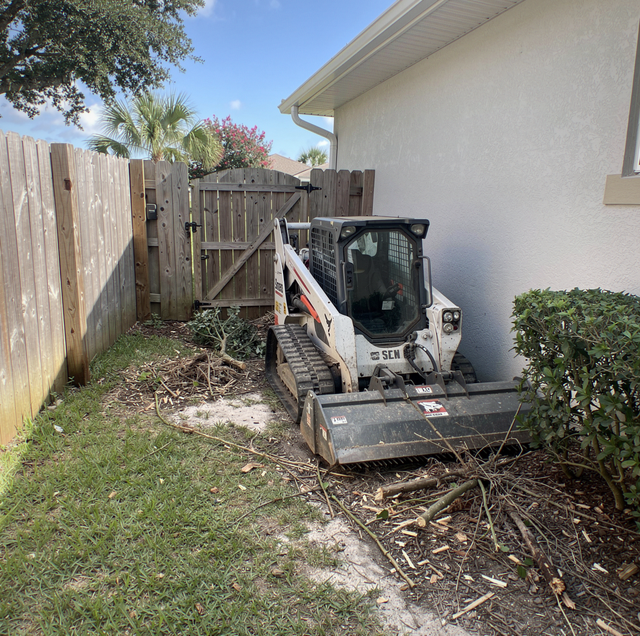
You've got a fence line buried under blackberry canes and volunteer saplings, a side gate barely three feet wide, and a truck-mounted brush hog that will never fit through it. That gap between what full-size equipment can reach and what a hand crew can clear in a reasonable day is exactly where a mini skid steer earns its keep.
What Makes a Mini Skid Steer Different From a Full-Size Loader
A mini skid steer, sometimes called a compact utility loader, is built around one idea: shrink the machine down so it can go where a standard loader physically cannot. Most run 36 to 46 inches wide and weigh between 1,000 and 2,700 pounds, compared to a standard skid steer's 60- to 74-inch frame and several thousand pounds. That width difference sounds small on paper, but it's the line between rolling through a garden gate intact and pulling the gate posts out to make room.
The compact frame also changes how a crew plans the work. A full-size loader usually needs a trailer, a ramp, and enough clear yard to turn around. A mini skid steer can often walk off a small trailer, cross a lawn without a ramp, and pivot in a space not much bigger than a driveway.
Why Ground Pressure Decides What Ground It Can Cross
Weight alone doesn't tell you whether a machine will tear up a yard. What matters is how that weight is distributed across the ground, measured in pounds per square inch of ground pressure. Rubber tracks on a mini skid steer spread the machine's weight over a wide contact area, so the actual pressure on the soil is roughly the same as a person's footstep. A standard skid steer, riding on smaller tracks or tires, can carry far more weight and run at several times that pressure.
That difference is why the mini option gets called in on ground a bigger machine would rut: a lawn still soft from recent rain, sandy soil that compacts and shifts under load, or turf sitting close to a septic drain field or irrigation line where a deep track mark means a repair bill on top of the clearing job.
How One Machine Swaps Into Several Tools
A quick-attach plate on the front of the loader lets an operator disconnect one attachment and lock on another in a few minutes, without a second machine or an extra trailer trip. The loader's own hydraulic pump supplies pressurized fluid, measured in gallons per minute, that powers whatever tool is bolted to the front: a brush cutter one hour, a grapple bucket the next, an auger after that.
Grapple bucket: curved steel fingers close over loose material, such as cut brush, limbs, or old fence sections, so it can be lifted and loaded without hand-stacking. Auger: a rotating bit bores post holes for a new fence line once the old growth is gone. Blade: a straight steel edge knocks down high spots and fills shallow low spots as a finishing pass.
Because all of these run off the same hydraulic system, one operator and one machine cover work that would otherwise require a rented attachment for each task, plus a way to haul it between tasks.
What the Brush-Cutting Attachment Actually Does
The brush cutter head is a steel drum spinning at high speed, ringed with fixed or free-swinging carbide teeth. As the drum rotates, those teeth shred standing brush, vines, and saplings into small chips in a single pass rather than cutting them down whole. The shredded material drops straight to the ground as mulch, rather than remaining as a pile that still has to be gathered and hauled.
That mulching action is also what makes the equipment faster than a hand crew for this kind of work. A crew with chainsaws and brush cutters has to fell growth, then gather it, then load it, three separate motions repeated across an entire lot. The mulching head collapses the fell-and-shred step into one continuous pass, and it doesn't stop for the fatigue a hand crew eventually hits swinging tools for hours.
When the Job Still Needs a Chainsaw Crew
A brush cutter head isn't built for everything. Most attachments handle woody growth up to roughly 4 to 6 inches in trunk diameter reliably; beyond that, the trunk's fiber density resists the cutting teeth faster than they can chew through it, and pushing the equipment past its limit just wears the teeth down without finishing the cut. Anything larger than that threshold calls for a chainsaw crew instead, sometimes paired with a grapple saw attachment for the bigger trunks once they're down. A tree close enough to a structure, fence, or power line to need a controlled drop is its own specialized job and usually calls for a certified arborist rather than general clearing equipment.
Knowing that boundary in advance matters more than it might seem. A lot with scattered brush and saplings under that diameter is a same-day mini-skid-steer job. A lot with several mature trees mixed into the brush is really two jobs stacked on top of each other, and pricing or scheduling one as if it were the other is how timelines slip.
Matching the Machine to the Lot Before Work Starts
A quick walk-through of the property before any equipment shows up saves more time than the equipment itself. Three things determine which machine and attachment combination fits: how wide the access points are (gates, side yards, gaps between a fence and a neighboring structure), how soft or uneven the ground is, and the average trunk diameter of what needs to be removed.
| Site condition | Best-fit equipment | Why |
|---|---|---|
| Narrow gate or tight side yard | Mini skid steer, brush cutter or grapple head | Fits through openings under 4 feet without removing fencing |
| Soft, sandy, or recently rained-on ground | Mini skid steer (rubber tracks) | Lower ground pressure avoids ruts and soil compaction |
| Wide-open lot, minimal obstacles | Standard skid steer | Higher horsepower and bucket capacity clear more ground per pass |
| Mostly saplings and brush under 6 inches diameter | Mulching head | Shreds material into on-site mulch, no separate haul-off |
| Mature trees mixed into the brush | Chainsaw crew plus grapple saw | Handles larger diameter trunks a mulcher can't process |
That table isn't a hard rulebook; ground conditions and access vary a lot from lot to lot, but it's the same sequence of questions a crew runs through before deciding whether one small machine handles the whole job or the work needs to be split between equipment types.
Frequently Asked Questions
Most compact units top out around 5 to 6 mph, noticeably slower than a standard skid steer's 7-to-11 mph range. That trade-off is intentional: the smaller machine is built for maneuvering in tight spots, not for covering long, open ground quickly.
No commercial driver's license is needed since these units fall well under the weight threshold that triggers that requirement, though most operators still complete a manufacturer safety course before running one, covering attachment changeovers and tip-over limits specific to the machine.
It rides on a small dual-axle trailer light enough to be towed behind a standard pickup truck, unlike a full-size skid steer, which typically needs a heavier-duty trailer and a truck rated for that additional load.
Rated operating capacities for most compact models fall in the 500- to 1,000-pound range. That's enough for fence sections, small stumps, and loaded pallets, but not a full shed wall or a mature tree trunk.
Carbide teeth are typically inspected every 20 to 40 hours of cutting time and replaced individually as they dull or chip, rather than replacing the entire cutting head once wear begins to show.
It depends on the attachment, and on what's mixed into the brush. A mulching head shreds clean woody material into chips left on-site as ground cover, while a grapple bucket loads whole brush, limbs, and anything metal or wire-tangled onto a trailer for haul-off. Old fence wire, chain-link, or trash caught in the growth gets pulled and grappled separately before mulching starts. Wire wrapped around a spinning cutter head can jam the drum or snap a tooth, so a quick walk-through before cutting begins determines which material goes to which attachment.
The next time an overgrown corner of a lot looks unmanageable, check the gate width and the ground moisture before assuming it needs a bulldozer or a week of hand-clearing. Chances are a mini skid steer with the right attachment gets through it in an afternoon, and the trunk diameter of what's out there is the only real question left to answer.
Schedule a lot-clearing estimate — get a free walk-through and a same-day quote for brush, saplings, and debris removal. Polk Services LLC serves Lakeland, Highland City, and Mulberry. Call (863) 344-5806.
