

What to Do With Debris After a Tree Comes Down
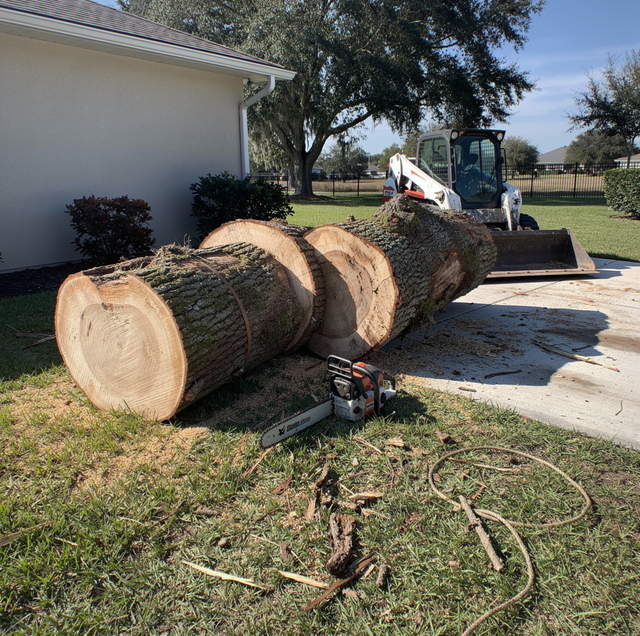
A tree can come down for a handful of reasons: root rot that finally gave out, a wind gust that caught a tree already leaning, disease that hollowed the trunk from the inside, or simple age catching up with a shallow root system. Whatever caused it, what's left behind afterward follows the same basic sequence no matter which of those it was.
Step One: Check for Hazards Before Touching Anything
Before any cutting or hauling starts, the area around a downed tree needs a hazard check. Look for a power line the tree may have pulled down, or that's now resting against a branch, since a line that looks slack or disconnected can still be energized. Check whether the tree fell across a fence, a shed, or another structure in a way that created tension; a branch bent under load can snap back with force once the weight shifts during cleanup. And look at what the tree was standing near before it fell: a gas meter, a septic lid, or a water line running underground can all be affected if roots pulled up soil as the tree fell.
Anything involving a power line or a tree resting against a structure under visible tension is a call-a-professional situation before it's a cleanup situation.
Step Two: Separate the Debris Into Categories
Once the area is confirmed safe to work in, debris usually breaks into three rough categories that get handled differently. Small branches and brush, generally under 2 inches in diameter, can often be cut and stacked or run through a chipper on-site. Trunk sections and larger limbs need to be cut into manageable lengths, typically limited by what a two-person lift or loader can handle rather than by any fixed measurement. And root ball material, the mass of soil, roots, and sometimes rock that comes up if the tree uprooted rather than snapping at the trunk, is its own separate problem since it's heavier and denser than wood debris and often needs equipment rather than hand tools.
Step Three: Deal With the Root Ball and the Hole It Left
An uprooted tree leaves a hole where the root ball tore free of the ground, sometimes several feet across and a couple of feet deep, depending on the tree's size and the development of its root system. That hole doesn't fix itself by filling it with whatever loose dirt is nearby; low spots left behind can hold water after rain and eventually create a soft or uneven patch of yard that outlasts the original tree by years.
The root ball itself, if it's still attached to the fallen trunk, is usually cut free and handled separately from the rest of the tree, since it carries embedded soil and rock that can dull cutting equipment designed for wood. Backfilling the hole with suitable soil and compacting it in layers rather than dumping it loose is what keeps that spot from settling into a depression again over the following months.
Step Four: Handle the Stump if One's Left Standing
If the tree snapped rather than uprooted, a stump is usually left in the ground along with a root system that's still very much alive and, depending on the species, capable of sending up new shoots for a season or more afterward. Whether that stump gets ground down, pulled, or left in place is really a separate decision from the debris cleanup itself, since stump removal involves the root system rather than just what's above ground.
Step Five: Sort What Gets Hauled From What Gets Left
Not everything from a downed tree needs to be removed from the property. Smaller branches run through a chipper can be left on-site as mulch, which is often the fastest way to deal with the brush category from Step Two without a separate haul-off trip. Trunk sections large enough to be worth keeping sometimes get set aside for firewood if the property owner wants them. Everything else, including any root ball material and debris too large or too damaged to be useful, typically gets loaded and hauled as yard debris.
Why the Direction a Tree Fell Changes the Cleanup Plan
Where a tree lands changes almost everything about how cleanup gets approached. A tree that fell into an open part of the yard is usually the simplest case: clear access on all sides, no structure to work around, and a clear path for equipment to get in and out. A tree that fell against a fence, a shed, or a house wall adds a layer of caution, since removing debris in the wrong order can shift weight onto whatever it's resting against and cause additional damage beyond what the fall already caused.
A tree that fell across a driveway or walkway usually gets prioritized differently too, not because the debris itself is more dangerous, but because it's blocking access that a household needs back sooner rather than later. Crews typically clear a path through blocking debris first, then return to complete the rest of the cleanup once the immediate access issue is resolved.
What Equipment Gets Used for Each Stage of the Job
Different stages of cleanup call for different tools, and using the wrong one for a given stage either slows the job down or creates unnecessary risk. Chainsaws handle the cutting stage, breaking a trunk and larger limbs into sections short enough to move. A grapple attachment on a skid steer or loader handles lifting and loading those sections once they're cut, especially root ball material that's too heavy and awkward for hand loading. A chipper handles the brush and small-branch category, turning material that would otherwise take up a large volume in a truck bed into a much smaller pile of chips.
Matching the equipment to the debris type is part of why a crew with the right combination of tools on-site finishes a job in hours that would otherwise stretch into a multi-day project with hand tools alone.
Frequently Asked Questions
Left untouched, a root-ball hole can visibly sink for a full season or more as loose backfill settles unevenly under rain and foot traffic. The fill material matters as much as the compacting: soil that closely matches the surrounding yard settles at roughly the same rate as the lawn, while pure sand or mulch used as a quick fill often settles faster and leaves a visible ring or dip years later. It's also worth checking whether a sprinkler line ran through that section of the yard before backfilling, since a root ball tearing free can shift or expose irrigation piping that needs rerouting rather than just burying back over it.
In a wooded or naturalized part of a property, a downed trunk left in place can serve as habitat for insects and small wildlife, and some property owners choose to leave a section for that reason rather than hauling everything off, as long as it's not near a structure, fence, or walkway.
Species matters more than size here; dense hardwoods season and burn well as firewood, while softer woods with high moisture content are less practical to season and more often hauled as debris regardless of how large the section is.
It depends heavily on the type of tree. Many broadleaf hardwoods are prone to sending up root suckers around a cut stump, while most conifers rarely resprout at all once the trunk is down. That difference is often the real deciding factor in whether grinding a stump is worth scheduling versus just leaving it to break down on its own.
There's no way to visually confirm a line is de-energized just by looking at it. A downed line can also energize anything metal it's touching, a chain-link fence, a metal gate, or damp ground nearby, so the safe distance to keep is roughly the length of the fallen tree itself, not just an arm's reach from the wire.
A trunk or branch, pinned or bent by the way it landed, can store energy like a loaded spring. Professional crews look for the compression side, where the wood is bunched and likely to pinch a saw blade, versus the tension side, where fibers are stretched and likely to fracture first, and plan the cut sequence around that difference rather than starting wherever looks convenient.
Hazards first, then debris, then the hole, then the stump, then the sorting decision; that order isn't arbitrary. Skip a step or take them out of sequence and a crew ends up redoing work: cutting around a hazard that should have been flagged first, or hauling material that should have been set aside for firewood before it ever reached the truck.
Schedule fallen tree cleanup — get a free estimate for debris removal and hauling. Polk Services LLC serves Lakeland, Highland City, and Mulberry. Call (863) 344-5806.
