

What Forestry Mulching Does That Bulldozing Can't
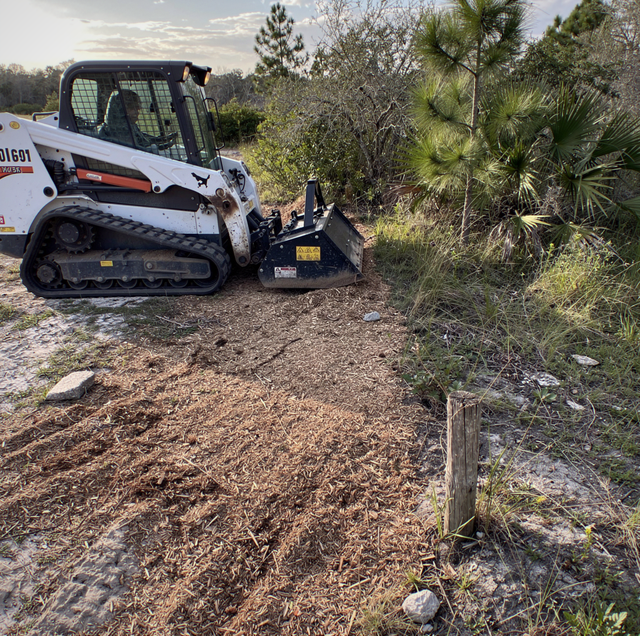
The usual assumption about clearing an overgrown lot is that it takes one of two approaches: a bulldozer pushing everything into a pile to burn or haul, or a chainsaw crew working tree by tree for days. Forestry mulching skips both, and the reason it works comes down to what the equipment does to the vegetation rather than to the dirt underneath it.
What a Forestry Mulcher Actually Does
A forestry mulching head is a steel drum mounted on a skid steer or compact track loader, ringed with fixed carbide teeth or swinging hammers. Driven by the carrier's hydraulic system, the drum spins at high speed and grinds standing brush, saplings, palmetto, and small- to mid-size trees into wood chips in a single continuous pass. There's no felling step first and no separate gathering step after; cutting and shredding happen at the same time, on the same pass.
Why Mulching Leaves the Root System in the Ground
Traditional land clearing with a dozer blade works by force: the blade pushes against a tree or stand of brush until it tips over, root ball and all, then drags the debris into a windrow. That process rips up the soil layer along with the vegetation, leaving a disturbed strip of loose dirt behind the blade.
Mulching cuts vegetation at or near ground level rather than uprooting it. The root system stays in the ground, still doing the job roots do: holding soil in place. That distinction matters most on sloped ground or land near a drainage path, where a dozer's uprooting action can loosen enough soil to start an erosion problem that outlasts the clearing job itself.
What Happens to the Debris After It's Ground Up
The shredded material doesn't get hauled off; it stays where it fell, spread as a mulch layer roughly 2 to 4 inches deep across the cleared ground. That layer does three things on its own: it blocks enough sunlight to slow new brush from sprouting back in the same spot, it holds soil moisture that would otherwise evaporate off bare dirt, and it breaks down over months into organic matter that improves the soil underneath it.
Practically, that also means no burn pile waiting on a dry-weather window and no separate haul-off trip for a trailer full of brush. The cleanup step that usually follows a dozer clearing job is largely finished by the time the mulching pass is done. The mulch layer also breaks the visual line between a cleared patch and untouched brush that a dozer's push-pile approach leaves behind; since the material stays spread across the ground rather than stacked at one edge of the lot, the finished site reads as clearance rather than a construction zone waiting on a haul-away truck.
Where Mulching Beats Traditional Land Clearing
Mulching earns its place on jobs where disturbing the soil is the actual problem, not just an inconvenience. That includes overgrown lots being reclaimed for light use rather than construction, right-of-way or fence-line clearing where a clean edge matters more than a bare surface, land on a slope where erosion control is part of the job, and any site close enough to a pond, ditch, or drainage swale that loose soil runoff is a real concern.
It's less of a fit when the end goal is a building pad, a new driveway, or anything that requires the ground to be graded flat and the root systems fully removed. In that case, the roots left behind by mulching eventually need to come out anyway, so a dozer or a stump-focused approach makes more sense from the start.
What Size Growth a Mulching Head Can Process
Most mulching heads mounted on standard-size skid steers or track loaders are rated for trunks up to roughly 8 to 10 inches in diameter, with some dedicated forestry carriers built to handle larger material. Wood density changes how long a given trunk takes to grind through even at the same diameter; dense hardwood resists the teeth longer than softer pine, which is one reason two lots with similar-looking overgrowth can take noticeably different amounts of time to finish.
How a Mulching Job Actually Runs Start to Finish
A mulching job typically starts with a walk of the property to flag anything the operator needs to work around: a septic tank lid, a well cap, a fence line that must remain in place, or a specimen tree the owner wants to keep standing. Those get marked before the carrier ever moves onto the lot.
From there, the operator works the mulching head in overlapping passes, usually starting at one edge of the property and working across it in strips, similar to mowing a field, but with a machine that cuts standing growth rather than grass. Dense pockets of brush or a cluster of mid-size trees usually take multiple passes over the same ground before the material is fully broken down; a single quick swipe leaves half-ground stalks that still need another pass to finish.
Because the carrier is tracked rather than wheeled, it can reposition in tight corners without the wide turning radius a wheeled dozer needs, which is part of why irregularly shaped lots, ones with a narrow back corner or an odd-angled property line, are often a better fit for mulching than for equipment built to clear ground in long straight passes.
Signs a Lot Is a Good Candidate for Mulching Over Clearing
Not every overgrown property benefits equally from this approach. A lot is usually a strong fit when the growth is mostly brush, vines, and saplings rather than a stand of mature trees, when the ground has any slope or sits near a drainage feature, and when the plan afterward is to leave the land in a more natural, walkable state rather than pour a new slab or driveway on it.
A lot leans toward traditional clearing instead when most of the growth is large-diameter trees beyond what a mulching head can process, when the end use requires the root systems fully removed and the ground graded flat, or when the property is being prepped for construction that will disturb the topsoil anyway, in which case mulching's soil-preserving advantage doesn't carry the same weight.
One practical side effect of the on-site approach is paperwork: since nothing gets burned and material isn't hauled to a disposal facility, mulching typically sidesteps the burn permit and landfill ticket steps that traditional clearing and debris disposal often require.
Frequently Asked Questions
Mulching cuts vegetation off near ground level and grinds it, but for species that resprout from the roots, one pass isn't always the end of it. Some brush grows back and needs a follow-up pass a season later to finish the job.
Depending on rainfall and shade, a layer like this typically breaks down substantially within 12 to 18 months. A spot that stays consistently damp decomposes faster, while a dry, sun-exposed area can take longer to fully return to soil.
Tracked carriers used for mulching sit lower and distribute weight more evenly than wheeled dozers, and many are rated to operate on grades of around 20 to 30 percent. A dozer pushing soil on a similar slope risks loosening enough dirt to start a slip, which mulching's roots-in-place approach avoids.
As with any wood mulch, it's worth keeping the ground-up material a few feet clear of a foundation or siding rather than piling it right against the structure, the same precaution used for a mulch bed in a landscaped yard.
A forestry mulching head is usually mounted on a carrier built for continuous, hours-long cutting, while a compact loader's brush-cutter attachment shares that machine's hydraulic power with several other quick-attach tools, so it's built for lighter, shorter-duration work rather than grinding through a dense stand for an extended stretch.
No. Mulching clears what's standing on top of the ground but doesn't touch the soil surface itself, so a lot with existing low spots or uneven grade still needs a separate grading pass afterward if it's being prepped for a driveway, patio, or structure.
An overgrown lot doesn't always need to end up as bare dirt and a burn pile to be usable again. Matching the clearing method to what the land is actually going to become- cleared and left natural, or graded flat for something new- decides more of the outcome than the size of the equipment does.
Get a free lot-clearing walkthrough — see whether mulching or full clearing fits your property. Polk Services LLC serves Lakeland, Highland City, and Mulberry. Call (863) 344-5806.
