

How Contractors Verify a Finished Grade Is Actually Right
Quick Answer: A finished grade isn't verified by looking at it. A contractor confirms fall with a laser level and grade rod at multiple points, a taut string line for shorter runs, and a water test, checking whether the flow reaches the low point.
A rod, a taut string, and a running hose do the actual work of confirming a finished grade, not a walk-through at the end of the job. Water sitting in a corner of the yard two days after a storm, or one section of new sod staying soggy while the rest drains fine, traces back to a slope that was never actually confirmed, just assumed once the soil looked smooth and raked flat. A grading contractor doesn't sign off on a site by eye. A finished grade gets checked with an instrument, more than once, at more than one point, before anything permanent goes on top of it.
Why the Eye Gets This Wrong
A person standing at one end of a yard, sighting toward the other end, is a poor tool for judging small slopes. Below roughly a 2% grade, most people can't reliably tell a surface is sloped at all; it just reads as flat. That's not a lack of attention or experience. It's how human depth perception works over a wide, open, textured surface like lawn or bare dirt, where there's no vertical reference line to compare against.
The problem is that 2% is close to the exact range most drainage depends on. A hardscape surface like a patio or a walkway typically wants a 1-2% fall to shed water without looking obviously tilted underfoot. Open lawn generally wants a bit more, but a lot of a finished yard's actual working slope still falls inside that band the eye is worst at reading. A grade can fail at exactly the slope at which a person would swear, standing on it, that it looks level.
A flat-looking yard with poor drainage and a flat-looking yard with correct drainage are not the same thing, and nothing about how they look tells them apart. That's the entire reason instrument checks exist as a separate step from finishing the surface, rather than a formality tacked onto the end of the job.
Every Reading Has to Tie Back to One Fixed Point
A benchmark gets set before dirt ever moves, not at verification time, and every reading taken during the actual grade check ties back to that same fixed point. This is usually a stable, unmoving feature on the site (a driveway edge, a foundation corner, a manhole rim, sometimes a stake driven and left in place for the duration of the job) assigned an arbitrary elevation, often just "100.00," that every other reading on the site gets compared against.
Without a benchmark, a reading of "6 inches of fall" is meaningless on its own; fall relative to what? Every laser reading, every rod shot, every string height on the job ties back to that one fixed number, which is what lets a contractor compare a spot check taken at 9 am to one taken after lunch and know they're reading the same slope, not two different surfaces that happen to look similar.
The Rotary Laser Level and Grade Rod
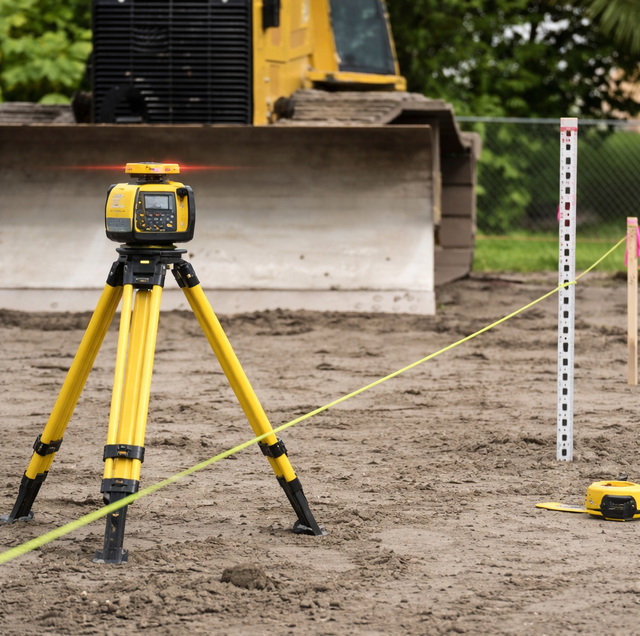
For checking fall across an open site, the standard instrument is a rotary laser level mounted on a tripod at a fixed, central spot. Once leveled, it spins a beam that projects a flat reference plane across the entire work area, visible (or detectable, depending on the model) at any point a person can insert a rod. A self-leveling laser typically compensates for small tripod tilt on its own, within a couple of degrees, and will flash or shut off if it's set up outside that range, which is itself a useful check that the tripod was actually stable.
A grade rod, held vertically at any point on the site, has a sliding receiver that catches the laser beam and reads out a height, or a fixed set of graduated markings a second person reads by eye where the beam crosses the rod. The first shot, taken with the rod held on the benchmark itself, fixes the instrument's own height above that reference point. Every subsequent shot at a new point is subtracted from that instrument height, and the difference is the actual current elevation of that exact spot, not an estimate.
The rod gets walked to multiple points, not one. A typical check pattern runs the rod across a rough grid, often every 10 to 15 feet across an open yard, tighter (every 5 to 8 feet) near a drain inlet, a low corner, or anywhere the finished surface changes direction. One good reading near the high end of a lot and one near the low end tell a contractor almost nothing about what's happening in the middle; a grade can dip or hump between two checked points and still pass a two-point check while holding water on a wide, flat lawn. The grid is what catches that.
A rough working tolerance most graders check to is fall staying within about half an inch to an inch of the target line over any 10-foot run, tighter near a foundation or drain, a little looser out in open lawn.
The String Line and String Level
A laser and tripod aren't always the right tool for a short, tight run: the last stretch into a drain inlet, the edge of a trench, a narrow side yard between a fence and a house wall where a tripod barely fits. For those, a taut string pulled between two stakes set at known heights does the same job over a shorter distance.
Setting stakes or probing test holes for a grade check may require digging, especially for deeper stakes near a fence line, utility box, or driveway edge. Call 811 first to have buried gas, power, water, and communication lines marked before ground gets disturbed.
Two stakes go in at each end of the run, each marked at a measured height above the ground. A mason's line gets tied off between them, pulled tight enough that it doesn't sag (any sag reads as false fall and throws the whole check off), and a small line level, a short bubble vial with a hook at each end that hangs directly on the string, confirms the string itself is level before any measurement is taken off it. From there, the vertical distance from the string down to the ground at any point along the run, compared against the known stake heights, gives the actual fall over that stretch.
It's a faster setup than a full laser rig for a run under 20 or 30 feet, and it doubles as a visual guide while the surface is actually being shaped, something a laser plane alone doesn't give a crew mid-job. Run a fingertip along the taut string itself, the same check a carpenter runs along a tabletop edge, and a low spot in the ground below that the eye skipped right past often shows up as a gap between string and surface you can feel before you can see it.
The Water Test
The most physical of the three checks is also the simplest: run water at the highest point of the graded area and watch, in real time, whether it actually travels to and exits at the intended low point, or stalls, spreads sideways, or pools along the way.
A hose set to a moderate, steady flow, not a full-blast stream that would just carve its own channel through loose soil, gets placed at the high end of the run. From there it's a matter of watching: does the leading edge of the water keep moving downhill in a reasonably direct line, or does it stall out, spread wide, or double back? Any spot where the water visibly slows and widens, rather than staying a narrow moving edge, is very often the same spot a laser grid would flag as slightly high, off-plane, or reverse-pitched, just confirmed by watching it in motion instead of reading it off a rod.
The water test also catches something the instrument checks can't: how the finished surface actually behaves once water hits it, not just what its elevations measure. A grade can read correct on paper and still shed water unevenly across ground that isn't uniformly compacted, since looser pockets of soil soak water in faster than the surrounding area and can make an otherwise-correct slope look like it's failing in one spot. Running the water is often the last check before sod, gravel base, or a slab goes down, because it's the one test that shows the surface doing the actual job it's being built to do.
What "Good" Actually Looks Like
None of these three checks stands alone. A laser grid confirms the numbers are right across the whole site; a string line fine-tunes a short run or an edge condition; a water test confirms the numbers translate into water actually moving where it's supposed to. A contractor who runs only one of the three is trusting that method to catch every kind of failure, and each one has a blind spot that the others cover.
Consistency across the checks is the real pass/fail line, not any single reading. A grid that reads correct everywhere except one 15-foot stretch that comes up flat, or a water test where the flow stalls in a spot the laser grid missed because the check points happened to land on either side of it, is a real failure, not a rounding error. That's the value of checking at multiple points on a grid instead of a couple of spot readings: a slope can be correct on average across a yard and still be wrong in the one place that matters, right where a downspout empties or a patio slab is about to sit.
Catching a grade problem at this stage with a rod, a string, or a running hose means reworking the dirt. Catching the same problem after sod is rolled out or a gravel base is compacted on top of it means pulling material back up first. The checks exist because that difference in effort is the whole reason to run them before anything goes in, not after.
Frequently Asked Questions
A rotary laser is self-leveling and projects a beam automatically once it's set on a stable tripod, with an electronic compensator that corrects for small tilt on its own. An optical transit or dumpy level has to be manually leveled with adjustment screws and a bubble vial, and a second person reads the crosshairs through the scope rather than catching a beam on a rod. Transits are still used for very precise or long-distance survey work, but a rotary laser is faster to set up and read for routine grade checks on a residential lot.
Open ground grading usually works with a percentage of slope, but a drain pipe under the ground is set to a much smaller number: a common minimum is around 1/8 inch of drop per foot of pipe run, a little over 1% grade, to keep water and sediment moving through the pipe without settling out. That's a separate check from surface grading and usually gets confirmed with a string line or a laser set at pipe-trench depth rather than at surface level.
Not for a full-site check. Most phone-based digital levels are accurate to about half a degree to a degree once you account for how the phone is held and minor sensor drift, which may sound small but can throw off a slope reading meant to hold within an inch over 10 feet. A phone level is fine as a quick spot check on a short section, but it isn't a substitute for a rod-and-laser grid across an open site.
A grade stake driven into the ground usually gets marked with a cut or fill number, how many inches of soil need to come out or go in at that exact spot to reach target grade, plus sometimes a colored flag or paint mark showing what the stake represents. Utility locate marks follow a standard national color code (red for electric, yellow for gas, blue for water, orange for communications), so those are consistent from job to job. A contractor's own cut-and-fill and property-line stake markings aren't standardized, so the color key is usually confirmed at the start of the job rather than assumed.
Yes. A basic field calibration check involves setting the laser up roughly equidistant between two points, taking a reading at each, then rotating the tripod or the laser itself 180 degrees and re-shooting both points. If the two sets of readings don't match, the instrument's internal level is off and needs adjustment or professional calibration before it can be trusted for a job. Drops, bumps in a truck bed, and general wear are the usual causes.
The laser grid is the more reliable of the two when they conflict, since a water test can be thrown off by wind pushing the flow sideways, by a patch of loose, freshly worked soil soaking water in faster than it flows across the surface, or by thick grass or thatch that holds water against the blades before it drains through. When that happens, the instrument readings are trusted first, and the water test is rerun after conditions settle, rather than reworking a grade based on a single flow pattern that might have had an unrelated cause.
A grade that checks out on a laser grid, holds up over a string line, and moves water cleanly in a hose test has earned its pass through three different kinds of proof, not one glance across the yard. That's worth confirming before sod gets rolled out, gravel gets spread, or a slab gets poured on top of it, since all three of those cover the surface right back up.
Get a finished grade checked before you build on it — Polk Services LLC verifies fall with the same instrument and water checks before sod, gravel, or a structure goes in. Polk Services LLC serves Lakeland, Highland City, and Mulberry. Call (863) 344-5806.
