

Pool Deck Pavers: Which Ones Can Actually Be Saved
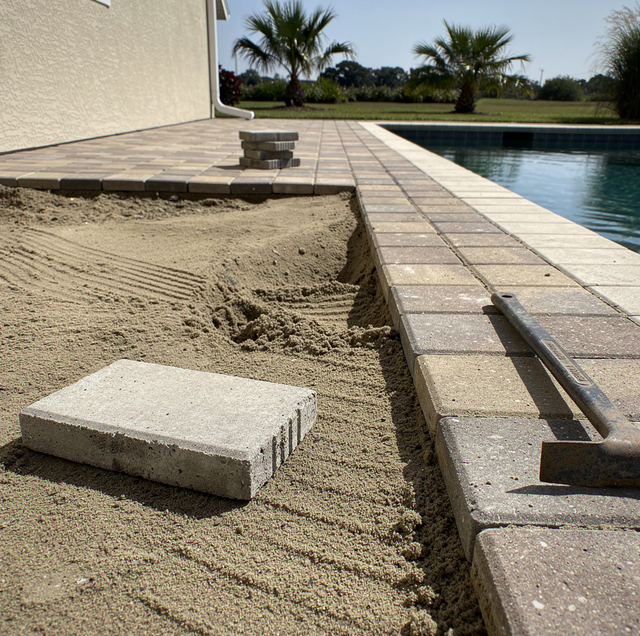
Quick Answer: Whether pool deck pavers can be reused depends on how they were set. Sand-set units lift out whole and can be kept if the faces are sound and enough of them match. Mortar-set pavers break loose and become fill instead.
The first paver a crew works loose from a pool deck tells you almost everything about the several hundred still in the ground. If it lifts clean, dry sand crumbling off the back, with the paver next to it sliding free the same way, the whole field was probably built the same way and a real share of it can come up whole. If that first unit comes up with a crust of hardened mortar stuck to its underside, or snaps across the middle before it clears the joint, the deck was built differently, and that one detail changes what happens to every paver after it.
The question behind this is a simple one: can any of this be kept, given away, or reused elsewhere on the property, or does all of it become fill. The answer depends on how the deck was assembled, what shape the individual units are in, and whether enough of them match to be useful as a set. Here is how each of those gets decided, in the order the crew works through them.
How the Deck Was Built Decides What Comes Up
Most paver pool decks are built one of two ways, and the difference is what separates a paver that can be lifted intact from one that cannot. A poured concrete deck is a different question entirely, depending on whether to take the deck with the pool or leave it.
Sand-set pavers: These sit on a layer of sand screeded level over a compacted base. Nothing bonds one unit to the next or to the base underneath. An edge restraint, a strip of plastic, aluminum or concrete set into the ground at the perimeter, keeps the outer row from creeping outward, and joint sand swept into the gaps locks the field together across its surface rather than at any single bond point. Clear the joint sand around one paver, and it lifts as a single whole piece.
Mortar-set pavers: These are bedded in mortar over a poured concrete slab, closer to being glued down than sitting loose. The mortar bonds directly to the underside of each unit, so a mortar-set paver usually brings a layer of hardened mortar up with it, or breaks at its weakest point before the bond gives way. A mortar-set paver that comes off in one piece still has a mortar-crusted back, making it hard to set flush anywhere else.
Reading the Edge, the Joints and the First Unit
You do not need to lift every paver to know which category a deck falls into. Three places tell the crew what to expect from the rest of the field.
The perimeter edge Is the first tell. A plastic or aluminum restraint strip, or a poured concrete edge set flush against the outer row, means the deck was likely sand-set. If the outer row is instead locked into a continuous mortar bead against a slab edge, expect mortar-set construction underneath.
The joint lines are the second. Sand-set joints show a visible line of loose sand between units that can be brushed or vacuumed out. Mortar-set joints are usually filled solid with the same hardened material as the bed underneath, with no give when you run a finger along the line.
The first unit lifted confirms it. The crew treats that one as the sample for the whole deck rather than as an isolated case. What it does under a pry bar is what the next several hundred are expected to do.
What Decides Whether a Paver Can Be Kept
Coming up whole is the first requirement and not the only one. A sand-set paver that lifts clean still has to clear a condition check before it gets stacked aside instead of loaded out.
Chipped or spalled edges: The most common disqualifier. Years of pool chemicals, foot traffic, and heat and cold cycling work at the corners and edges of exposed units, and a chipped paver looks worse once it is reset somewhere new and out of context.
Uneven fading: This shows up on units that sat under a table, a planter, or permanent shade for years, beside units that did not. Pavers from the same production run age differently depending on sun exposure, and a sun-bleached unit next to a shaded one reads immediately in a new location.
Efflorescence: The pale, chalky mineral deposit that leaches out of masonry exposed to moisture. It tells you a unit has been wicking water for a long time. It is not structural on its own, but it is a detail to check for.
Cracked-through units: An easy no. A hairline surface crack is one thing; a paver cracked clean through the body will not hold up to being lifted and reset again.
There is also a detail people do not expect. A paver's buried face and its exposed face have aged in two completely different environments: the top has taken sun, chemicals, and foot traffic, and the bottom has sat in damp sand in the dark. That mismatch is normal and is not a reason on its own to set a unit aside.
The Set-Matching Problem That Limits Reuse
Condition is not usually what ends a reuse plan. Matching is.
Paver shapes, patterns, and colors are discontinued on an ongoing basis, just like flooring and tile lines. A deck installed even a few years ago may use pavers no longer made in that exact color or profile. That matters because a partial salvage has to stand entirely on its own: whatever comes up sound and matching is the whole available quantity, since there is no supply run to reorder from once the line is gone.
This is why the crew separates units by shape, color, and wear pattern as they come up rather than stacking everything into one pile. A deck that looks uniform from a chair on the patio often turns out to be two or three subtly different runs when you look at loose units side by side, patched in over the years as sections were repaired. Sorting at the point of lifting keeps a truly matched set intact, rather than scrambling several partial sets into one unusable pile.
Ask the crew to set aside more sound units than you plan to use. A paver that looks fine the day it comes up can still crack in storage, and a buffer protects a matched set from that loss.
What Salvaging Actually Involves as Work
Keeping the pavers changes how the crew works the deck.
A machine scrapes a field of pavers up in sections, and scraping breaks corners and cracks units that would otherwise have come up sound. Salvage runs after the water is down and the shell floor has been opened, which is the first thing that happens on any pool removal regardless of what the deck is made of. Where a paver field is being saved, the machine works that step from the driveway side or off mats, so the units are not tracked over before anyone lifts them. From there, units are worked loose by hand or with a flat paver puller, one at a time or in small sections, starting at the edge restraint and working inward along the same direction the deck was originally set.
As each unit comes free, joint sand and bedding sand separate rather than remain stuck to the paver, since sand clinging to the back makes stacking and later handling messier. Sound units get stacked, usually banded in bundles or set on a pallet, sorted into the groupings described above.
All of that takes space. A deck's worth of salvaged pavers is a real footprint on the property and not a pile that tucks into a corner, so it helps to have a spot picked out, a side yard, a garage bay or a covered area, before the first unit comes up.
When a Machine Takes the Deck Out Instead
Not every deck is a salvage candidate, and not every homeowner wants one. Mortar-set construction, heavy cracking throughout, or a simple decision not to keep anything all point toward a machine pass instead of hand lifting.
A machine pass treats the pavers as part of the demolition rather than as units to preserve. An attachment scrapes and breaks through the field in sections, pulling base material up along with it. It is the right call when hand-lifting the deck does not make sense in the first place, but whatever comes up during that pass will not be reused. Cracked, chipped, or mortar-crusted pavers headed for that outcome anyway are exactly the ones a machine pass suits.
Pavers snapping loose under an attachment throw sharp fragments, and broken pieces grip far less cleanly than intact ones. Stay well back during a machine pass, and use gloves on anything broken.
Where the Leftover Pavers End Up
Pavers that are not kept do not disappear. They join the demolition debris stream the same way broken concrete does, as inert material with no organic content to break down later, and like broken concrete they get worked down small enough to nest instead of span before anything goes on top of them.
Whether that material leaves the property or stays on it depends on the same factor that decides what goes back into the pool cavity: how much fill space there is to take it, and what the ground is going to be asked to do afterward. Where a slab or structure is planned over the footprint, more material is deliberately left out, and clean fill comes in instead. How much actually goes out of any given yard is a site answer rather than a rule, and it gets settled at the same time the rest of the scope does.
Frequently Asked Questions
Yes, as long as the units are sand-set, sound, and enough of them match for full coverage. Keep in mind that lifting pavers out and installing them somewhere new are two different trades. The crew that salvages a deck stacks the units for you; setting them into a new base and pattern elsewhere is a separate job you would hire out on its own.
That split is common on decks repaired in sections over the years rather than built all at once. The sand-set portion still sorts out for salvage, as any sand-set field does. The mortar-set portion, usually the patched-in section, goes the same direction as any other mortar-bonded material once it breaks loose.
Rarely worth attempting. Getting mortar off the back means chipping or grinding it, and what you are left with is a unit whose underside is no longer flat or parallel to its face. Sand-set paving depends on every unit bearing evenly on a screeded bed, so one unit sitting on a high spot of leftover mortar rocks underfoot and works its joint sand out from around itself. The face may be perfectly sound yet unusable in a sand-set field.
Not into a dish under lawn. A void under a lawn does not settle; it collapses, and it does so a season or two after everyone has stopped watching for it. They belong in an open cavity where they can be broken down and knitted into fill, or on the truck. Filling a shallow low spot in a yard is a soil job.
Look at how the unit sits relative to its neighbors. A paver pulled and reset during an earlier repair often sits slightly proud or sunk relative to the surrounding field because it was not reseated to the original screed line. Units from the initial build typically sit flush and level with one another across the entire section.
Mostly no. Efflorescence forms when moisture moves through masonry and, as it evaporates, deposits minerals on the surface, so it needs an ongoing moisture source to continue developing. Units stacked dry in open air typically stop producing new efflorescence once they dry out, though the white residue already on the surface does not reverse on its own.
A paver field is read once and lifted once. The sort happens while units are still coming up, in the hour the deck comes apart, and there is no going back over ground that has already been taken out. That is the practical difference between this and most demolition decisions: almost everything else can be revisited on the second day, but this cannot.
Schedule your pool deck removal — get a crew that separates what can be salvaged from what needs to be hauled away. Polk Services LLC serves Lakeland, Highland City, and Mulberry. Call (863) 344-5806.
