

Carpet to LVP: What Each Crew Needs from the Other
Every job that swaps carpet for luxury vinyl plank has one moment where one trade's work becomes another trade's starting point: the bare sub-floor underneath. Neither crew you hire owns that surface outright. Your removal crew leaves it behind, your flooring crew inherits it, and LVP asks more of that handover than carpet ever did. A rigid or semi-rigid plank shows you what carpet quietly absorbed for years, which means the standard you should expect at that handover rises even when nothing about the room looks any different.
Ask Your Installer What the Deck Should Look Like
A complete removal leaves your sub-floor swept, not just cleared of carpet. That distinction matters more than it used to because your flooring crew is about to work directly on that surface rather than stretch a forgiving layer of padding over it. Photos texted ahead of the job set the scope on both ends: your flooring crew gets a sense of what the deck looks like before anyone shows up, and your removal crew knows what condition the room needs to be in when the last piece leaves.
There is no universal handover standard you can look up, and assuming one is where this goes sideways. What "ready" means for your deck comes from your flooring installer, so ask that question directly before removal day is on the calendar: do they want the tack strip and the staples pulled, the deck swept bare, anything left alone? Settling it in advance means the room is cleared to the right condition the first time, rather than requiring a second visit to correct what was pulled or left behind.
That answer can sound minor until you consider how much carpet used to hide. Carpet installed the traditional way could sit over a sub-floor with small flaws for years without you ever noticing, because the padding underneath did the forgiving. Luxury vinyl plank removes that buffer, so the swept, empty deck your removal crew hands off is no longer just a courtesy. It's the actual surface your new floor has to live on.
Fasteners the Removal Crew Needs to Catch
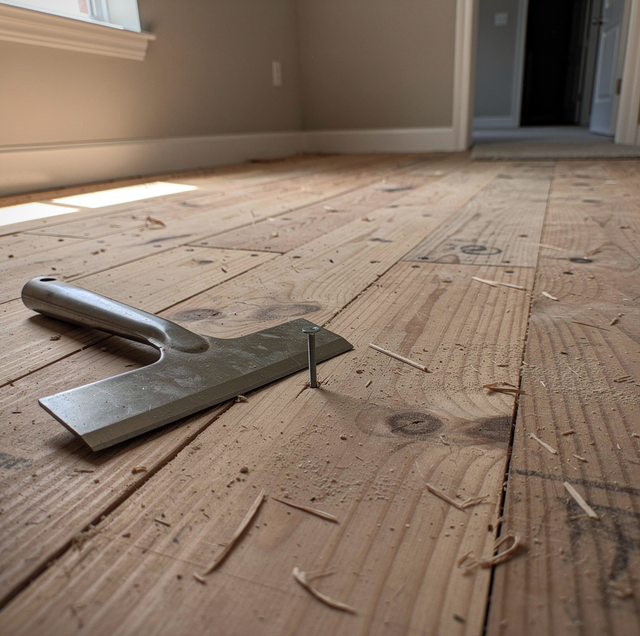
Carpet padding cushioned many small imperfections in your sub-floor, including a fastener that sat slightly higher than the deck around it. Luxury vinyl plank doesn't give you that cushion. Any fastener left proud of the deck can be felt underfoot through a plank once it's down, and depending on how it sits, it can catch and damage the underside of a plank as your flooring crew sets it in place.
That changes what "the carpet is out" actually means when you're lining up a removal ahead of an LVP install. A complete removal was once judged by an empty room. On a plank job, it's worth looking at the bare deck itself for anything still standing above the surface, not just confirming the floor is clear. A fastener you'd never have noticed under a carpet job for a decade becomes a problem on day one under a rigid plank.
That look is a job for light and a tool, never for your hands. Low, raking light thrown across the deck from one side turns a staple crown or a proud nail head into a shadow visible from standing height. A stiff scraper or a flat bar drawn flat along the boards finds the rest: anything sitting above the surface stops the blade, and a fastener that stops a blade will stop a plank.
Keep bare hands off a freshly stripped deck. Pulled tack strip keeps its angled pins, and missed staples stay sharp. Check for proud fasteners by raking light with a stiff scraper or flat bar across the boards.
Flatness: The Standard Carpet Never Enforced
Carpet and its padding are compressible. They flex under a dip in your deck and compress over a slight rise, which is exactly why your subfloor can accommodate small variations for years without anyone noticing. Luxury vinyl plank works differently, whether you install it floating or glued down, because a rigid or semi-rigid plank doesn't flex the way padding does. Your sub-floor and the plank meet the way two rail cars meet at the coupler: a slack coupling can shrug off a height mismatch that a rigid coupling cannot.
Manufacturers set a flatness tolerance for the deck a plank goes over, and it's written into the install instructions packed with the product rather than left to opinion. That's a new bar for a surface that used to only need to meet carpet and padding requirements. It also explains why your removal crew's sweep-and-clear finish, while still the right baseline, isn't the same thing as confirming your deck meets that bar. The two trades are judging the same surface against different standards, and the gap between those standards is exactly where your problems start.
Manufacturer installation instructions specify the flatness tolerance a plank floor has to meet, and a deck that reads flat to your eye can still miss it. Ask your installer to check the deck against that sheet.
What Changes between Floating and Glue-Down Floors
Floating and glue-down are the two common ways luxury vinyl plank is installed, and the difference depends on what your deck underneath needs to deliver. A floating floor locks its planks to each other rather than to the deck, so your deck's job is mostly about flatness and cleanliness rather than bonding strength. A glue-down installation asks something different of that same surface, since the plank is meant to adhere directly to it.
What this means for your removal crew is that "the deck is ready" doesn't mean one fixed thing across every LVP job. A removal finished to a high standard for one installation method can still fall short for the other, not because the removal work changed, but because what your flooring crew needs from that surface changed with it. Knowing which method is going down, even in general terms, helps you understand why your flooring crew might come back with an unexpected request about a room your carpet crew has already called finished.
Floor Height and Transitions the Removal Crew Should Anticipate
A luxury vinyl plank floor rarely ends up at the same finished height as the carpet, and the direction usually surprises people. Carpet plus its padding is normally the thicker stack of the two, so the new floor most often finishes lower than the old one did. That's a small shift in absolute terms, but it's a real one, and it shows up in places carpet never made you think about: door clearance, door jambs, and the transitions where one room's flooring meets another's.
None of that is your removal crew's job to correct. But knowing which way the height moves explains why swapping one flooring type for another isn't as simple as it looks from the outside. A door that used to swing just over the carpet pile can end up with a visible gap underneath it once a thinner plank replaces that stack. Jambs undercut so carpet could tuck beneath them can show the same gap at the sides. A transition that used to be a plain carpet-to-tile edge becomes an entirely different kind of joint because the two floors no longer meet where they once did. Your removal crew doesn't need to solve any of that, but knowing it exists changes what "the room is ready" means once your old flooring is gone.
Agreeing on the Deck before Planks Go Down
The cleanest handoff between your removal crew and your flooring crew happens when both sides are looking at the same bare deck before any plank goes down, and photos of the bare deck sent to your installer do that without anyone making an extra trip. A proud fastener, a soft spot, or a section that turns out to sit outside tolerance gets dealt with while the room is still empty and nothing is bonded down. The same three findings after the floor is down mean planks coming back up, a re-set, and a return trip for whichever crew has to make the fix.
That's the real value of treating your sub-floor as a handover rather than an afterthought on either end. Your removal crew won't finish the job once the carpet is gone. Your flooring crew isn't starting fresh when it arrives. Both trades are meeting at the same surface, and the deck they agree on is the one your finished floor has to live with.
| Point of Contact | What the Flooring Crew Needs | What the Removal Crew Should Know |
|---|---|---|
| Sub-floor cleanliness | A swept deck free of debris, matching what the photos showed | A complete removal is judged by what's left, not just what's gone |
| Fasteners | Nothing proud of the deck surface | A missed fastener can be felt through a plank or damage it |
| Flatness | A deck that meets the manufacturer's flatness tolerance | Carpet and padding forgive dips and rises that planks won't |
| Floor height | Awareness that the finished height will shift, usually downward | Doors, jambs and transitions to adjoining rooms may need attention later |
Frequently Asked Questions
The finish is the one every complete removal gets: carpet, padding, tack strip and staples out, and the deck swept before the crew leaves. What changes with plank is how much of that bare deck stays exposed afterward, since nothing soft is going back over it. Any surface work the plank itself calls for belongs to your flooring installer, not to the removal scope.
Only up to a point. Once the deck is bare, a crew can point out what's plainly there: a board that moves underfoot, a ridge of old patching compound, a section that sits noticeably low. Measuring that deck against the flatness tolerance in your plank's install instructions is your flooring installer's call, not something a removal crew signs off on.
Tack strip has no role under a plank floor, so on most of these jobs it comes out along with the carpet and padding, and the staples that held the padding down get pulled with it. Confirm it with your installer anyway before removal is booked, since that answer sets the scope. The pulled strip keeps its angled pins and gets handled as sharp debris.
It depends on the product. Some luxury vinyl plank comes with underlayment already attached to the back of each plank, and some is sold without it. Manufacturer instructions decide this — attached-pad product often prohibits an added layer, so check the install sheet for the product you bought.
It's worth doing. The deck is swept when the removal crew leaves, but a room standing open collects dust, grit, and whatever gets tracked through it, and grit trapped under a plank telegraphs through the finished floor. Keeping the room closed off between the two visits cuts down how much of that comes back.
The standard is the same, even though the material is different. A slab won't have proud fasteners, but it can have its own high spots, cracks, or uneven patches, and it doesn't flex the way a wood deck can. Flatness and cleanliness still matter just as much before your plank goes down.
New floor booked and the old carpet still down? — A complete removal clears your sub-floor and leaves it swept, ready for the flooring crew's first walk-through. Polk Services LLC serves Lakeland, Highland City, and Mulberry. Call (863) 344-5806.
