

Where Your Pool Pump, Filter, Heater and Salt Cell Go
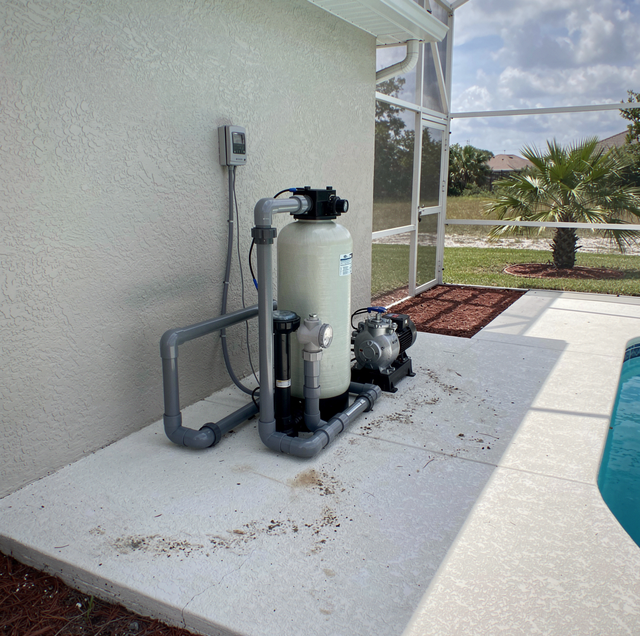
A pool equipment pad is a slab of concrete off to the side of the pool, poured with the deck in most builds and just as permanent. On it sits a cluster of tanks, pipe fittings and metal boxes: a pump housing, a filter tank, often a heater cabinet, a run of PVC elbows tying it all together, and a wall-mounted control panel with a scatter of low-voltage wire disappearing into conduit. Most of what is bolted to that slab predates the current owner. A motor casing streaked with rust below the bracket that has held it since a remodel two owners back. A filter tank with a sun-bleached, brittle lid and a manufacturer sticker faded past reading. Almost none of it comes off that pad in reusable condition, and none of it leaves as one assembly.
The Equipment Pad Comes Out as Its Own Job
The pad holds several different kinds of material bolted, glued, and wired together in one small footprint, which is exactly why it gets handled as its own piece of the job, separate from the pool cavity. The slab itself typically comes out along with the deck once everything bolted to it is gone.
The Pump
A pool pump is two assemblies joined at a flange: a wet end and a motor. The wet end, the volute housing and the impeller inside it, is almost entirely plastic, molded to move water and nothing else. The motor bolted to the back of it is a different material story: a steel can wrapped around copper windings, with a shaft, bearings, and a built-in cooling fan. Separation at removal: The motor and the wet end are broken apart at the pad instead of hauled off as one unit, because the motor is scrap metal and the wet end is scrap plastic, and keeping them together on the way out would undo the sorting that makes either one useful. A pump that has been running for two decades usually shows it before it is even unbolted: a shaft seal weeping a thin rust trail down the volute, a fan shroud gone brittle and cracked at the mounting ears.
The Filter
Pool filters look similar from the outside, but the three common types come off the pad differently. A cartridge filter housing is largely plastic, so once it is disconnected, it is light enough to carry off in one trip, with no draining or disassembly required beforehand. A sand filter is a sealed tank still holding its full load of sand, which makes it heavy; the sand is emptied from the tank before the tank itself is moved, not after, since a full tank is a different lift than an empty one. A DE filter carries internal grids coated in diatomaceous earth powder, and that residue has to be accounted for during removal in a way a cartridge or sand tank does not require. Knowing which of the three sits on a given pad changes how that part of the work is planned, since a sand tank full of media, handled like an empty cartridge housing, is a good way to strain something.
The Heater and the Heat Pump
Gas and propane heaters are common cabinet-style units on residential pads, and mechanically they are sealed cabinets: a heat exchanger, a burner assembly, and a shell that separates into metal for scrap once disconnected. A heat pump is a different machine entirely. It runs on refrigerant, the same category of sealed system as an air conditioner, and that refrigerant has to be handled by a facility equipped to recover it. It is not vented or drained on site. A heat pump coming off a pad is routed to that kind of facility; the crew does not recover the refrigerant itself, and it is not treated like the other cabinet-style heaters on the way out.
The Salt Chlorinator
A salt system consists of two pieces that are often treated as one unit but are not. The cell is a sealed housing with plates inside, mounted in line on the pad's plumbing. The control box is a separate wall-mounted unit wired to the cell and to the pump's timer. Both come off the pad, but the cell is removed as its own item rather than crushed with the general pad debris, since a sealed housing behaves differently under demolition equipment than open pipe or sheet metal does.
Controls, Valves and the Manifold
The wall panel or post-mounted box that runs the system is where most of the pad's low-voltage wiring terminates, and it comes off along with the runs feeding it. Below and around it, the pad usually has a cluster of valves, unions, and fittings where most of the plumbing from the pool actually ends. That manifold is often the busiest few square feet on the pad because it is where suction lines, return lines, and any water-feature or spillover line converge into the equipment train. Sorting that cluster into what is metal-bodied and what is plastic happens right there before it leaves the slab, and a pad with a spillover or water feature tends to have a noticeably larger manifold than a plain single-pump setup.
Ladders, Handrails and the Diving Board
Pool ladders and handrails are stainless steel, anchored into the deck or coping with sleeves or bolted plates. Depending on how they were originally set, they either cut free at the anchor point or draw straight out of a sleeve. A diving board is handled the same way: it is not glued to the deck, it is anchored, and it comes free at those anchor points instead of being pried up as one slab-to-board unit.
Where It All Ends Up
Metal is the largest category leaving the pad: pump motors, heater cabinets, brass valve bodies, ladder rails, and handrail posts all get routed to scrap. Plastics and mixed material, filter housings, PVC pipe, sand and DE media, plastic panel covers, go to disposal. Leftover pool chemicals are outside all of this: they are not demolition debris, they do not travel with the load, and they stay the homeowner's to route to a household hazardous-waste drop-off. Nothing from the pad gets left buried in the pool cavity once the slab comes up. That includes anchor bolts and brackets pulled from the slab itself, not only the equipment that sat on top of it.
Old pool chemicals are not general debris and are not safe to consolidate. Tablets and shock from different containers can react with each other, so leave them sealed, separated and where they sit until they go to a hazardous-waste drop-off.
One thing to settle before any of this starts: if equipment still runs and someone else has a use for it, a newer pump, a filter with some life left, a working salt cell, that has to be arranged and collected before the crew begins. Once the pad is being worked, everything bolted to it is going out as material.
Frequently Asked Questions
Not reliably by the valve, because either tank can carry a multiport. The data plate does it: a DE tank names a fill weight in pounds of powder, a sand tank names a sand fill by the hundredweight. Where the plate has weathered off, the tank gets opened and looked in rather than guessed at, because a full media tank handled like an empty one is how somebody gets hurt lifting.
The plates mounted inside a salt chlorinator cell are titanium and carry a mixed-metal-oxide coating that does the actual work of converting the dissolved salt, which is part of why the cell is kept intact as a single unit rather than crushed with the rest of the pad's metal.
Yes. The flue or vent stack attached to a gas or propane heater is a separate piece of sheet metal, separate from the heater cabinet, and it comes off and is scrapped along with the heater rather than being left standing.
A diving board sits on a base with a fulcrum assembly bolted into the deck separately from the board itself, so removal involves that base as its own anchored piece, not just the board plank.
No. The low-voltage wiring between the pad's components and the control panel typically runs above ground or in shallow conduit on the pad itself, distinct from the buried runs covered in the pool's utilities.
It comes out of the cabinet as its own piece. The exchanger is a copper or cupronickel tube bundle in a header, a different metal from the sheet steel wrapped around it, so the two are separated at the pad and not scrapped as one unit.
By the time the slab comes up, the pad has usually produced more separate material streams than the pool itself does: steel, copper, stainless, brass, rigid plastic, filter media, and sealed units routed out whole.
Schedule pool equipment and pad removal — clear the pump, filter, heater, salt system, and everything else bolted to the pad in one visit. Polk Services LLC serves Lakeland, Highland City, and Mulberry. Call (863) 344-5806.
