

Gravel Driveway Ruts, Washouts, Potholes: What They Mean
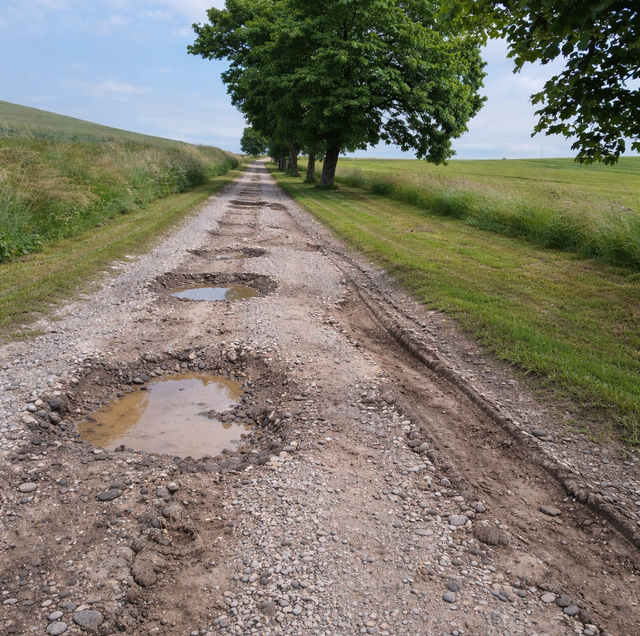
Ask three different people what's wrong with a rutted, washed-out gravel driveway and the guesses usually run to bad stone, bad luck, or just age. A rut, a washout, and a pothole are typically none of those. Each one forms through a distinct mechanism, and mixing them up leads to the wrong fix: another load of loose stone dumped into a spot that fails again within a season, or a full rebuild in a place that only needed reshaping. Reading what the damage itself shows, before ordering more gravel or making a call, is what makes the difference.
Cosmetic Wear vs a Structural Drainage Problem
Not every rough patch means something is wrong underneath. Light stone displacement in the tire paths, a slightly duller or thinner-looking band where you drive most often, is ordinary wear, and it usually resolves with a routine top-off of fresh stone. The distinction that matters is whether the low spot holds water and comes back after you've addressed it, or whether it's just cosmetic scuffing that any gravel surface develops under regular traffic.
A useful gut check: kneel and look across the surface at a low angle rather than straight down. Wear shows up as a shallow, even dulling. A drainage problem shows up as a defined depression with a visible edge, sometimes with standing water sitting in it well after the rest of the surface has dried.
A Rut Forms Under Load, a Washout Forms Under Flow
These two get lumped together constantly, and they call for different fixes because different forces cause them.
Rut: Formed by repeated tire weight pressing the stone and the base beneath it down and outward, along the direction of travel. Water can soften the ground first and make a rut form faster under the same traffic, but the rut itself is carved by weight and repeated passes, not by water moving across the surface. Ruts run with the wheel path, and the displaced material usually piles up along the sides of the track rather than disappearing.
Washout: Cut by moving water rather than tires. A washout is a channel, often narrow and irregular, with stone carried downhill and deposited in a pile or fan wherever the water finally slowed down and dropped it. Washouts don't have to follow the tire path at all; they follow wherever water was moving fastest across the surface.
The quickest field test is to look at where the missing material went. A rut's stone is mostly still there, just pushed to the sides. A washout's stone is gone from the channel and sitting somewhere downhill of it.
A Rut Running the Length of the Driveway Usually Means the Crown Is Gone
When the low spot tracks straight down the center or along the full length of the drive, rather than crossing it, and there's no obvious flow channel or downhill debris pile, the underlying cause is almost always shape, not water volume. A driveway's crown or cross-slope is what sheds water off both edges; once traffic and weathering flatten that shape out, water that used to run off starts sitting and softening the same low line every time it rains, which then gets driven over and compacted deeper. (A circular or loop driveway follows a different pattern, pitched from the inner edge outward instead, so this particular read doesn't apply the same way there.) The general fix for this pattern is regrading to restore the lost shape, not adding stone on top of a low spot that has no way to shed what lands on it.
A Washout at One Edge Usually Means Runoff With No Path to Shed
A channel that consistently opens at one edge or in one corner, rather than down the middle, usually indicates that water is arriving in concentrated volume rather than spread evenly across the surface. Common sources include a downspout discharging near that corner, a spot where a neighboring slope drains onto the property, or a transition point where two different grades meet, like the junction with the road or a walkway. What separates this from a rut is that the damage has a clear point of origin upslope and gets progressively worse as it moves downhill, rather than being an even depression the width of a tire. The general fix category here is about addressing where the water is coming from rather than reshaping the whole driveway: sometimes that's a homeowner-side fix, like redirecting a downspout, and sometimes it's driveway-side work, like adding edge restraint or tying the low point into a swale that already handles drainage elsewhere on the property.
A Pothole That Keeps Returning After Topping Off Signals a Subgrade Problem
This is the pattern that trips people up most, because the obvious response, dump more stone in the hole, is often the one thing that doesn't work. If a depression fills back in cleanly with fresh stone and stays solid for a season or more, the surface material itself was simply displaced or worn thin, and topping it off was the right call. If the same spot pumps mud, sinks back within weeks, or the fresh stone you added disappears into soft ground below it, that's a different mechanism: the layer that's supposed to keep the subgrade separated from the base stone has failed, or was never built into that section, and fine soil is working its way up into the stone under the flex of vehicle weight, a process sometimes called pumping.
The visible tell is discoloration. Stone that comes up grayish, muddy, or slick at the bottom of a recurring soft spot, especially compared to firm, clean stone a few feet away, points to fines migrating up from below rather than stone wearing down from above. A soft spot like that needs to be excavated and rebuilt with proper separation between the ground and the base, not topped off indefinitely.
To check a suspicious low spot without digging it up, push a length of rebar or a metal probe straight down into it, then compare how far it sinks with a probe in a firm section nearby. A probe that sinks several inches with almost no resistance, while the surrounding base holds firm, points to a weak or saturated layer beneath the surface, not just displaced surface stone.
Where on the Driveway the Damage Shows Up Is a Clue Itself
Location matters as much as the shape of the damage. Trouble that shows up down the center, following the length of the drive, points back toward lost crown or cross-slope. Trouble concentrated at one edge, especially near a downspout, a slope, or a grade transition, points toward a concentrated water source rather than a shape problem. A single isolated low pocket, unconnected to any visible flow path and not aligned with either wheel track, more often points to settled fill or a weak spot in the subgrade below it. A driveway can have more than one of these happening in different spots at once, which is part of why treating the whole surface the same way- more stone everywhere- so often falls short.
How Fast the Damage Formed Is Also a Clue
A washout that appears overnight after one unusually heavy rain is telling you something different than a rut or soft spot that's been getting slightly worse for months without any single dramatic event. A sudden channel usually traces back to a specific water event: a clog that backed up, an unusually intense storm, equipment, or a heavy delivery truck compressing wet ground. Gradual, creeping damage with no single trigger point is more consistent with an ongoing mechanical cause: a worn-out crown or a subgrade that was never properly separated from the base, which keeps producing the same result every time it rains rather than just once. If the same spot has needed fresh stone three or more times within a year, that recurrence is itself diagnostic; a properly shaped, properly based section of driveway shouldn't need repeated topping off that often.
Matching the Fix to the Pattern You're Seeing
Reading the damage first saves you from guessing. A rut running the length of the drive generally calls for regrading to restore the crown or cross-slope. A washout at one edge generally calls for addressing the source of the water and giving it somewhere to go, rather than reshaping the whole surface. A pothole or soft spot that keeps coming back after being topped off generally calls for excavating and rebuilding that section down to the subgrade. Where two patterns show up in the same spot, or you're not confident which one you're looking at, that's the point to get an assessment rather than keep guessing with more stone.
Frequently Asked Questions
As a rough guide, a rut under about an inch that doesn't hold water is typically routine wear; a light top-dressing or blading handles. A rut deeper than about an inch, especially one still holding water 24 hours after a storm, is worth treating as a shape problem, meaning the base itself needs attention, rather than a surface one.
Filling it will look fixed for a while, but if the water source that cut the channel isn't addressed, the same channel typically re-forms in the same place after the next comparable rain. Repeatedly topping off the same washout also has a side effect worth noting: the added stone can build up into an informal berm along the channel's edge, which sometimes redirects the water to a less convenient spot, such as a foundation, garage slab, or a neighboring property, instead of stopping it.
Yes. Gray, silty, or slick-looking mud mixed into the stone at the bottom of a recurring low spot usually means fine soil is pumping up from the subgrade into the base, which points toward a rebuild. A depression that's simply missing stone, dry and sandy underneath with no muddy staining on the surrounding rock, more often just needs fresh material added back. A pothole that keeps sinking without producing any visible mud at all is a different case worth knowing about: it can mean an organic pocket in the subgrade, sometimes called muck, that compresses under weight without pumping fines to the surface the way wet clay or silt does. That still points toward excavation and rebuilding, just with different material beneath than in an ordinary wet-soil case.
It can be. A rut in a single-track often means most drivers are favoring one side of the driveway, sometimes to avoid a low spot or an obstruction elsewhere, which concentrates extra load on that one line rather than spreading it evenly. Ruts running in both tracks along the full length point more toward a driveway-wide loss of crown or cross-slope rather than a habit of where people happen to drive.
Probing helps without a full excavation. Push a length of rebar or a metal probe straight down into the soft spot and compare how far it sinks with how little resistance to a probe in a firm section nearby. A probe that sinks several inches with almost no resistance, while the surrounding base holds firm, is a sign of a weak or saturated layer beneath the surface, not just displaced surface stone.
Yes. A narrow channel of fairly consistent width usually indicates concentrated, higher-velocity water coming from a single source like a downspout or a pipe outlet that erodes a defined path before it has room to slow down. A wider area that spreads out as it goes, without a single defined channel, usually indicates general sheet flow losing speed and spreading across the surface rather than one identifiable point source, which changes where you'd look for the fix.
Get a driveway damage assessment — we'll identify whether your ruts, washouts, or potholes need a regrade, edge restraint, or a subgrade rebuild before you spend on more stone. Polk Services LLC serves Lakeland, Highland City, and Mulberry. Call (863) 344-5806.
