

Gravel Delivery vs. Full Install: Which One Fits Your Lot?
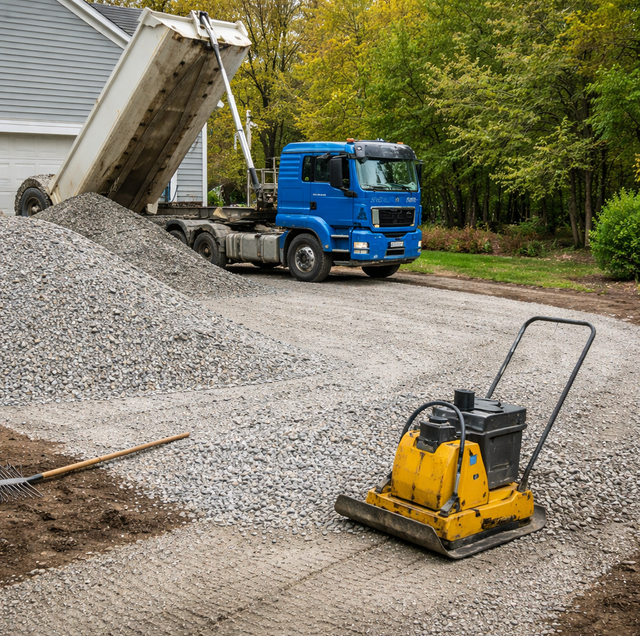
Before you order gravel for your driveway, there's a decision that matters more than which material to pick: are you buying material delivered to your property, or a complete installation? These sound like two versions of the same job. They aren't. One is a raw materials purchase. The other is groundwork, with materials as just one part of it. Mixing the two up is how a driveway that looks fine for the first season ends up rutted, puddling, or migrating into the yard within a year.
Which one matches your property depends on what the ground is actually doing underneath the gravel, since the base is what determines whether the surface holds, not which company's truck shows up.
What a Delivery-Only Order Includes
When you order delivery-only gravel, a truck shows up, tips the load at the curb or the mouth of your driveway, and leaves. That's the entire scope. The material is now yours to move, spread, and compact.
What's not included is everything that makes gravel behave like a driveway instead of a pile of loose rock: no excavation of the old surface, no grading to establish slope for drainage, no base course laid underneath, and no compaction. If your existing driveway has ruts, low spots, or bare patches where the base has washed out, a delivery order won't fix those conditions. It just adds new material on top of the same problems.
Delivery-only also puts the decisions about labor and equipment entirely on you. Spreading a few yards with a rake across a short stretch is manageable. Spreading, leveling, and compacting several tons across a driveway that's fifty or a hundred feet long is a different job, and one where the mistakes don't show up until the material starts moving under tire weight.
If a delivered pile will sit for more than a day or two before you spread it, cover it with a tarp. Rain forms a crust on the outer few inches while the interior stays loose and dry, so material spread straight from an uncovered pile won't compact evenly.
Why Compaction Is the Step That Decides It
Compaction is the part people underestimate most. Loose gravel dumped and raked flat can look finished well before it actually is. Loose material has air pockets between the stones, and until those pockets are pressed out, the driveway will keep settling every time a vehicle drives over it, unevenly, in whatever pattern the tires happen to hit.
Proper compaction uses a plate compactor, a piece of equipment that vibrates and presses the material downward in controlled passes. A hand tamper can firm up a small patch, but it can't deliver the uniform density a plate compactor achieves across a full driveway width. And compaction isn't a single pass over the whole depth of material. It's done in lifts, thin layers, commonly two to four inches at a time, that each get compacted before the next layer goes down. Compact eight inches of loose stone in one pass, and the bottom of that layer stays loose no matter how long you run the machine over the top.
This is also where a base course matters. A well-built gravel driveway isn't one type of stone dumped to full depth. It typically starts with a larger, angular crushed base layer that locks together and drains, sometimes over a geotextile fabric that keeps the base from working its way down into soft soil beneath it, then a finer surface layer compacted on top. Skip the base and the surface gravel has nothing stable to sit on: it migrates sideways, ruts under wheel tracks, and needs replenishing far sooner than a properly built driveway would.
When Delivery-Only Is a Reasonable Choice
There's a real, narrow use case where ordering material without the install work makes sense: topping off an existing driveway that already has a solid, compacted base and just needs a fresh layer of surface stone because the old layer has thinned or washed out at the edges. If the ground underneath is stable, drains correctly, and hasn't rutted or shifted, spreading and compacting a modest top-off layer is a manageable job for an owner with basic equipment and a free weekend.
The key qualifier is "small and existing." A top-off on a driveway that's already doing its job structurally is a maintenance task, a different undertaking than building a driveway's foundation from bare or damaged ground.
When Delivery-Only Falls Short
Three situations move a job out of delivery-only territory, regardless of how confident you feel with a rake and a rented compactor.
New construction or a bare-ground driveway: If there's no existing gravel surface to build on, there's no base to top off. The ground has to be graded for drainage, a base course installed and compacted, then a surface layer compacted on top. Skipping straight to loose gravel on ungraded dirt means the driveway will hold water, rut in the first heavy rain, and require rebuilding within a season or two.
An unstable or missing base: A driveway with soft spots, standing water after rain, or visible sinking under vehicle weight has a base problem, not a surface problem. Adding more loose gravel on top hides the symptom for a few weeks and then the same low spots reappear, usually worse, because the added weight of new material accelerates the settling, since a base problem doesn't get fixed by adding more weight on top of it.
Larger square footage: Spreading and hand-compacting a short strip is realistic DIY work. Doing it correctly across a full-length driveway, in even lifts, with consistent grade for drainage the whole way, is a different scale of job. It's easy to end up with a driveway that's compacted well near the road and progressively looser toward the house, because the effort and the equipment's effectiveness taper off over distance without anyone noticing at the time.
How to Check Whether Your Existing Base Still Has Support
Before deciding which route fits, walk the driveway after a period without rain and look for a few specific signs. Standing water that lingers more than a few hours after a storm means the grade or the base underneath isn't draining. Wheel ruts that remain depressed rather than spring back indicate that the material beneath the tire path has lost density. Soft or spongy spots where the surface flexes underfoot, rather than feeling solid, usually mean the base has washed out or was never properly compacted to begin with. Gravel that's visibly thin, showing bare dirt in patches, but sitting on ground that otherwise feels firm and doesn't pool water, is the profile of a driveway where the base is fine and only the surface layer needs renewing.
If you see any of the first three signs, the base is compromised, and a delivery-only order will not fix the underlying issue. If the ground underneath is solid and the problem is limited to thinning surface stone, a top-off delivery is a fair match for the job.
Frequently Asked Questions
Confirm whether the truck is a standard dump truck or a tandem/tri-axle, since larger trucks carry more per trip but require a wider, straighter approach and greater overhead clearance to maneuver and tip the load without cutting across the soft shoulder or landscaping. Ask where on the property they'll drop the material; a pile dumped in the wrong spot means extra time and labor moving it before spreading even starts.
Yes, reversible plate compactors are available at most equipment rental counters, but the machine alone doesn't guarantee a good result. It has to be run in the correct pattern with slight overlap between passes, and the material has to be compacted in thin lifts rather than all at once, or the bottom of the layer stays loose regardless of how many passes you run on top.
Rain on an unspread pile forms a crust on the outer few inches while the interior stays loose and dry, so the material doesn't compact evenly if it's spread straight from the pile without breaking that crust up first. A pile that's going to sit more than a day or two is better covered with a tarp, or spread and rough-graded even before final compaction, rather than left exposed as one mound.
Once surface stone gets pressed down into bare subgrade under a wheel path, regrading doesn't bring it back; that stone is mixed into the soil below and effectively gone, which is why a driveway built this way needs full replenishment rather than a light top-off within a season or two. That's the structural risk a delivery-only order can't fix on its own, since ordering surface stone doesn't include the base course underneath it.
Most owners who take on delivery-only find the practical limit is less about total square footage and more about how many separate rental days the compaction work ends up needing; a job that can't be finished within a single equipment rental period, because the driveway is long or the base needs multiple lifts, tends to lose the labor advantage that made delivery-only worth doing in the first place.
Yes, and for anything beyond a small top-off, the more common approach is a heavier, angular base material delivered and compacted first, then a separate, finer finish-layer delivered once the base has been checked and is holding its shape. Ordering both as one mixed load usually means the two materials never separate into distinct layers the way a proper base-and-finish build needs.
Get a driveway assessment before you decide — a quick site visit tells you whether your base can take a top-off or needs a full rebuild. Polk Services LLC serves Lakeland, Highland City, and Mulberry. Call (863) 344-5806.
