

Suction Lift Limit: Why No Pump Beats About 25 Feet
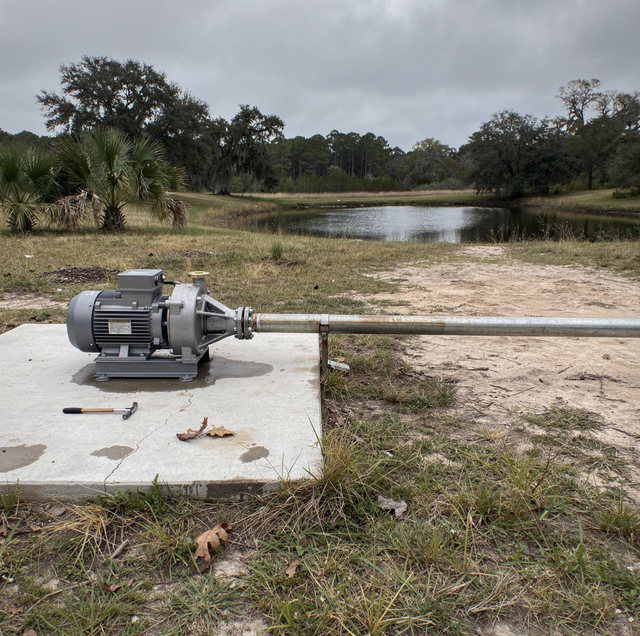
About 25 feet at sea level. That is the ceiling on how far above the water a pump can sit and still draw water up to itself, and it has the sound of a manufacturer's cautious rounding, a figure you assume was set low on purpose and can be pushed a little. It cannot. That number is not a limit of the motor, the impeller, the pipe, or the horsepower behind any of them. It is a limit of the air sitting on top of the water, and nothing sold in a pump house moves it.
Put a modest centrifugal pump and a far larger one at the same height above the same pond, and they hit the same wall in the same place. The larger one just makes more noise doing it. Understanding why, and what quietly subtracts from that figure, separates a suction system that runs for years from one that eats an impeller.
What the Atmosphere Actually Buys You
Start with the thing that gets the mechanism backward in nearly every conversation about it: a pump does not pull water. It cannot. Water has no tensile strength, so there is nothing in a column of it for an impeller to grab and haul upward. Suction is not a force applied to the water. It is the absence of pressure.
The impeller creates a region of low pressure at the pump's intake. Meanwhile, the full weight of the atmosphere presses down on the pond, the ditch, or the water standing in the casing. That pressure has to go somewhere, and the only relief it finds is up the suction pipe toward the low-pressure region the pump made. The atmosphere does the lifting. The pump only makes room for it.
Seen that way, the ceiling stops being arbitrary. The question is never how hard a pump can pull. It is how much push the atmosphere has available, and at sea level, what a working surface pump can actually spend on vertical lift is about 25 feet. That figure is the practical ceiling, the one to design against, not the raw maximum the column of air could support in a laboratory. No installation reaches the raw number, and the reasons it cannot are the subject of the next section. The impeller can lower the intake pressure as far as it can; beyond that, there is nothing left on the pond side to push against.
This is also why horsepower is the wrong lever. Everything a bigger motor buys happens on the discharge side, after the water is already inside the pump: more pressure at the heads, more reach down the mainline. On the intake side, it buys nothing at all.
Why the Working Number Sits below the Theoretical One
The figure a manufacturer prints and the figure physics allows are not the same number, and the gap between them is where most field failures live.
Atmospheric pressure is not a constant. It rises and falls with passing weather systems, so a design built with no margin can perform one day and struggle the next with nothing about the equipment having changed. The pump also needs some pressure remaining at its intake to work at all, since it cannot accept water arriving with nothing left in it. Manufacturers publish that as a net positive suction head requirement, unique to each pump at each flow rate, and it is a real subtraction, not a cushion someone added for comfort.
Then there is friction, the largest and most commonly ignored subtraction of all.
What a Long Horizontal Run Takes Away
Moving water through pipe consumes pressure. On the discharge side, that loss is annoying and manifests as low heads. On the suction side it is far more serious, because it comes out of the same limited allowance the vertical lift is already drawing from. Friction and height are not the same problem. They are one problem, spending from one account.
The same pump at the same height behaves one way at the end of a short suction line and another at the end of a long run out through the field. The second acts as though it were mounted far higher than it is. The vertical rise on the drawing has not changed. The effective lift has.
Three things determine how long a run takes: its length, the pipe's diameter, and how fast water moves through it. Length and velocity work against you. Diameter works for you, sharply, which is why enlarging the suction line is one of the most effective changes available on a marginal system. It also means the same installation gets worse the more water you ask it to move at once.
On the suction side, pipe smaller than the pump's intake port is a common way a working system quietly slides past its limit. A technician sizes suction pipe up, never down, when the lift is already marginal.
Agricultural systems collide with this constantly, because the pump goes where the power drop and the pad are, and the water is wherever the pond, ditch, or casing happens to be. Those two places are rarely close together. That distance is why the practical number on a long farm suction run lands below 25 feet, sometimes well below, and why a lift that looks fine on paper turns out not to be.
How Warm Water and Elevation Move the Ceiling
Two site conditions shift the ceiling further, and both are easy to leave out of a plan.
The first is water temperature. Water turns to vapor more readily as it warms, and also as pressure falls. The suction side is the one place where both conditions apply at once: pressure is low by design, and the source water may be warm. Open surface water in a shallow pond or ditch runs warmer than water drawn from a well casing, and warmer water gives up less of the lift you thought you had before it flashes into vapor inside the pipe. Cold water forgives a marginal design. Warm water does not.
The second is height above sea level. That qualifier is doing real work. The higher a site sits, the less atmosphere is stacked overhead, and the less push is available to spend on lift. On low, flat ground, the full figure applies. Climb, and the ceiling comes down with you.
Both carry the same lesson. A system built with no margin does not work. It is one that happens to be working under today's conditions.
What a Pump Asked to Exceed the Limit Does to Itself
Ask a pump for more lift than the atmosphere can supply, and it does not stop. It keeps running and destroys itself in the process.
When intake pressure falls far enough, water inside the pump flashes into vapor. Those bubbles are carried into the impeller, where pressure rises again as the vanes do their work, and they collapse. Each collapse is a small, violent implosion, and there are enormous numbers of them, continuously, against metal. That is cavitation. The usual description is a housing full of marbles, though telling that sound apart from a bearing complaint is a subject of its own.
The damage is mechanical and cumulative. Repeated collapse pits the impeller vanes, and pitted vanes lose the smooth profile that generates pressure in the first place. Output falls. The pump gets blamed for being worn out and replaced, and the replacement goes into the same suction condition and starts the same process on day one. Left long enough, cavitation chews an impeller into scrap.
A pump running in cavitation is not merely loud. Vapor bubbles collapsing against the impeller remove metal every second it runs, so a system left alone for months can turn a serviceable impeller into scrap.
What makes it hard to catch is that it is progressive rather than sudden. A marginal design does not fail the day it is commissioned. It runs, moves water, and slowly grinds down, so by the time symptoms are obvious, the installation decision behind them is years in the past, and nobody connects the two. A pump that spins but delivers nothing has several possible causes, and a suction condition past its ceiling is among the most often missed.
Three Ways a Design Gets Back under the Ceiling
There are three real moves, and all three are design decisions made by the technician sizing the installation, not adjustments made on a running system.
Shorten the suction: Move the pump closer to the water, vertically and horizontally. Setting it lower on the bank or nearer the source attacks lift and friction at once, which is why it is considered first when a system is fighting its limit.
Enlarge the suction pipe: This gives back the friction portion of the allowance without touching the vertical rise. It is the right answer when the run, rather than the height, is consuming the margin, and the wrong answer when the pump is mounted too high.
Stop pulling entirely: A submersible pump sits down in the water and pushes rather than pulls, which removes the ceiling from the conversation instead of working around it. Pushing has no atmospheric limit. That is why deep water has always been submersible territory, and why a stubborn suction problem sometimes has no good surface answer.
On a new agricultural installation, this work happens before anything is set: matching the pump's published suction requirement against the actual lift, run, and flow at that site. Working it out is its own exercise in sizing math, and less trouble than learning the answer through a ruined impeller.
The ceiling itself never moves. Everything else in the design is negotiable, and a system living at the edge of it usually announces itself as falling output long before anyone thinks to check the one number that was set by the sky rather than by the equipment.
Frequently Asked Questions
A technician threads a vacuum gauge into the suction port and reads it in inches of mercury while the pump runs. That is a service procedure rather than an owner check, since it means opening a port on the suction side of a running system. The reading is worth taking because it captures the total suction condition, lift, friction, and fitting losses together, which a tape measure never will, and it has to be read under load, since a stopped pump shows only the static condition.
To the pumping water level, the level the water settles to while the pump is drawing, not the static level you see with everything shut off. In a well that draws down under load, or a surface source that falls through a dry stretch, the pumping level can sit well below the resting level. That is how a system that worked for years slides past its ceiling with nothing at the pump changing.
No, and it often makes matters worse. A larger pump moves more water, which increases velocity in the suction line and, in turn, increases friction loss in that same line. An oversized pump, when dropped onto a marginal suction run, often cavitates sooner than the smaller unit it replaced.
Yes, and they are routinely left out of the arithmetic. Every elbow, the check valve, and the strainer basket at the intake adds friction loss, and a screen blinded with sediment adds more the longer it goes unserviced. A partly plugged screen behaves as extra lift the design never accounted for.
It does. Pitting also appears on the volute walls and around the wear ring, and vibration on the mechanical seal causes a cavitation history to often surface first as a seal that starts weeping. A technician pulling a chattering pump checks all three, because replacing the impeller and reusing an eroded wear ring just restarts the clock.
A shallow-well jet pump does not. It sits above the water and lives under the same ceiling as any surface pump. A deep-well jet pump takes a different route: an ejector assembly is lowered into the well, pressurized water is sent back down to it, and a venturi at the bottom does the lifting from below. The arrangement changes. The physics still gets respected.
Ask about a suction-side evaluation — find out what your lift and your run are actually taking from the pump before an impeller pays for it. Perry-Pump Repair Service LLC serves Lake Butler, Gainesville, and Alachua. Call (352) 320-2412.
