

What a Gravel Driveway Quote Should Spell Out Before You Sign
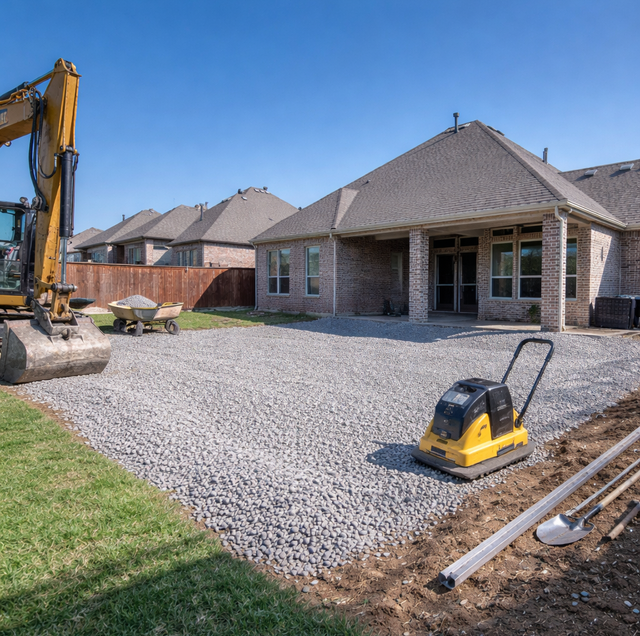
Ten different installers could hand you ten quotes that all say "gravel driveway installation" and mean ten different jobs. The measured area, the material's depth in inches, and whether edge restraint or grading is even part of the scope: these determine what actually gets built, regardless of how many bids are sitting on the counter. What follows is a rundown of what a single written quote should spell out on its own, item by item, so a property owner can look at one document and know whether it's complete.
The Measured Area As Its Own Line Item
A written quote should state the square footage or area being covered as its own number, not folded into a single description like "driveway install." That number should also note what ground it covers: the main run, a turnaround, an apron near the garage, any extension planned for a boat or trailer pad. A quote that lists an area without saying what's included in it is easy to misread later if the finished surface turns out to cover less ground than expected.
Material Name and Depth in Inches, Not Just "Gravel"
"Gravel" by itself describes almost nothing about what goes down. A complete quote names the specific material, whether that's an angular crushed stone, recycled concrete aggregate reclaimed from a removed slab, or crushed asphalt millings, and states the finished depth in inches. Angular, sharp-faced crushed stone interlocks and compacts tighter than rounder material like pea gravel, so the shape matters as much as the type. Depth matters because it's the number that decides how the driveway holds up under weight: a standard base typically runs 4 to 6 inches, while a driveway carrying heavier or more frequent axle loads, or sitting on ground with a high water table, usually needs closer to 8 inches. Material and depth together: a quote that only says "gravel driveway, standard depth" without naming either one leaves out the two details that determine how the finished surface performs.
Base Course Scope: New Build or Resurface
A quote should say plainly whether the job is a full base rebuild, built and compacted in lifts, or a resurface that goes down over an existing base with only the top layer replaced. Those are different amounts of work with different long-term results, and "gravel driveway install" as a single line item can mean either one. If a full rebuild is scoped, the quote should note that the base gets built in stages, roughly 2 to 4 inches per lift and compacted between each one, rather than dumped and rolled in a single pass. If it's a resurface, the quote should say so directly rather than letting a fresh layer of stone on top read as a full rebuild.
Edge Restraint: Included or Left Out
Edge restraint, anything from steel or aluminum edging to a simple mow strip, keeps gravel from migrating into the lawn or a flower bed over time. Not every driveway needs it, and leaving it out isn't automatically a problem. What matters is that the quote states one way or the other whether edge restraint is part of the scope, rather than leaving it unmentioned. A driveway quoted without edging, with the reader assuming it's included, is a common source of a finished job that doesn't match expectations, not because anything was done wrong, just because it was never agreed to in writing.
Drainage and Grading: In Scope or Assumed
Water is what wears out a gravel surface over years, so a quote should state whether grading for drainage is part of the job. A straight driveway usually needs a crown or cross-slope that sheds water off both edges; a circular or loop driveway works differently, pitching from the inner edge near the island outward instead. If a quote doesn't mention grading at all, it likely means the existing grade is being used as-is, which is worth confirming rather than assuming drainage will be addressed automatically just because a driveway is going in.
Site Prep and Haul-Off of the Old Surface
If there's an existing driveway, dead grass, or root-heavy ground on the site, the quote should say what happens to it: broken up and hauled off, ground up for reuse as sub-base, or left in place with new material built over the top. A quote that goes straight from "grade the site" to "install gravel" without addressing what happens to what's already there skips a step that affects how the finished base performs, not just how the job is scheduled.
A Timeline Tied to Phases, Not a Single Date
A start date alone doesn't say much about a job that involves compaction in stages. A useful timeline in a written quote breaks the work into phases: site prep and grading, base delivery and compaction, fabric if it's being used, finish layer and final compaction, and notes roughly how long each phase takes or how many separate visits the job requires. A quote that lists only a single date range for the entire job isn't necessarily wrong, but it also leaves the reader no way to check progress against the plan once work starts.
What Happens to the Deposit If Plans Change
A written quote should specify when the material is actually ordered relative to the deposit, not just the deposit amount. Some installers order base and finish materials as soon as a deposit clears, so they're on hand for the scheduled date; others don't place the material order until closer to the start date. That timing matters if plans change: a quote silent on it leaves open the question of whether a deposit is refundable if a homeowner needs to cancel or push the date back after material has already been purchased on their behalf.
What the Quote Says When Conditions Change
Ground doesn't always match what a walk-through and a quote assumed. Soft spots, unexpected water, or a layer of old debris beneath the surface can only show up once digging starts. A complete written quote addresses this directly: what happens if the base needs to go deeper than planned, or if more of the old surface has to come out than expected, once work is underway. That doesn't need to be a lengthy legal document; it just needs to say, in plain terms, that conditions different from what was scoped get discussed and agreed on before work continues, rather than assumed to be covered by the original quote either way.
One Missing Line Is the Tell
Incomplete quotes rarely announce themselves as incomplete. They tend to share one trait: a single vague line item standing in for several separate decisions, "gravel driveway install" covering area, material, base, and grading all at once, with no way to tell which of those were thought through. A written quote that spells out area, material and depth, base scope, edge restraint, drainage, site prep, timeline, deposit and material-order terms, and what happens if conditions change gives a property owner something to check the finished job against later, not just a number to compare against another number.
Frequently Asked Questions
It's not required, but naming the equipment is a useful detail to look for. Plate compactors work well for smaller runs and finish layers, while a walk-behind roller covers ground faster on a larger base rebuild. A quote that lists the equipment for each phase describes an actual plan rather than a general process, and it's reasonable to ask about it if the quote doesn't mention it.
Ask whether the material is dense-graded or clean, single-size stone, since that distinction matters more than the brand name on the ticket. A dense-graded aggregate, sometimes labeled crusher run, limerock base, or graded screening depending on the region, includes a mix of particle sizes down to fine dust, which allows it to compact into a tight, load-bearing base course. A clean stone with the fines screened out won't lock together the same way, so it's not what a driveway base calls for, though it can still have a place as a decorative or wear-course topping over the compacted base listed further up the quote. An installer who can explain which type is being quoted for which layer, and why, is working from an actual spec rather than a supplier's local name for whatever's on the yard.
It's worth asking, separately from haul-off of the old surface. Some installers order slightly more material than a job needs and either use the extra to top-dress the driveway a little heavier than planned or remove it; others leave a small stockpile on the property. A quote that's silent on this usually just means it hasn't come up yet, but it's a fair question to ask before delivery, especially on a smaller lot where a leftover pile has nowhere convenient to sit.
It can be either, but it should be somewhere in writing before work starts, not agreed to verbally after. A written quote or the contract it leads to should state how long a defect period runs, commonly the first several months to a year, and what it actually covers: deep rutting or standing water that shows up in that window, as distinct from the normal, minor settling that happens as traffic compacts a new base further in the weeks after installation. It's worth asking what voids that coverage, too: most installers exclude damage from the homeowner's own heavy equipment, a driveway regraded or altered by someone else after handoff, or a spot the original walk-through specifically flagged as needing monitoring rather than something the crew missed.
That's worth asking about directly rather than assuming none are needed. Whether a driveway apron connecting to a public road or a certain amount of added impervious surface requires a permit varies by jurisdiction, and it's worth checking with the local building department rather than relying on the quote alone. At minimum, the quote should specify who's responsible for pulling any permit that turns out to be required, so there isn't a surprise split between homeowner and installer after the fact.
Yes, and it's a detail that's easy to overlook because it happens before the visible work starts. Most driveway projects that involve excavation or a base rebuild require that underground utility lines be marked first, typically through a free regional locate service, though exact requirements and notice periods vary by jurisdiction and are worth confirming locally. A written quote should state whether the installer arranges that locate as part of the job or expects the property owner to have it done, since skipping it is a real risk to buried lines, not just a paperwork step.
Request a written, itemized gravel driveway quote — every material, depth, and phase spelled out before work starts, on gravel driveways in Plant City, Winter Haven and across the radius. Polk Services LLC serves Lakeland, Highland City, and Mulberry. Call (863) 344-5806.
