

Waterbed Removal and Draining: More than One Object
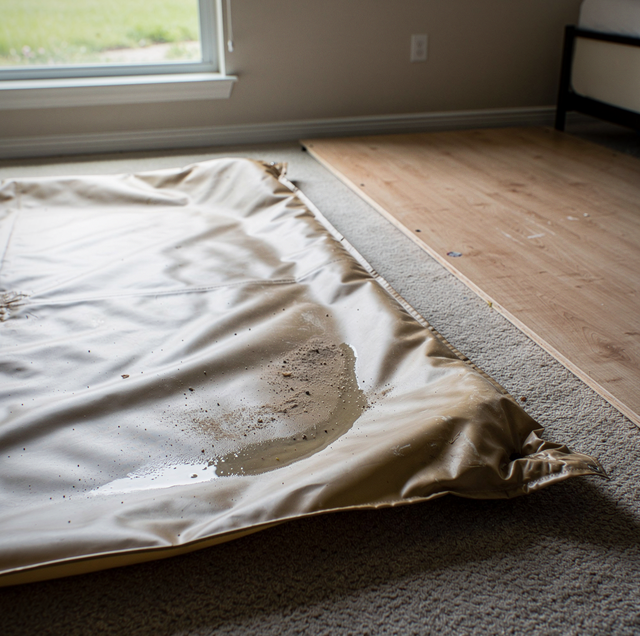
A waterbed is not a single item left by the curb. Under the sheets you're looking at a vinyl bladder full of water, a safety liner beneath it, a corded heater pad, a wood frame, a deck, and a pedestal base. A hardside model builds those parts around a wooden shell, while a softside version hides the same stack inside a foam-walled enclosure that looks like an ordinary mattress. None of those pieces travel together, and none of them moves until the ones ahead of it are gone.
What Drains before Anything Else Moves
Nothing above the deck gets lifted, tipped, or unbolted while the bladder is still full. The water leaves through a fill valve built into the bladder itself, and draining it is part of the work before any part of the frame is touched. The fill valve is the only built-in access point to or from the bladder, and it remains the focus of this stage until the bladder is light enough to be treated as an empty shell rather than a full one. Even after most of the water is gone, a flat pool remains at the bottom of the bladder that won't drain on its own, simply because the floor of a vinyl bladder lies flat rather than sloping toward the valve the way a basin might. A full bladder carries a large mass of water across the entire footprint of the frame, and that weight is distributed evenly enough that it's easy to forget how much of it there is until the bed starts coming apart. A rain barrel against the side of a house works on the same logic: nobody tips it while it's full, and a waterbed follows that rule at a much larger scale, with the water itself treated as its own object before the frame around it is worth touching at all.
Bladder and Liner Come Out Together
Once the bladder is empty, the drained vinyl is heavy on its own and folds rather than stacks, so it comes out as a separate object rather than something handled alongside a frame or a headboard. Underneath the bladder sits a safety liner, built to catch a failed bladder's contents if a leak ever happened over the years the bed was in use. That liner can be holding water of its own even when the main bladder never leaked at all, so it gets checked and handled as a second wet object, not an afterthought tucked under the first one. Both pieces are carried out as separate loads rather than bundled with the rest of the bed, since a wet liner and a folded bladder don't behave like the other furniture around them. Neither piece is flagged as donation-eligible during the walk-through; a drained vinyl bladder simply isn't that kind of item, and it leaves the house as its own load.
Check the liner even when the bladder drained clean. It sits directly under the bladder and is designed to hold water on its own, so a dry-looking bed can still have a damp, heavy liner underneath.
Heater and Power Connection Come Next
A waterbed heater is a pad that sits between the deck and the liner, and it runs on a standard cord and plug rather than being wired into the room, as a ceiling fixture is. That distinction keeps the heater itself squarely inside the scope of the work, even though the wiring feeding its outlet is not. Unplugging it and letting it cool before it's handled is part of the work. The pad unplugs; the outlet feeding it is electrician work.
Don't move the heater pad or its cord while the unit is still warm or still plugged in. It's a corded appliance, not a fixture, and it needs to be unplugged and given time to cool before it's handled at all.
Frame and Deck Break Down in Pieces
A hardside frame is usually bolted together rather than joined the way furniture is glued or doweled, and the deck and the pedestal come apart as separate flat panels rather than lifting away as one solid box. Panels that size are still handled with care once separated, since a single deck panel spans most of the bed's footprint, even when nothing is left sitting on top of it. That's part of why a waterbed doesn't leave as a single object the way a platform frame might. By the time the bladder, the liner, the heater pad, and the frame panels are all accounted for, what used to be one bed in the room is several distinct things stacked where it used to sit.
Pedestal and What Sits underneath It
The pedestal base is often hollow and doubles as storage, so it's worth checking before the panels come apart, since whatever was tucked inside needs to come out on its own rather than getting treated as part of the frame. Because the pedestal carries the weight of everything built on top of it, it's usually the last piece standing once the deck and frame panels above it are gone. What's underneath the whole assembly matters too. Carpet under a waterbed can be damp even when the bladder never leaked, and that is worth knowing before the panels come apart.
What Photos Settle before the Crew Arrives
A few photos are usually enough to set the scope, since a waterbed's scope depends on how many of those pieces are still assembled and how the bed is built, not just its overall size. Photos that show whether the bed is a hardside model in a wood frame or a softside version built into a foam surround help set that scope accurately before anyone arrives. A written estimate confirms the complete scope before anything is scheduled, and that scope covers the full assembly rather than a single mattress swap.
Frequently Asked Questions
No. Some are free-flow, meaning the water moves freely inside the vinyl shell, while others are waveless or semi-waveless, built with internal fiber baffling that limits how much the water shifts when someone gets in or out. Both styles still have to be drained and removed as a separate object from the frame and liner.
Waterbed conditioner was commonly sold for this, added to the bladder water to control algae and bacteria growth over the years the bed stays filled, so the water coming out of an older bladder isn't always plain tap water by the time the bed gets taken apart.
No. Waterbed heaters generally use a separate thermostat box that sits outside the bed frame, connected to the heating pad underneath the liner by its own length of wire. That control box is a distinct piece from the pad and needs to be accounted for alongside it.
A softside model is built inside a foam-walled enclosure rather than a wood frame. Softside beds often have zippered access panels sewn into the foam so the bladder and liner can be reached without removing the outer shell, unlike a hardside deck panel, which simply lifts away.
Yes. The valve stem and its cap can retain a small amount of residual water in the threads, even after the bladder itself has been drained, which is why a bladder that looks completely empty can still drip slightly when it's picked up and moved.
Yes. The side rails carry the bladder's lateral load once the bed is filled, keeping the vinyl shell from bulging outward under the water's weight rather than just framing the deck panels above it. That's part of why a hardside frame stays bolted together tightly until the bladder itself has already been drained and removed.
A drained bladder, a wet liner, and a frame in panels — carried out in the order they come apart. Polk Services LLC serves Lakeland, Highland City, and Mulberry. Call (863) 344-5806.
