

Water-Damaged Carpet: The Clock Starts before You Decide
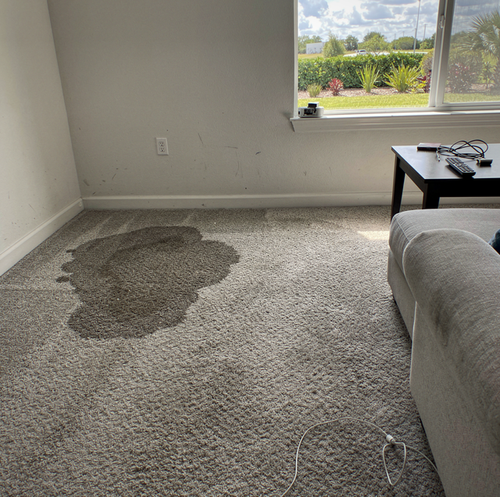
A soaked carpet is not sitting still. Water is moving down through the backing into the padding, sideways through the padding into dry sections you have not looked at yet, and slowly into whatever sits below. That movement does not pause while the decision gets made. Each change that follows lands one layer deeper than the last, and the deeper layers are not the ones you can haul away. What lifts out easily today lifts out differently later.
What the Padding Underneath Is Doing
Carpet padding is open-cell foam, meaning it is made of interconnected air pockets. Air pockets are exactly what water fills. Padding holds many times its own dry weight in water, and once it does, it stops behaving like the springy sheet you walked on and starts behaving like a reservoir with a lid on it.
A bath towel rolled up, wet, at the bottom of a gym bag has nothing in common with the same towel hanging dry on a rack. It is heavier than it looks; it holds its own shape; it stays cold; and it keeps everything pressed against it damp for as long as it stays rolled. Padding under a wet carpet is that towel, pinned flat across the entire room, with a woven lid stapled over the top.
Water inside padding also travels sideways. It wicks through the foam well past the edge of the wet patch you can see, following the path of least resistance under the carpet rather than stopping politely at the spill's boundary. The dry-looking half of a room is often not dry at all. It simply has not shown itself yet.
Why the visible wet patch misleads you: The carpet face dries faster than the padding does. Surface fibers give up moisture to the room air, so the top of the carpet can feel nearly dry to the touch while the layer beneath it is still fully loaded. Judging the situation by touch alone reads the one layer that lies the most.
The First Things You Notice
Odor usually arrives first. Damp fiber and damp foam give off a flat, musty smell that builds in a closed room and thins out the moment a door opens, making it easy to convince yourself it is fading. It is not fading. The air is diluting it you just let in.
The carpet also changes underfoot. It feels cool where the rest of the floor does not. It stays compressed where you step instead of recovering, and the nap mats down and stays matted. Seams and edges start to look slightly different from the carpet field because the backing swells and the tension across the room no longer remains even.
Baseboards and walls often look untouched at this stage. That is not evidence that the problem is contained. It only means the water has not climbed that far, and climbing is a later item on the list, not an absent one.
Standing water at floor level is near outlets, floor vents, and extension cords running along the baseboard. Keep the room's power off at the breaker and stay off soaked carpet on a slick sub-floor until someone qualified has cleared it.
The Next Stage Reaches the Sub-Floor
Below the padding are the fasteners and the deck, and both start reacting well before anything looks dramatic.
Fasteners: Tack strips are thin wood strips studded with angled pins, and the padding above them is held down with staples. Pins and staples are steel. Wet steel rusts; rust stains the sub-floor in a pattern that traces every strip, and every staple line, and corroded fasteners snap off instead of pulling cleanly, leaving metal in the deck rather than in the trash.
The deck: A plywood or OSB sub-floor takes on water fastest through its cut edges, and every cut edge sits at a seam. Swelling starts at those seams and works inward, which is why a saturated wood sub-floor eventually reads as a grid of raised lines across a room, visible through whatever gets laid on top of it later.
A slab behaves differently: Concrete absorbs moisture and then gives it back upward for a long time afterward. A slab that has sat under wet carpet continues to release moisture into the room and into anything placed over it long after the standing water is gone. Covering it back up too soon simply traps the same moisture under a new material.
Where the Change Stops Being Reversible
The useful distinction is not wet versus dry. It is removable versus attached.
Early on, the water is in material that exists to be thrown away. Carpet and padding are consumable layers. Pull them, and the wet part of the problem leaves in a truck. Nothing about that stage is permanent, and nothing about it takes the floor itself away from you.
Later, the water is in things that stay. Swollen sub-floor seams do not flatten back out on their own once the panel edges have expanded and crushed against each other. Rust marks left by staples and tack strips stay in the wood. Adhesive and fastener holding power changes. Mold growth on damp organic material is a progression rather than a switch, and the further a wet floor gets along that progression, the less of it is solved by hauling material away. No honest description of your room can put an hourly or daily figure on it.
Drying in place: That is not a call to make from the surface of the carpet, and it is not a call this trade makes at all. The padding is what decides it, and the padding is the layer nobody can see. A remediation professional is the one who assesses whether material is salvageable, using instruments rather than a hand on the pile.
Every stage described above is powered by one condition: saturated material staying in contact with the deck. As long as the wet layer is stapled down, it keeps handing water to the layer below and keeps wicking outward into square footage that was fine an hour ago. Take the material out, and the supply stops.
Removal is also what makes anything after it possible. A sub-floor cannot be inspected, dried, or treated while the wet carpet and padding are still fastened over it, and no amount of air moving through a room can reach the underside of a carpet that is still tacked to the walls. The order does not bend. Material comes out first, and everything else follows.
Waiting rarely buys anything. Wet carpet does not return to a usable condition on its own, and each day it stays down widens the footprint the next crew has to deal with.
What a Full Carpet Removal Takes Out
A complete removal is one visit and one scope. Carpet comes up, padding comes up as its own layer, tack strips come out, staples are pulled, and every piece of it is loaded and hauled to disposal.
Waterlogged carpet weighs far more than the same carpet when dry, which changes how it must be handled. It gets cut into manageable sections, rolled, and carried with appropriate PPE rather than dragged across a wet floor. That is crew work, not a task to take on yourself with a utility knife and optimism.
Timing: A standard single-room removal typically takes one to three hours on-site. Larger jobs and multi-room water events run longer, but a single room is generally a same-visit item.
Storm response: Removal is handled at the same rate card, so a wet floor after a storm is not a reason to delay the decision and wait for things to settle down.
Clear the room before the crew arrives. Furniture legs, boxes, and anything metal left standing on damp carpet mark the fibers and force the removal to work around obstacles instead of cutting and rolling in clean sections.
Where Water Damage Remediation Fits
Removal and remediation are two different trades, and it is worth being plain about the line between them.
Drying a structure, taking moisture readings, running dehumidification, applying antimicrobial treatment, and performing mold remediation are specialist work that requires its own licensing, equipment, and standards. A removal-and-haul crew does none of that. It takes the saturated material out of the building and disposes of it, which is a real and necessary step, but it is not remediation and should never be described as remediation.
The two fit together in sequence. Getting the wet material out clears the deck so a remediation contractor can actually see and reach what they need to work on. If your situation involves contaminated water, a large footprint, or a sub-floor you already suspect is compromised, a remediation professional is the one who assesses it, not the crew hauling the carpet.
Frequently Asked Questions
Yes, and not in the direction most people expect. Some carpet cushions are built with a plastic moisture-barrier layer on their underside, meant to keep spills from reaching the subfloor. Once water gets past that barrier, the same layer traps it against the deck rather than letting it drain or evaporate, so a barrier-backed pad can hold water longer than an open-cell pad without one.
Rooms wider than a single roll of carpet are joined using heat-activated seam tape running beneath the joint. Saturation weakens that bond, so a wet carpet frequently separates along the seam line when lifted, rather than coming up as one piece. It is a normal part of handling a wet room, and it is a good reason to expect the carpet to come out in sections.
Usually, yes. The metal or wood transition strip at a doorway pins the carpet edge down, and it has to be unscrewed or pried up before that edge will release. Doorways are also common paths for water to travel out of the room, so the flooring on the other side of a threshold is worth checking, even when the carpet stops there.
Yes, and they get missed often. Carpet and padding usually run continuously under a closet door rather than stopping at the frame, so a closet floor is fed by the same wet layer as the room. Closets are enclosed, poorly ventilated, and stacked with contents, so they are slow to reveal a problem that is already well established beneath them.
They are. Stairs are fastened with far more staples than an open stretch of floor, with each tread and riser secured separately, and they often carry a separate pad piece for each step. That makes wet stairs a slower, more fastener-heavy removal than a comparable patch of room carpet, and worth flagging up front rather than treating as an add-on.
The carpet edge tucks down into the gap between the bottom of the baseboard and the sub-floor, which puts the underside of the baseboard and any shoe molding directly against the damp layer. Wood trim sitting in that gap takes on moisture through its unfinished bottom edge, which is why trim can be affected while the painted face still looks perfectly normal.
Wet carpet does not get better on its own — clearing the carpet, padding, tack strips, and staples in a single visit prevents the wet layer from feeding the sub-floor underneath it. Polk Services LLC serves Lakeland, Highland City, and Mulberry. Call (863) 344-5806.
